Overview
Two recent reports of alleged Bigfoot encounters have surfaced on the long‑running paranormal program Coast to Coast AM. One involves a group of teenagers hiking in Wisconsin’s Kettle Moraine State Forest who say a large, ape‑like creature approached them during a fireworks display and nearly ran them over before they fled. The other describes a brief sighting by a couple walking near Cannock Chase in England, where only one member of the pair noticed a “large, hair‑covered biped” moving through the trees. The stories were highlighted in host George Knapp’s latest Mystery Wire episode, which also examined historic newspaper accounts of Bigfoot and unusual track prints discovered at Nevada State Prison.
Wisconsin Teen Encounter
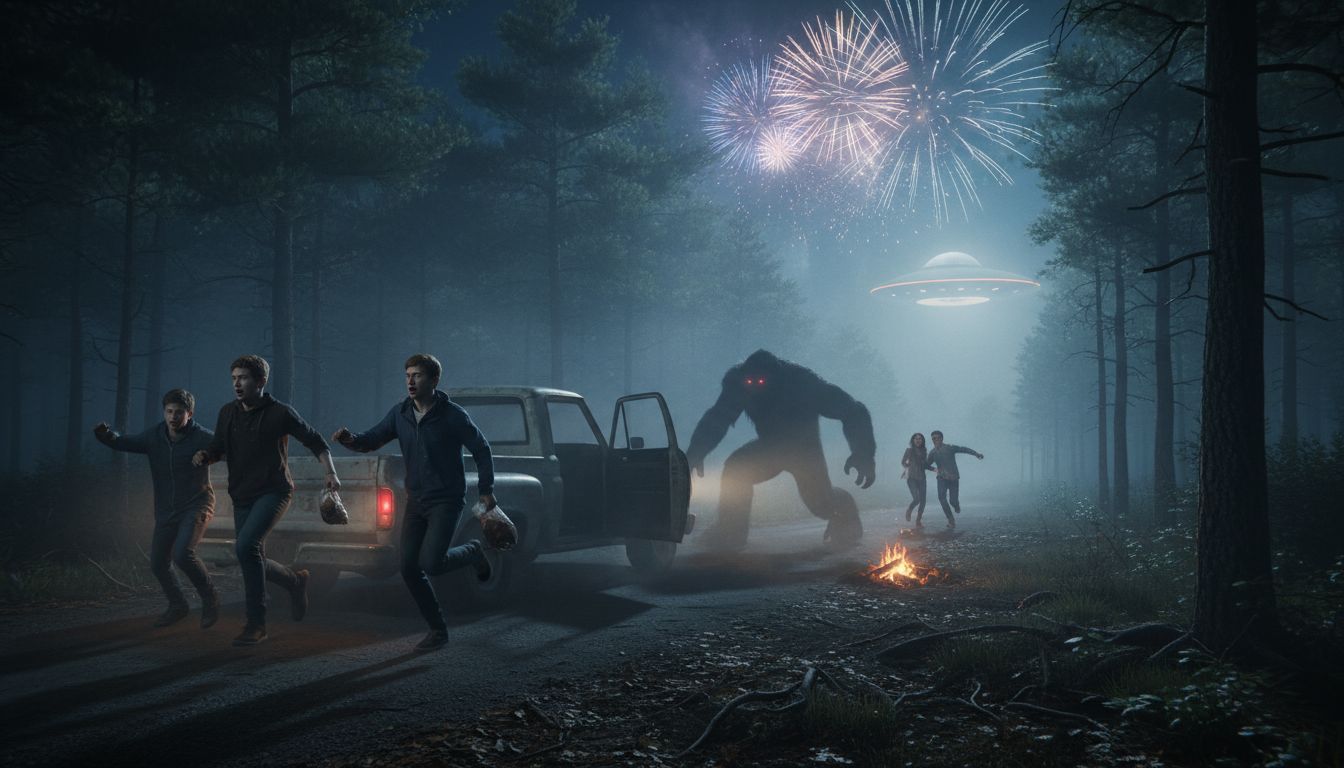
According to the teenagers, who chose to remain anonymous, the incident occurred on the evening of August 12 while they were celebrating the Fourth of July with fireworks near the forest’s “Moraine Trail.” The teens reported hearing a low, guttural growl followed by the sound of heavy footsteps on the forest floor. “It was like nothing we’d ever heard before—deep, resonant, and it seemed to come from right behind us,” one teen recounted to the Coast to Coast AM hosts.
The group claims that a tall, dark figure—approximately 7 feet tall and covered in dark, shaggy hair—emerged from the trees and began moving toward them. As the teens scrambled for cover, the creature allegedly stepped onto the path where a parked car was idling for the fireworks, narrowly missing the vehicle. The teens say they fled the area on foot, later reporting the incident to local authorities, who found no physical evidence but noted that several hikers had reported hearing unusual noises that night.
Cannock Chase Sighting
Across the Atlantic, a couple walking near the historic forested area of Cannock Chase in Staffordshire reported a fleeting glimpse of a similar creature on September 3. The husband, who was photographing the landscape, said he saw a “large, hair‑covered silhouette moving quickly between the trees.” His wife, however, did not notice anything unusual. “It was there for only a second, but the shape and the movement were unmistakable,” the husband told the Coast to Coast AM interview.
Cannock Chase is known for its own folklore, including reports of “The Cannock Chase Beast” dating back to the 1970s. Local police records show no recent complaints or physical evidence linked to the couple’s claim, and the area’s dense foliage makes corroboration difficult. Nonetheless, the couple’s account adds to a growing list of European sightings that parallel North American Bigfoot reports.
Broader Context and Historical Accounts
Bigfoot, also known as Sasquatch, has been a staple of North American folklore for over a century. Newspaper archives from the 1930s onward contain dozens of accounts describing “hairy men” roaming remote forests, with the most famous early case being the 1958 “Patterson‑Gimlin film.” The Mystery Wire episode referenced in the Coast to Coast AM broadcast revisited several of these historic reports, noting that many share common details: large stature, dark hair, and a tendency to appear near human activity such as camping or celebrations.
The episode also highlighted an unusual development from Nevada State Prison, where inmates in the 1970s reported discovering a set of large, irregular footprints in the prison yard that did not match any known animal. While prison officials dismissed the marks as a hoax, researchers have kept the incident on file as part of the broader “cryptid track” literature.
Expert Commentary and Ongoing Investigation
Host George Knapp, a veteran investigative journalist, approached the two sightings with a blend of curiosity and skepticism. “We’re not here to prove or debunk; we’re here to document what people experience and let the evidence speak for itself,” Knapp said during the episode. He cited Dr. Jeffrey Meldrum, a professor of anatomy and an acknowledged Bigfoot researcher, who emphasizes the importance of photographic, audio, and physical trace evidence over anecdotal testimony. Meldrum has previously warned that “human perception can be influenced by lighting, expectation, and even the adrenaline rush of a fireworks display.”
Law enforcement agencies in both Wisconsin and Staffordshire have opened standard “unusual wildlife” reports but have not launched formal investigations. The lack of physical evidence—such as hair samples, footprints, or clear video—means that these cases remain in the realm of unverified sightings. Researchers continue to monitor the areas, encouraging hikers and locals to report any corroborating data, while emphasizing the need for rigorous documentation to move the discussion beyond folklore.
What’s Next?
Both incidents underscore a persistent pattern: alleged Bigfoot encounters often occur in remote, heavily forested locations and are frequently tied to moments of heightened human activity—whether a fireworks celebration or a quiet evening walk. As Coast to Coast AM and the Mystery Wire series continue to spotlight these reports, the conversation shifts from sensational speculation to a more methodical search for verifiable evidence. Until such data emerges, the Bigfoot phenomenon will remain a blend of cultural myth, sporadic eyewitness accounts, and a tantalizing mystery that continues to capture the public imagination.


