Overview
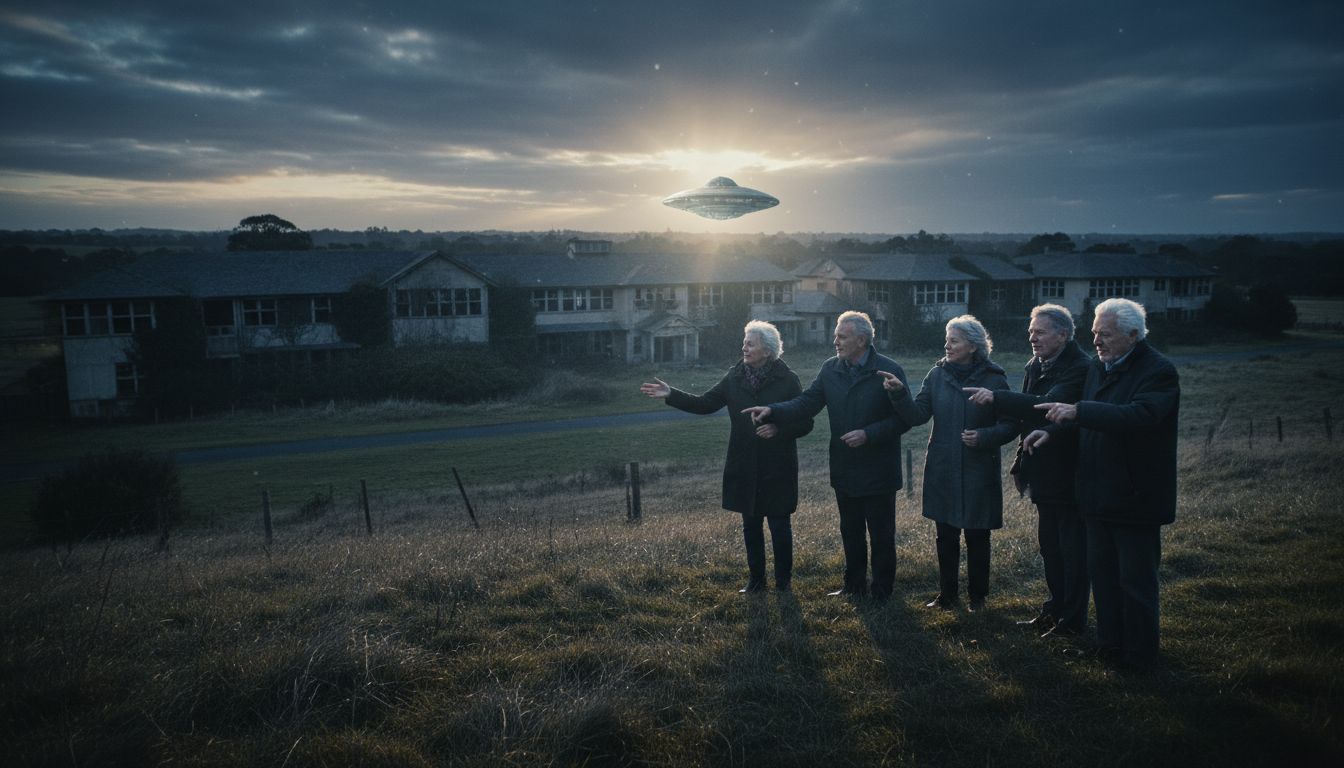
On 6 April 1966, a crowd of more than 200 students and staff at Westall High School in Melbourne reported a silent, metallic‑looking craft hovering over the schoolyard before disappearing into the sky. The incident, commonly referred to as the Westall UFO sighting, has remained one of Australia’s most documented and debated aerial phenomena. Six decades later, a small group of the original witnesses—now in their seventies and eighties—have formally petitioned the Australian government to release any remaining files and to launch a full, independent inquiry into the event, citing lingering unanswered questions and possible national‑security implications.
Witness Testimony
“The memory is still vivid,” says 78‑year‑old former student Margaret O’Connor, who was in Year 10 at the time. “We saw a disc‑shaped object, about the size of a small house, hovering silently for several minutes. It emitted a low hum, and then it shot straight up.” O’Connor is joined by former physics teacher Ian McAllister, who recalls the school’s emergency alarm being triggered by the sudden appearance of the craft. “We were instructed to stay inside, but the teachers themselves were as bewildered as the students,” he adds. Their accounts, corroborated by newspaper reports from 1966 and later oral histories, form the core of the petition submitted to the Department of Defence on 2 April 2026.
Calls for Transparency
The petition, signed by 12 original witnesses, urges the government to declassify all remaining documentation related to the Westall incident, including any Defence or intelligence reports filed in the weeks that followed. The group argues that transparency is essential not only for historical accuracy but also to assess whether the sighting posed a potential threat to national security. “If an unidentified aerial object entered Australian airspace in the 1960s, we need to know how it was evaluated and why the findings were never shared with the public,” the petition states. The witnesses have also requested a parliamentary committee to examine the case alongside other historic UAP reports.
Government Response
A spokesperson for the Department of Defence acknowledged receipt of the petition but declined to comment on specific classified material, citing standard security protocols. “The Department regularly reviews historical records to determine if further action is warranted,” the spokesperson said. The Australian Senate’s Joint Committee on Foreign Affairs and Defence, which conducted a broad UAP inquiry in 2022, has been asked to revisit the Westall case. Senator Claire Hawkins, a member of that committee, indicated that the Senate would consider the petition when scheduling its next hearing on unidentified aerial phenomena, noting that “the Westall incident remains a significant piece of Australia’s UFO history.”
Broader Context
The Westall sighting predates the United States’ recent declassification efforts, such as the 2021 release of the Pentagon’s UAP reports, and it has often been compared to the 1997 Phoenix Lights and the 2004 USS Nimitz encounters. While some researchers attribute the 1966 event to a misidentified military aircraft or weather balloon, others point to the consistency of eyewitness descriptions and the lack of any official explanation. As governments worldwide grapple with the rise of UAP investigations, the Westall witnesses’ demand for answers underscores a growing public expectation that historic incidents be revisited with modern scientific and security standards.


