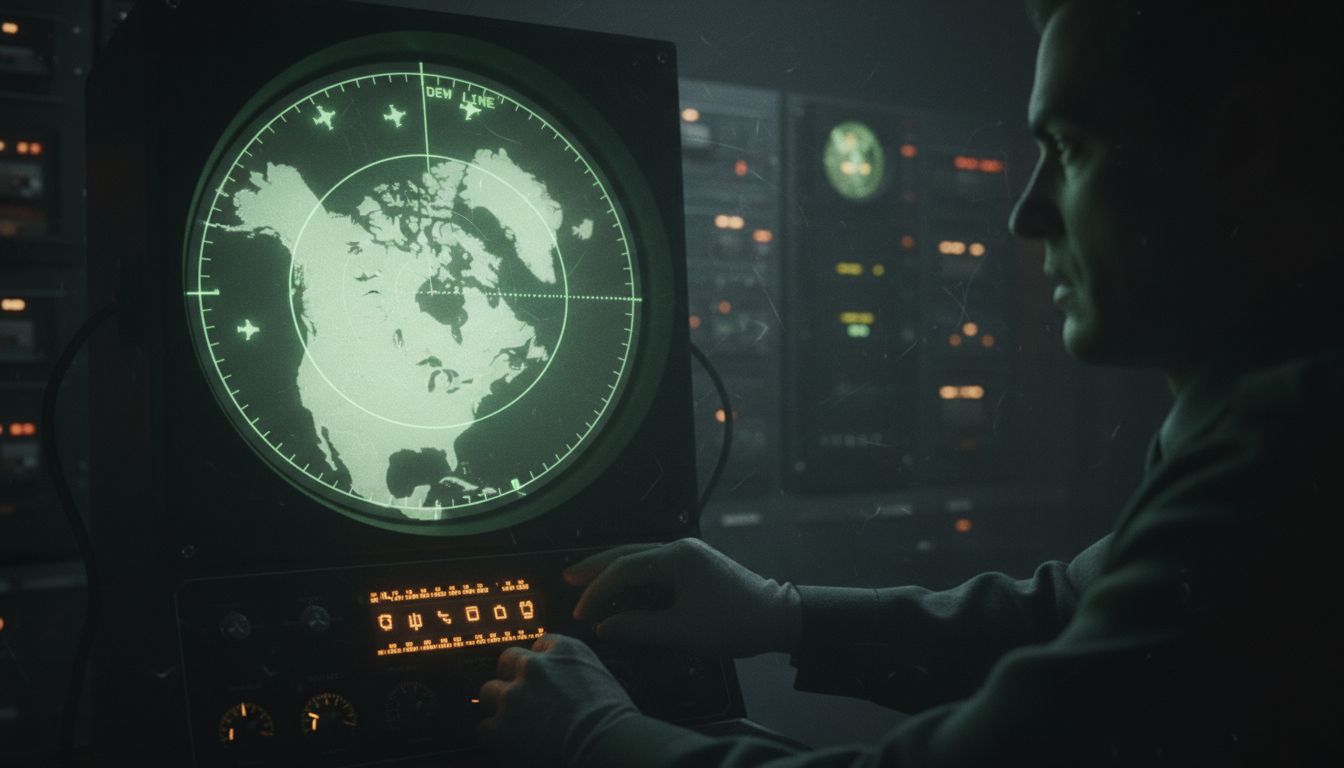
Archival footage from a Cold War-era Distant Early Warning (DEW) Line radar installation has surfaced, offering a rare glimpse into the persistent mystery of unidentified aerial phenomena (UAP) and their potential implications for national security. The historical video documents a calibration routine in which test flights are conducted to ensure the accuracy of radar coverage over North American airspace—an essential component of early warning defense systems designed to detect incoming bombers or missiles.
The footage centers on electronics engineer Mitchell McAfee, who was tasked with flying controlled routes to help chart radar "blind spots" and fine-tune the equipment. During one such flight, McAfee reported an extraordinary encounter. Despite heavy cloud cover and limited visibility, he witnessed an object in the sky that defied explanation. "A significant moment in history," the narrator calls it, recounting how McAfee immediately radioed the sighting of a UFO. However, the radar officer on duty dismissed the report, stating that aside from McAfee’s own plane, the radar detected nothing for hundreds of miles.
Undeterred, McAfee attempted to pursue the object, describing its rapid acceleration and extraordinary maneuverability. "It rapidly accelerates, climbs past our altitude and disappears. That's the last we saw of it," he reported, noting that the object was as large as a battleship and moved at a speed he could not estimate. The urgency in his voice led to a scramble of interceptor jets, highlighting the seriousness with which such anomalies were treated during the tense geopolitical climate of the era.
The incident also exposes the friction between civilian contractors and military personnel in dealing with unexplained aerial events. Major Bergen, the ranking officer, was quick to question McAfee’s credibility and threatened to damage his professional reputation over the report. "If you were in uniform, I'd have you under arrest and facing general court martial charges," Bergen told him, underscoring the stigma and skepticism that often surrounded UFO sightings, even when reported by technical experts. McAfee, an authority on radar, was adamant that he had observed something real—something that radar should have detected but did not.
This historical account lends weight to contemporary discussions about UAPs and their implications for airspace security. The inability of high-grade military radar to register a visually confirmed, fast-moving object raises questions about the limitations of existing detection technologies. As debates continue regarding the transparency and investigation of UAP encounters, incidents like McAfee’s highlight the persistent challenges faced by defense systems in distinguishing between conventional threats and the truly unexplained.
The DEW Line incident is a reminder that, despite decades of technological advancement, the phenomena of unidentified aerial intrusions remain unresolved. As the U.S. government and military agencies renew their focus on UAPs and their potential security implications, historical cases such as this serve both as cautionary tales and as catalysts for improved monitoring and analysis of the skies.