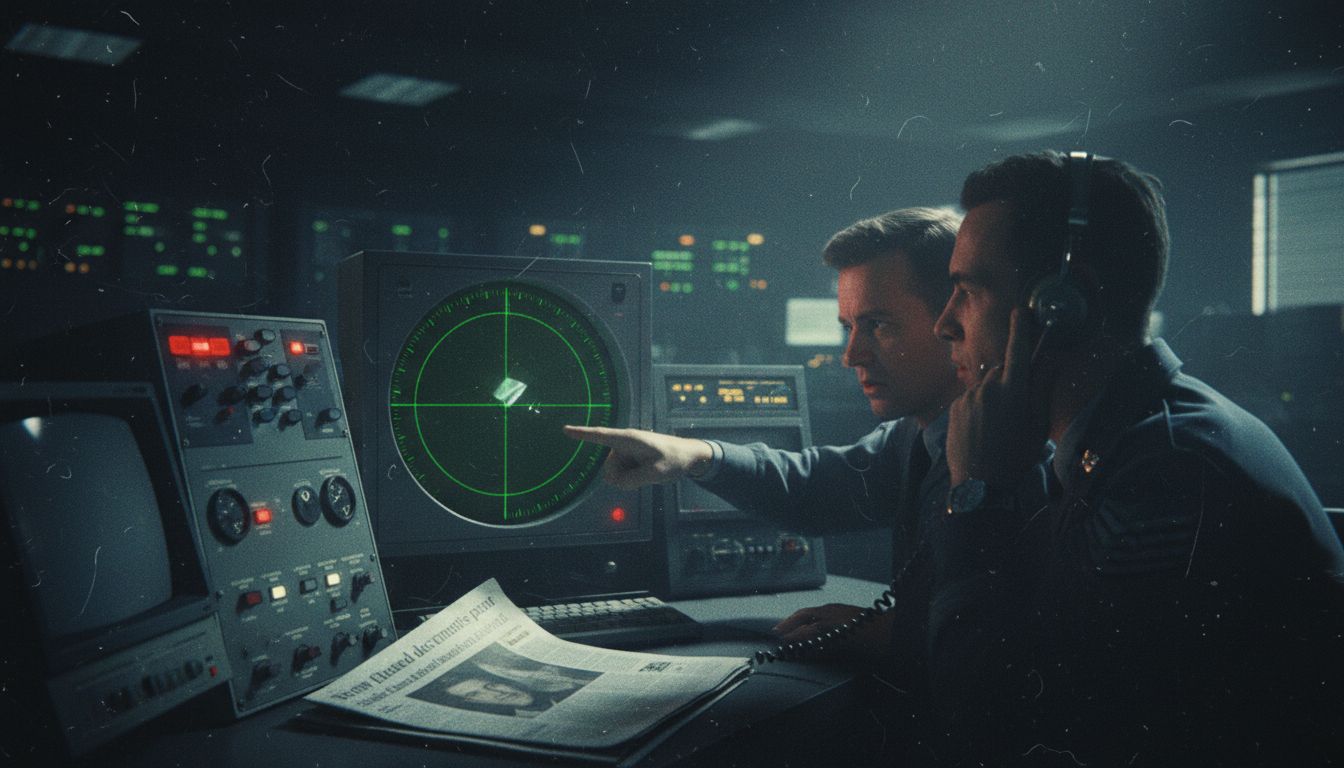
Declassified footage recorded in 1994 at Nellis Air Force Base in Nevada has reignited debate over the U.S. military’s knowledge of unidentified aerial phenomena (UAP). The video, captured by a state-of-the-art military tracking system and made public only after a leaker risked imprisonment, shows a mysterious object tracked by radar and closely monitored by air traffic controllers. Unlike typical grainy home videos, these images include high-tech computer-generated coordinates, providing precise data on the object’s location and speed—details that have left radar operators and experts alike baffled.
The incident occurred in the restricted airspace above the Nellis range, a vast 7,700 square mile area monitored by remote-controlled cameras and used for top-secret aircraft testing. Nellis is also adjacent to the infamous Area 51, often at the center of UFO lore. The footage depicts a small, solid object, first appearing stationary on radar before making a rapid, unexplained maneuver. In a second segment, the object moves slowly above the horizon, its shape shifting in a manner not consistent with known aircraft. Operators are heard unable to classify the target, and analysts note that the object’s radar return suggests it is of considerable size.
Experts consulted for the analysis express a range of opinions. Rich Terrell, an astronomer and optics specialist, suggests that the object’s transformations could be attributed to lighting effects or reflections, cautioning that appearances can be misleading under certain conditions. However, “Steve,” a former Nellis Air Force Base employee with experience on classified projects, maintains that such sightings are not uncommon. “Based on my experiences both personal and military, there’s no doubt these flying systems exist,” he asserts, suggesting that military personnel are often unable to identify or explain these encounters.
The authenticity of the footage has been supported by independent analysts. A government subcontractor, using the same image analysis equipment as the Department of Defense, confirmed that the video was likely recorded by contractor personnel operating the Nellis tracking sites. Aerospace journalist Bill Sweetman emphasizes the unusual nature of any unidentified object entering restricted airspace, noting, “I don’t think you’d really see many objects wandering in by accident. They are very, very careful to ensure that sort of thing doesn’t happen.” The seriousness of an unknown craft entering the area is underscored by the risk it poses to military operations.
Despite repeated attempts, both Nellis Air Force Base and the Pentagon have declined to comment on the incident. The lack of official response, combined with the risk faced by the individual who leaked the footage, has fueled speculation about broader military knowledge—and potential suppression—of UAP encounters. Chuck DeCaro, a former U.S. Special Forces member and military technology analyst, reviewed the tape and concluded, “There are only three things that could be on a tape: a hoax, a black project, or a true unknown. If you can eliminate the first two, then you have a pretty interesting piece of history.”
The Nellis incident is one among many historical UAP encounters that remain shrouded in secrecy. While skeptics point to possible mundane explanations, the persistence of such unexplained cases—and the government’s reluctance to address them publicly—continues to fuel debate among experts, the military, and the public alike.