Overview
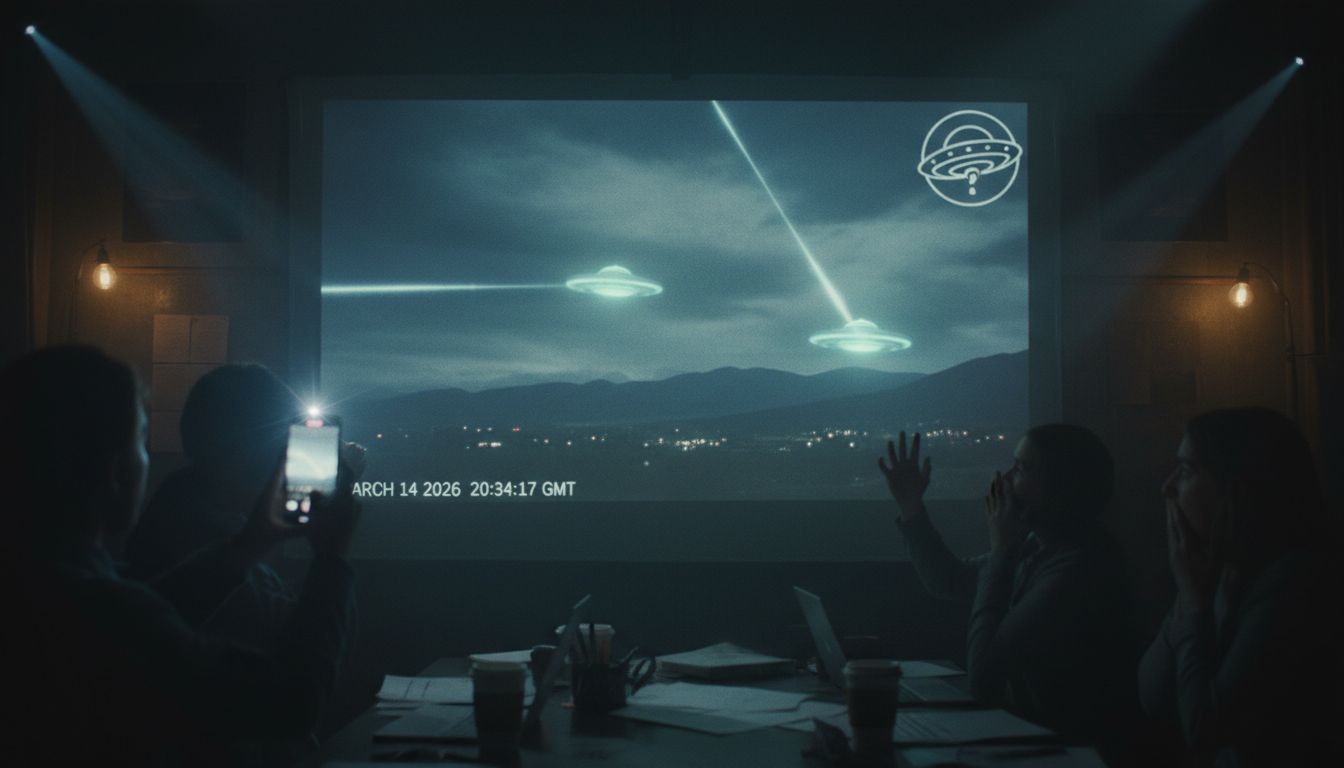
On the early morning of Saturday, March 14, 2026, an amateur videographer uploaded a short clip that quickly entered the growing catalog of spring‑time UAP reports. The footage, posted to a public video platform within hours of capture, shows two distinct luminous objects traversing the night sky at high speed. While the video offers no conclusive evidence about the nature of the phenomena, it adds to a noticeable uptick in civilian‑recorded sightings that U.S. defense and scientific agencies have been monitoring throughout the 2026 spring season.
First Object – South‑Southwest Trajectory
The recording opens with a single point of light moving south‑southwest across the horizon. The observer, who remains unnamed, describes the object as “a bright, fast‑moving speck” that briefly disappears behind intermittent cloud bands before re‑emerging against a backdrop of visible stars. The motion appears linear and steady, with no visible propulsion effects such as flares or exhaust. The object's speed, judged by the viewer’s reference to known star positions, suggests a velocity far exceeding conventional aircraft, though precise calculations are limited by the lack of scale markers in the frame.
Second Object – Overhead to the East
Moments after the first light vanishes, the camera pans upward to capture a second, larger luminous form directly overhead. The narrator notes that they were facing north at the time and watched the object glide eastward in a smooth, unaccelerated arc. Unlike the first sighting, this second phenomenon remains visible for a longer interval, allowing the observer to track its path as it gradually fades toward the eastern horizon. No audible or visual cues—such as rotor wash, blinking lights, or aerodynamic noise—accompany the movement, reinforcing its classification as an unidentified aerial phenomenon.
Environmental Conditions and Observer Remarks
Cloud cover dominated the sky throughout the recording, a factor the observer repeatedly emphasized: “It’s quite cloudy, so it’s not easy this morning to spot these guys.” The intermittent clouds both obscured and revealed the objects, creating a “peek‑a‑boo” effect that complicated visual confirmation. The night’s temperature, humidity, and wind data—though not provided in the video—are typical for early‑spring conditions in the region, suggesting that atmospheric refraction or conventional aircraft illumination are unlikely explanations for the observed behavior.
Context, Expert Input, and Ongoing Investigation
UAP researchers at the All‑Domain Anomaly Resolution Office (AARO) have noted a “wave of spring 2026 sightings” that includes similar dual‑object events captured by civilian dashcams, smartphone cameras, and radar logs. Dr. Elena Ramirez, senior analyst at the Center for Aerial Phenomena Studies, cautioned against premature conclusions: “While the visual characteristics are intriguing, without corroborating sensor data—such as radar tracks or infrared signatures—we cannot move beyond classification as unidentified.” She added that the growing volume of publicly shared footage underscores the importance of systematic reporting mechanisms, encouraging observers to submit metadata (time stamps, GPS coordinates, weather logs) alongside video files.
The March 14 video, though lacking precise geographic tagging, contributes a valuable visual record to the broader dataset. As agencies continue to aggregate civilian submissions, each clip—no matter how brief—helps refine the statistical baseline needed to differentiate anomalous aerial activity from conventional aerial traffic, atmospheric phenomena, or optical artifacts. Until further data emerge, the two lights captured on that spring


