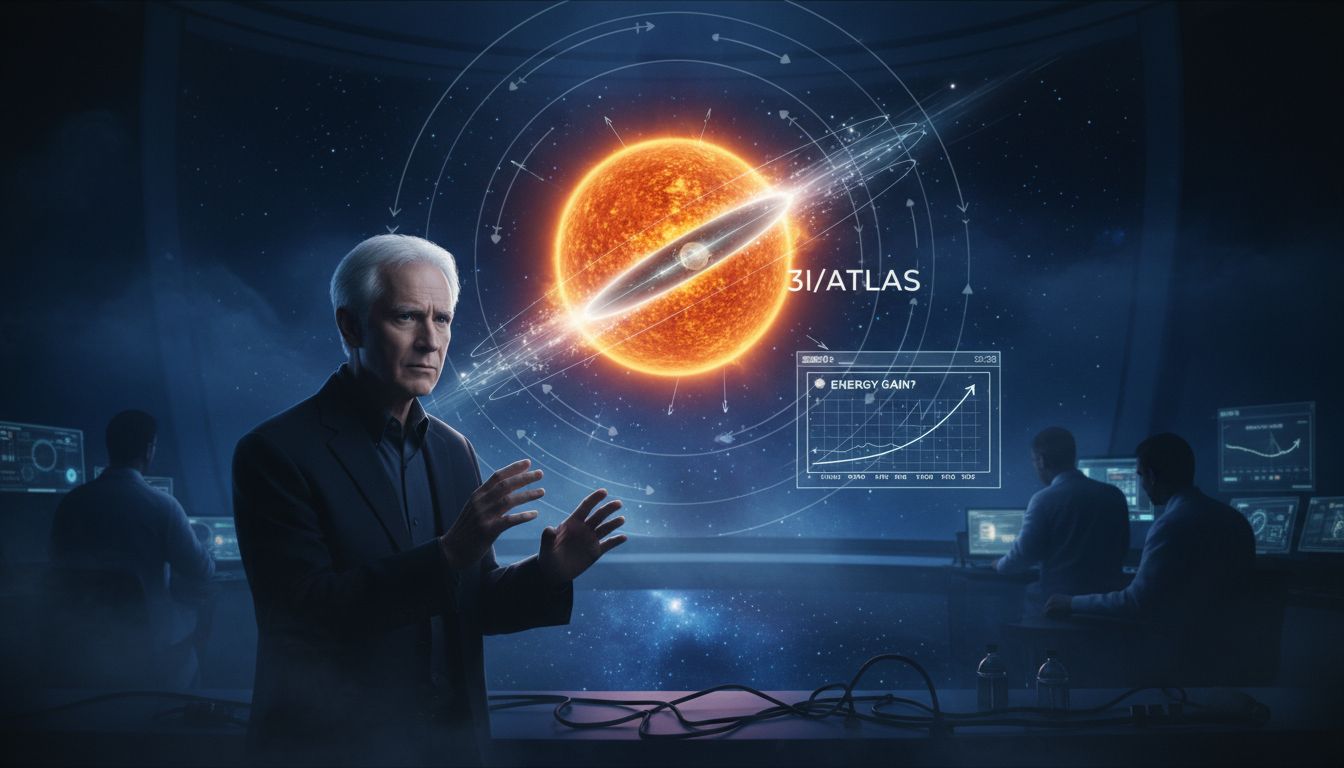
The interstellar object designated 3I/ATLAS, the third known visitor from beyond the Solar System, will pass within a few solar radii of the Sun on 30 October 2025. Its hyperbolic trajectory, speed of roughly 130 000 mph and icy composition have already drawn the attention of astronomers who are eager to collect data on a body that formed around another star. While the majority of the scientific community treats ATLAS as a natural cometary fragment, a small group of high‑profile astrophysicists has suggested that the fly‑by could provide a test for an extraordinary hypothesis: that the object is an engineered craft.
The most vocal proponent of the “alien craft” idea is theoretical physicist Michio Kaku, professor at the City College of New York. In a recent interview and on his X account, Kaku said, “If it picks up extra energy on its flyby, that would clinch it. It means there’s extraterrestrial intelligence involved.” He is referring to the Oberth effect, a well‑understood principle of orbital mechanics in which a spacecraft that fires its engine at the point of greatest orbital speed—typically near perihelion—gains more kinetic energy than it would at any other point in its orbit. Kaku’s “acid test,” as he put it, would be to measure whether ATLAS emerges from the Sun’s gravity well with a velocity that exceeds the amount predicted by purely gravitational acceleration.
Avi Loeb, the Harvard astronomer who previously argued that the first interstellar visitor, ‘Oumuamua, might have been of artificial origin, has echoed Kaku’s call for close monitoring. In a Medium post, Loeb warned that 29 October could be a “black‑swans event” because the object will move behind the Sun, making direct observation difficult. He and Kaku both stress that any anomalous acceleration would have to be detected indirectly, for example through precise tracking of the object’s inbound trajectory and comparison with post‑perihelion data gathered by solar‑orbiting assets such as the Parker Solar Probe and the Solar Orbiter.
NASA’s own communications, however, remain cautious. In a recent blog entry the agency noted that ATLAS is “expected to follow a standard hyperbolic path consistent with a cometary nucleus” and that the spacecraft’s instruments are calibrated to detect changes in speed of only a few meters per second—far smaller than the several kilometers per second that would be required to suggest an artificial boost. The agency’s Planetary Defense Coordination Office has scheduled a series of observations using ground‑based radar, the Hubble Space Telescope and the upcoming Vera C. Rubin Observatory, all aimed at refining ATLAS’s trajectory and composition. “Our priority is to gather high‑quality data that will help us understand the physical properties of this object, not to speculate on its origin,” a NASA spokesperson said.
The scientific response to Kaku’s and Loeb’s speculation has been measured. While the possibility of an engineered interstellar probe is not ruled out a priori, most planetary scientists point to more mundane explanations for any observed velocity anomaly, such as outgassing forces or non‑gravitational perturbations that have been documented for other comets. Dr. Karen Meech, a comet researcher at the University of Hawai‘i, noted, “Cometary activity can produce accelerations that mimic a thrust, especially when the object is heated intensely near the Sun. We have to exhaust those explanations before invoking extraterrestrials.” She added that the data set for ATLAS will be limited by the Sun’s glare, making precise measurements challenging.
Regardless of the outcome, the ATLAS encounter will add a valuable data point to the growing catalog of interstellar interlopers. The first two—‘Oumuamua in 2017 and 2I/Borisov in 2019—already reshaped expectations about the frequency and diversity of material crossing into the Solar System. Whether ATLAS proves to be a natural comet or reveals an unexpected propulsion signature, the event underscores the importance of rapid, coordinated observation campaigns and the continued dialogue between mainstream researchers and those who explore the more speculative edges of astrophysics.


