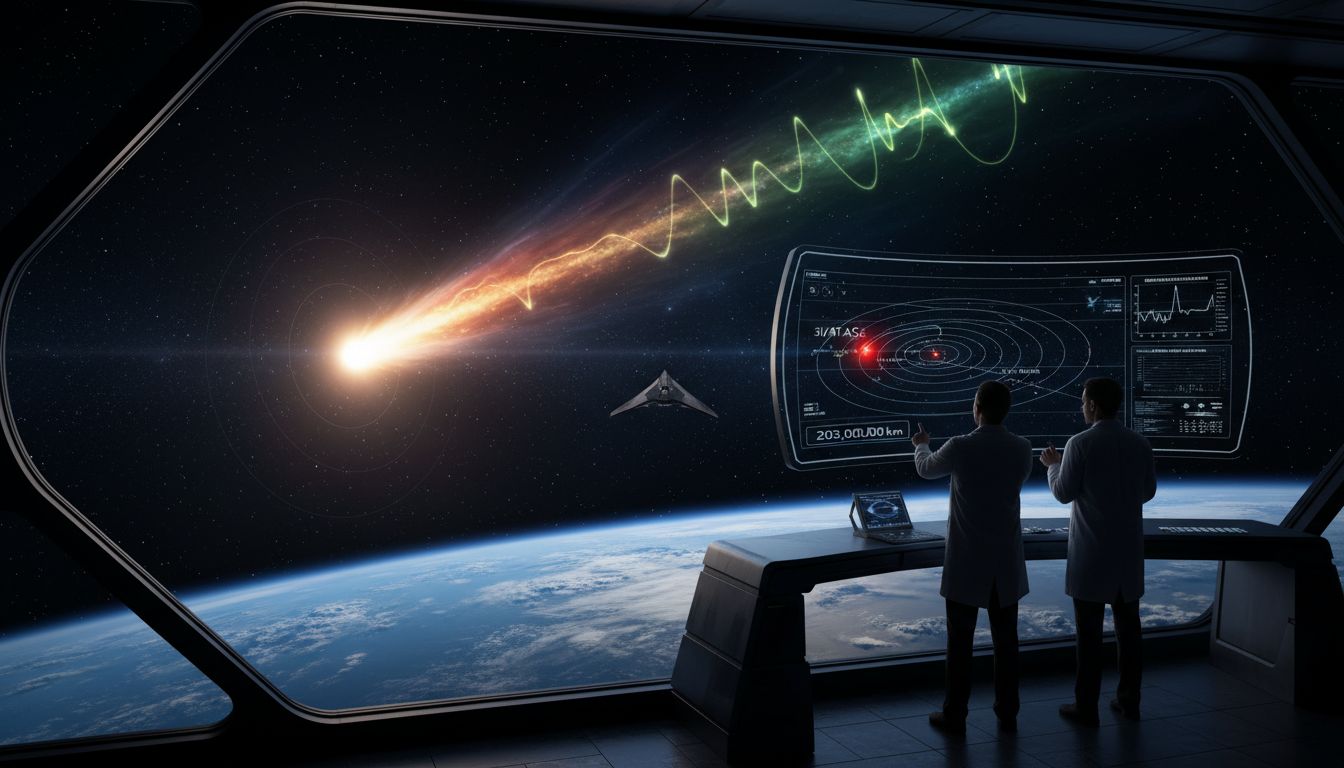
The interstellar comet 3I/ATLAS slipped past the Sun on Oct. 31, 2025, reaching perihelion at a distance of roughly 203 million kilometres. The event, tracked in real time by NASA’s Near‑Earth Object Program, offers a rare opportunity to study material that formed around another star. While the comet will not become visible to the naked eye—its brightness is swamped by solar glare—it will remain within the reach of large ground‑based telescopes and space‑based observatories for the next several weeks, allowing scientists to collect spectroscopic data and refine orbital models before it swings back toward the outer Solar System.
The discovery of 3I/ATLAS on July 1 by the ATLAS survey in Chile marked the third confirmed interstellar visitor after 1I/‘Oumuamua and 2I/Borisov. Its trajectory, now charted at a minimum of 240 million kilometres from Earth, eliminates any impact risk, a fact repeatedly emphasized by NASA officials. Nonetheless, the comet’s physical characteristics have sparked vigorous debate. Its nucleus is estimated to be a million times larger than ‘Oumuamua’s and a thousand times more massive than Borisov’s, while its velocity exceeds that of both predecessors. Spectral analysis reveals a gas coma unusually rich in nickel relative to iron, a nickel‑to‑cyanide ratio far higher than that observed in typical comets, and a water content of only about 4 percent by mass—far below the roughly 50 percent water fraction that defines most cometary bodies.
These anomalies have prompted a spectrum of scientific interpretations. “The high nickel abundance and low water fraction suggest we are looking at a body that formed in a very different protoplanetary environment,” said Jason Wright, professor of astronomy and director of the Penn State Extraterrestrial Intelligence Center. “It could be a fragment of a differentiated planetesimal that was stripped of its volatiles, or it might reflect an unusual formation pathway in its home system.” The comet’s extreme negative polarization—a rare optical property indicating unusual dust grain shapes or compositions—adds another layer of complexity, encouraging researchers to compare 3I/ATLAS with models of early‑stage planetary formation and with the limited data from previous interstellar objects.
The discussion has not been limited to conventional astrophysics. Harvard astronomer Avi Loeb, who has previously argued that ‘Oumuamua could be an artifact of extraterrestrial technology, has called for the release of high‑resolution images captured by the HiRISE camera aboard the Mars Reconnaissance Orbiter on Oct. 2. Loeb contended on “Elizabeth Vargas Reports” that “the politics of the day should not sabotage science,” urging NASA to share the data with the broader research community without delay. While NASA has not yet confirmed the existence of such imagery, the agency maintains that any data relevant to the comet’s composition and trajectory will be made publicly available in accordance with its open‑data policy.
Looking ahead, 3I/ATLAS will begin its outbound journey from the Sun’s vicinity in early December, re‑emerging from solar glare and becoming observable again from the Northern Hemisphere. Its closest approach to Earth is projected for Dec. 19, when it will still be well beyond the Moon’s orbit but bright enough for professional telescopes to monitor its fading tail. The coming weeks will be crucial for refining models of interstellar object dynamics, testing hypotheses about exotic chemistry, and, perhaps, gathering the first definitive evidence that such visitors can be traced to specific stellar nurseries. As the scientific community watches, the comet serves as a reminder that the Solar System is not an isolated laboratory but part of a broader galactic environment where material exchange may be more common than previously thought.