Overview
On 1 July 2025 the ATLAS survey telescope in Chile recorded the arrival of 3I/ATLAS, the third interstellar object confirmed to pass through the Solar System. Traveling at ≈ 60 km s⁻¹, the object’s speed exceeds that of any body bound to the Sun, confirming its extrasolar origin. Within weeks, a series of ground‑based observations revealed a suite of unexpected spectroscopic signatures that have sparked intense debate among astronomers and planetary scientists.
Observations and Anomalies
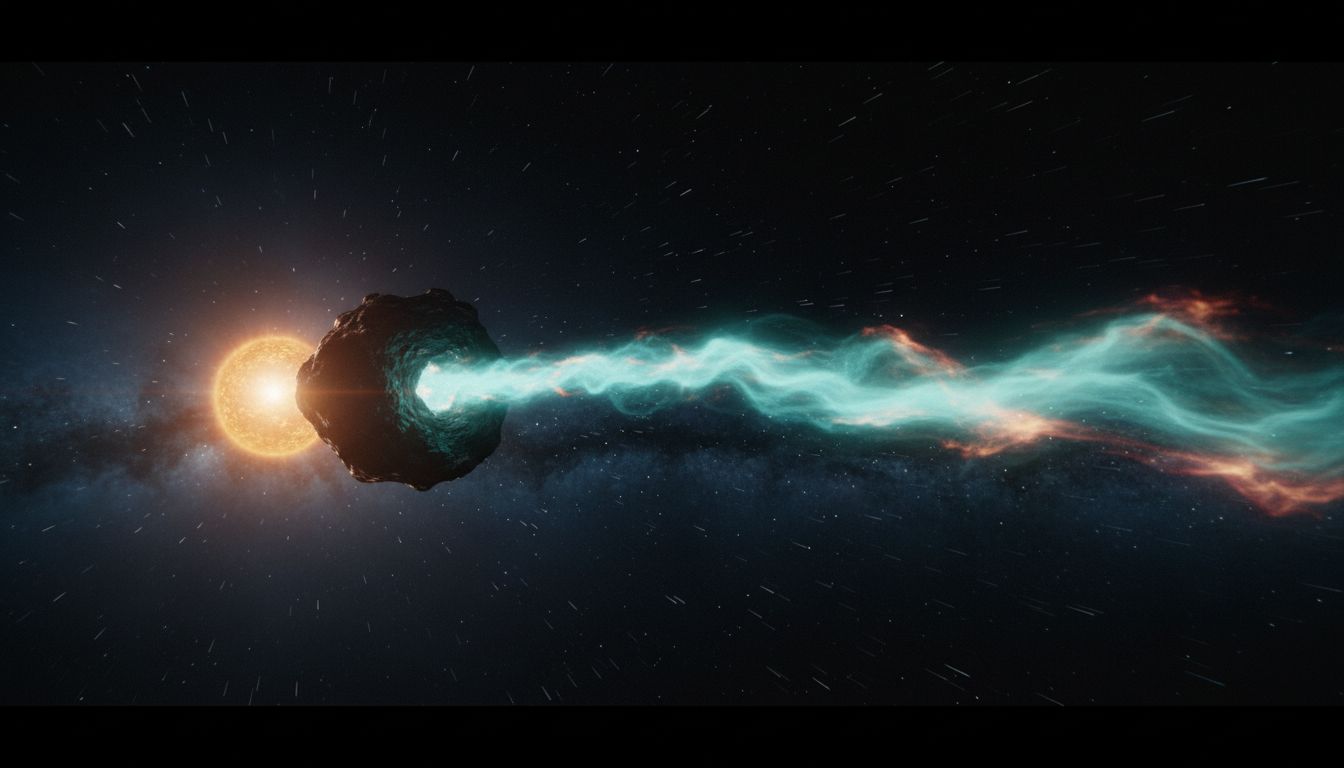
Spectra obtained with the Very Large Telescope (VLT) on 24 August 2025 displayed strong emission lines of nickel but no detectable iron—a composition that diverges sharply from the iron‑nickel ratios (≈ 10:1) typical of cometary dust. Follow‑up measurements with the Keck II telescope on 3 September 2025 identified nickel tetracarbonyl, Ni(CO)₄, a volatile organometallic compound produced industrially on Earth through the Mond process. The same data revealed a narrow, collimated plume extending roughly 847 km toward the Sun, contrary to the anti‑solar dust tails observed in ordinary comets. Quantitative analysis by the University of Chicago’s spectroscopist Adina Feinstein estimated a nickel‑vapor outflow of ≈ 4 g s⁻¹, a rate for which no natural outgassing mechanism has been proposed.
Scientific Interpretation
Harvard professor Avi Loeb, director of the Galileo Project, has presented these findings as evidence that 3I/ATLAS may be a technological artifact rather than a natural icy body. He argues that the presence of nickel tetracarbonyl—a molecule that, to date, has only been synthesized under controlled laboratory conditions—combined with the absence of iron points to an engineered source of exhaust. “The data “defy every known cometary model,” Loeb said in a recent video address, “and they line up with what we would expect from an object that is deliberately venting a nickel‑based propellant.”
Nevertheless, the broader planetary‑science community remains cautious. Dr Thomas Puzia of the Pontifical Catholic University of Chile, who led the VLT analysis, emphasized that “while the spectral signatures are unusual, extraordinary claims require extraordinary evidence, and we must first rule out all plausible natural processes.” Researchers have suggested that high‑temperature shock chemistry or previously undocumented mineral phases could, in principle, generate nickel‑rich vapors, though no published model currently reproduces the observed iron‑nickel decoupling.
Institutional Context
The rapid succession of observations coincided with a scheduled James Webb Space Telescope (JWST) program to probe 3I/ATLAS’s infrared composition. According to Loeb, the Space Telescope Science Institute (STScI) canceled the JWST window on 18 September 2025, citing “scheduling constraints.” Loeb characterizes the cancellation as “unjustified suppression of anomalous data,” while NASA spokespersons have reiterated that the decision was procedural and unrelated to the object’s scientific merit. The episode has reignited longstanding discussions about how the astronomical community handles unexpected findings that challenge established paradigms.
Outlook
The Galileo Project plans to continue independent monitoring of 3I/ATLAS using a network of ground‑based spectrographs and to seek additional time on space‑based platforms. Loeb has called for “transparent, peer‑reviewed analysis” and for the broader scientific establishment to remain open