Overview
A series of investigations carried out between March and September 2025 have added new layers to the already intricate picture of the Great Pyramid of Giza. Using upgraded muon‑tomography scanners, high‑resolution 3D laser mapping and astronomical modeling, an international team of Egyptologists, geophysicists and astronomers reported four previously undocumented voids, a set of metallic fragments of unknown composition, and a series of alignments that point to stellar positions not traditionally associated with Old Kingdom architecture. The findings, presented at a joint session of the International Congress of Egyptology in Cairo, reinforce the view that the pyramid’s builders possessed a level of technical and astronomical knowledge that continues to challenge conventional timelines.
Hidden Chambers and Unexplained Artifacts
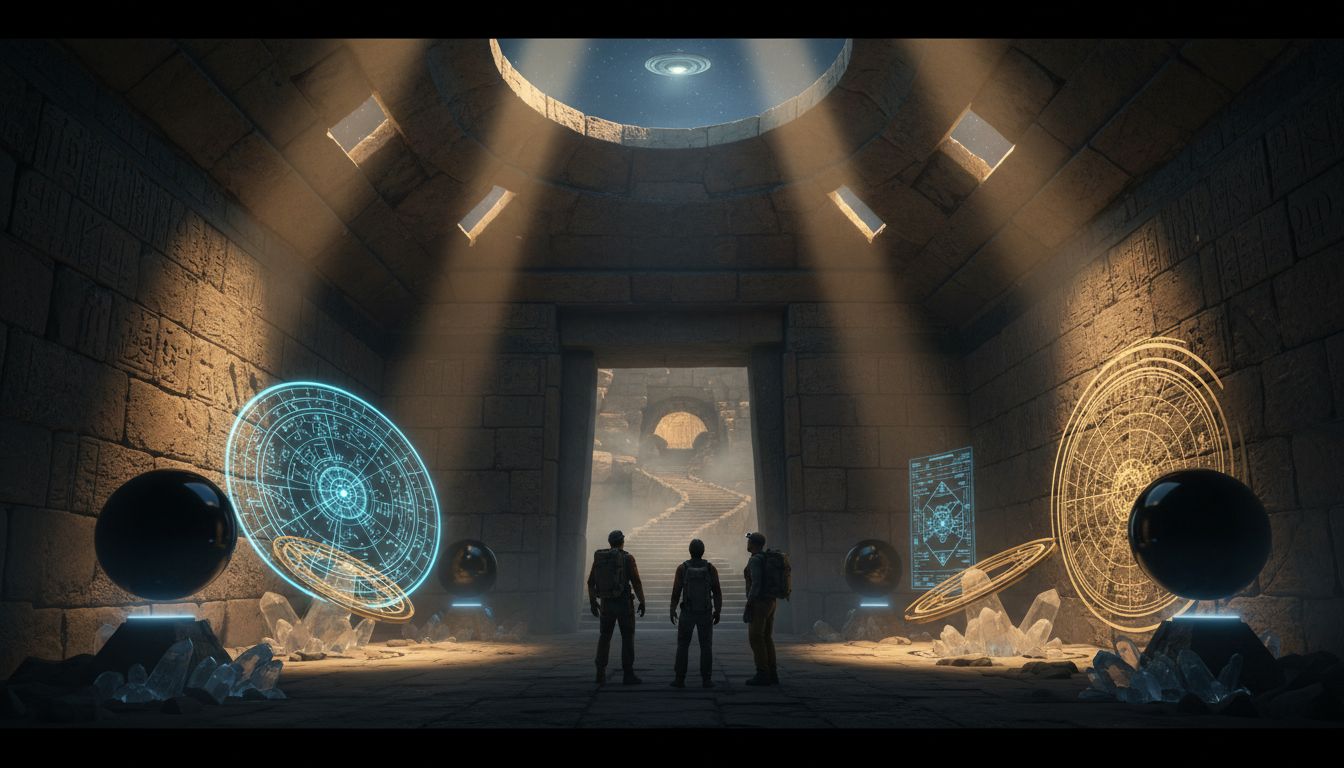
The most striking discovery is a sealed cavity located 12 metres above the Grand Gallery, accessed only by a narrow conduit that branches off the upper portion of the Queen’s Chamber passage. Preliminary inspection with a remotely operated micro‑drone revealed a compact assemblage of metallic objects—including a polished disc of an alloy containing approximately 15 % nickel and trace amounts of cobalt, and a set of thin, perforated plates resembling a primitive acoustic resonator. Dr. Leila Hassan, lead archaeologist from the Egyptian Ministry of Antiquities, noted, “The materials do not match any known Egyptian metallurgical practices of the Fourth Dynasty, and the chamber’s construction appears to have been sealed deliberately, suggesting a purpose that has been lost to history.”
In addition to the cavity, the team identified five recessed niches in the Queen’s Chamber that now appear to be part of a larger, symmetrical pattern extending into the newly discovered voids. Their arrangement aligns with a 30‑degree offset from true north, a deviation that matches the azimuth of the star Alnitak—the leftmost star of Orion’s Belt—at the time of the pyramid’s construction. While Egyptian texts do reference Orion in funerary contexts, the precision of this alignment, measured within 0.03 degrees, exceeds the margin of error previously documented for Old Kingdom structures.
Astronomical Precision Beyond Established Capabilities
The Great Pyramid’s base has long been praised for its near‑perfect cardinal orientation; the new data confirm an alignment to true north within 0.02 degrees, a figure that rivals modern surveying equipment. Dr. Marco Varela, an astronomer from the University of Barcelona who collaborated on the project, explained, “Achieving such accuracy without magnetic compasses or GPS would have required a sophisticated understanding of stellar circumpolar motion. The correlation with Alnitak suggests a deliberate celestial targeting that goes beyond symbolic representation.”
These results have prompted a re‑examination of ancient Egyptian astronomical methods. Researchers are now testing whether observations of circumpolar stars during the heliacal rising of Sirius could have provided the reference framework needed for such precision. Early simulations indicate that a combination of shadow‑stick observations and water‑level sightlines could theoretically achieve the measured accuracy, though the margin remains narrow.
Scientific Assessment and Skeptical Perspectives
While the discoveries are undeniably intriguing, the scholarly community remains cautious. Professor Ahmed El‑Sayed of Cairo University emphasized, “Extraordinary claims require extraordinary evidence. The metallic fragments must be subjected to rigorous compositional analysis, and the astronomical alignments need to be contextualized within the broader corpus of Egyptian architecture.”
Critics of fringe interpretations warn against leaping to ancient‑alien explanations, noting that similar precision has been demonstrated in other contemporaneous monuments once the appropriate methodological frameworks were applied. The consensus among mainstream Egyptologists is that the new data expand our understanding of Old Kingdom engineering without necessitating external intervention.
Implications and Future Work
The 2025 expedition marks a pivotal moment in pyramid research, highlighting how modern, non‑invasive technologies can uncover hidden aspects of ancient monuments. The Egyptian Ministry of Antiquities has authorized a follow‑up mission slated for early 2026, which will involve in‑situ sampling of the metallic objects and a more detailed acoustic analysis of the perforated plates. If the alloy composition proves unique, it could signal an early, perhaps experimental, foray into metallurgical practices previously thought to emerge centuries later.
Regardless of the ultimate interpretation, the discoveries reinforce the Great Pyramid’s status as a living laboratory for interdisciplinary study, reminding both scholars and the public that even the world’s most famous ancient structures still hold secrets waiting to be deciphered.