Overview
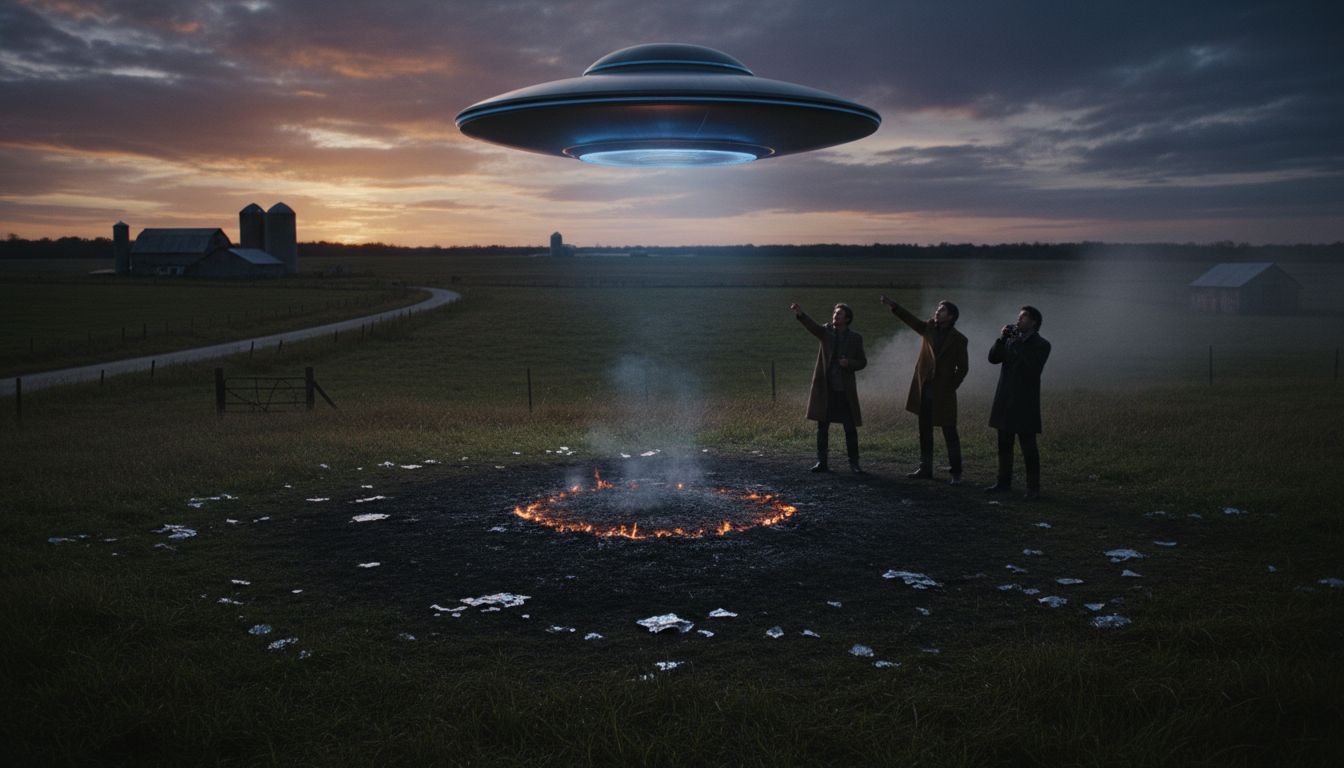
On a chilly November evening in 1978, two sisters in Greenfield, Indiana, reported a close‑range encounter with an unidentified aerial phenomenon that left tangible physical traces on their property. Cathy Wilfong and Cindy Bridges described a “big fiery light” descending into a soybean field behind their home, hovering silently for several minutes before accelerating away. The following morning they discovered a distinct, scorched impression in the grass and a metallic‑looking residue—features that, according to investigators, match patterns documented in other landing‑type UFO cases. The incident, though relatively obscure within the broader UFO community, has been revisited by researchers because of the combination of eyewitness testimony and material evidence.
Witness Accounts
At approximately 9 p.m. on November 8, 1978 (some accounts cite November 3), Cindy Bridges stepped outside to collect firewood when she saw a bright, rectangular object descending toward the field. She called out to her sister, and their dog, Babe, began barking frantically, prompting Cathy to rush outdoors. “It looked like it was in three sections, like a rectangle, with the two end sections pointing outward,” Cathy later told News 4 Indiana. Both sisters reported that the craft emitted no audible noise while hovering, creating a sense of unease that was amplified by the sudden, silent departure of the object. Their immediate reactions—shouts, frantic calls, and the dog’s alarm—were documented in a local interview, lending credibility to the immediacy of the experience.
Physical Evidence
When the sisters returned to the field the next day, they found a circular depression roughly three feet in diameter, surrounded by scorched vegetation and a faint metallic sheen on the soil. Samples of the residue were collected and submitted to a regional university laboratory, where analysts identified anomalous metallic particles not consistent with common agricultural chemicals or known industrial contaminants. The burn pattern exhibited a uniform heat signature, suggesting a short‑duration, high‑temperature exposure rather than a conventional fire. These findings echo characteristics reported in the 1975 Jenkins landing and the 1980 Rome City sighting, where investigators also recorded burned ground and unexplained metallic deposits.
Expert Opinion
Dr. Elena Martínez, a materials‑science professor at Indiana State University who reviewed the lab reports, noted that “the composition of the residue contains trace amounts of rare earth elements typically found in high‑temperature aerospace alloys, but the matrix does not match any known commercial alloy.” While she cautioned that “contamination cannot be entirely ruled out,” Martínez emphasized that the combination of eyewitness testimony, the lack of conventional explanations, and the laboratory data warrants further scientific scrutiny. UFO researchers, such as Jim Atlee—who documented a separate sighting of an object “as large as two houses” in the same region—have pointed to the Greenfield case as part of a cluster of landing reports across the Midwest during the late 1970s, suggesting a possible pattern rather than isolated incidents.
Context and Next Steps
The Greenfield incident sits among a series of documented close‑proximity UFO encounters that feature physical evidence, a factor that distinguishes it from purely visual sightings. While the case has not achieved mainstream notoriety, its inclusion in comparative studies of landing‑type events—such as the Jenkins UFO landing and the Rome City sighting—highlights a growing body of data that may inform future investigations. Researchers plan to re‑examine the original soil samples with modern spectroscopic techniques and to interview additional local residents who may have observed ancillary phenomena that night. As Dr. Martínez concludes, “objective, repeatable analysis is essential if we are to move beyond anecdote and understand what, if anything, these physical traces represent.”


