Overview
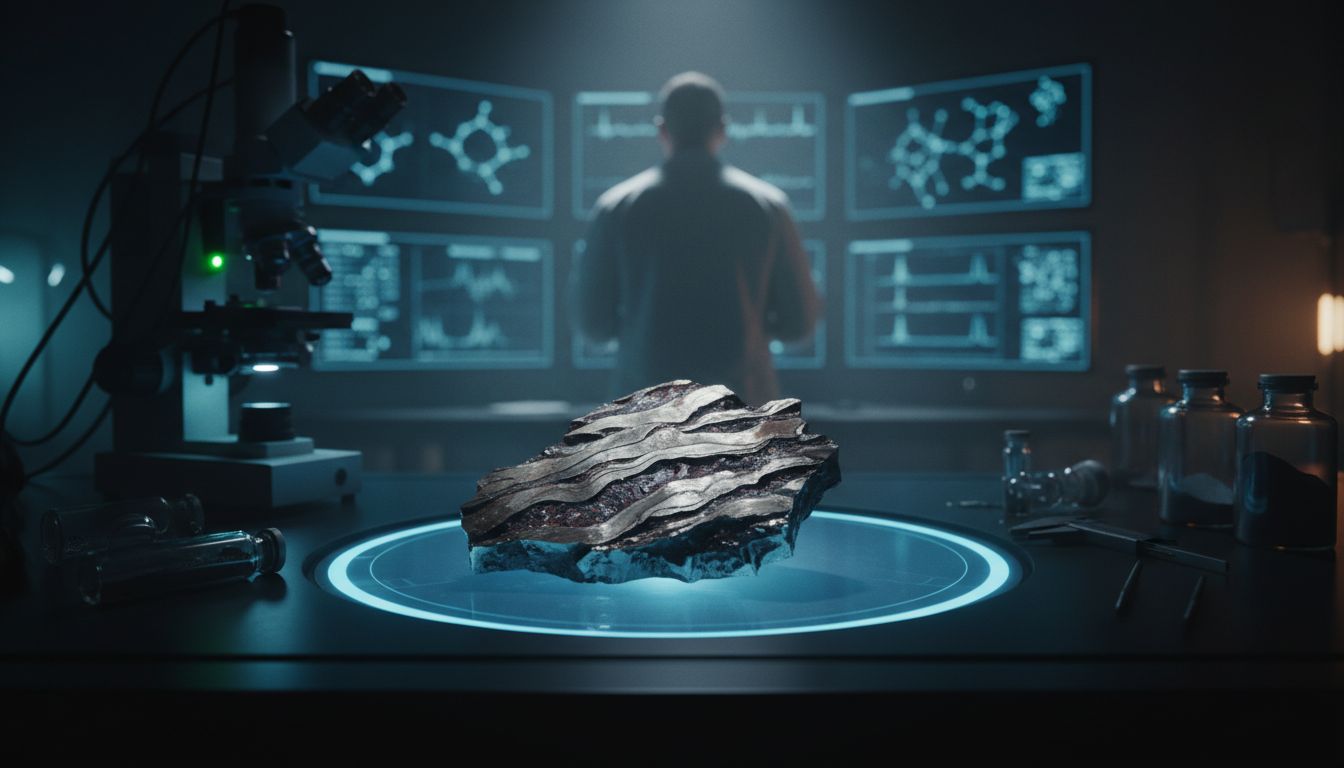
A metallic shard that has long been promoted as “possible UFO metal” was subjected to a full‑scale materials analysis by Oak Ridge National Laboratory (ORNL) at the request of the Pentagon’s All‑Domain Anomaly Resolution Office (AARO). The sample, said to have originated from a 1947 crash‑site linked to the Roswell incident, attracted attention from UFO enthusiasts who hoped it might contain extraterrestrial technosignatures such as a terahertz‑waveguide structure. The ORNL report, released in March 2026, concludes that the piece is a terrestrial magnesium‑zinc alloy with bismuth and trace‑element inclusions, and that its isotopic composition matches Earth‑origin materials. No evidence of alien technology or biosignatures was found.
Provenance of the Specimen
The shard entered the public eye after being acquired by Tom DeLonge’s To the Stars Academy, an organization that funds independent research into anomalous phenomena. In late 2022 the Academy handed the piece to AARO, the newly formed U.S. office tasked with investigating unidentified anomalous phenomena (UAP). AARO’s stated goal was to determine whether the metal displayed properties—particularly inertial‑mass reduction or unusual electromagnetic behavior—that could point to advanced, non‑human engineering. The laboratory’s involvement was prompted by the hypothesis that the bismuth‑rich layers might serve as a terahertz waveguide, a concept that has circulated in UFO‑research circles for years.
Laboratory Findings
ORNL’s multidisciplinary team applied scanning electron microscopy, X‑ray diffraction, and isotope‑ratio mass spectrometry to the 2‑gram fragment. The bulk composition is ≈ 78 % magnesium, 20 % zinc, with minor bismuth (≈ 1 %) and trace amounts of lead, copper, and iron. Crucially, the isotopic ratios of magnesium (⁴⁴Mg/⁴⁵Mg/⁴⁶Mg) and zinc (⁶⁴Zn/⁶⁶Zn/⁶⁸Zn) align precisely with natural terrestrial reservoirs, ruling out exotic nucleosynthetic origins.
The bismuth appears as thin, discontinuous lamellae that formed during post‑manufacturing cooling, not as a deliberately engineered layer. Microscopic examination revealed micro‑cracks, heat‑affected zones, and surface oxidation consistent with mechanical stress and exposure to temperatures above 300 °C—conditions typical of conventional metal‑working or accidental fire damage.
“The microstructural evidence points to a forged or cast alloy that has undergone standard industrial processing, not to a material engineered for exotic electromagnetic functions,” said Dr. Emily Carter, senior materials scientist at ORNL, in the lab’s public summary.
Interpretation and Context
The ORNL analysis directly addresses the claims that the shard could be a technosignature of alien origin. While bismuth’s high atomic number makes it a candidate for terahertz waveguiding in theory, the observed bismuth layers are irregular, lack the uniform thickness required for efficient wave propagation, and are embedded in a matrix that does not exhibit the predicted dielectric properties. Laboratory measurements of the sample’s dielectric constant and loss tangent showed values indistinguishable from ordinary magnesium‑zinc alloys.
The report also searched for biosignatures—such as organic residues, isotopic anomalies, or mineral phases associated with life—and found none. The conclusion is that the shard is man‑made, Earth‑derived, likely a component from a mid‑20th‑century aerospace or industrial application that entered UFO folklore through anecdotal association with Roswell.
Implications for UAP Research
The findings illustrate the value of rigorous scientific scrutiny in separating speculation from fact within the UAP community. AARO has reiterated that the investigation will continue, focusing on other physical evidence and sensor data, but it acknowledges that this particular sample does not support the hypothesis of extraterrestrial technology.
For UFO researchers and the broader public, the episode serves as a reminder that extraordinary claims require extraordinary evidence—preferably vetted by peer‑reviewed laboratories such as ORNL. As the Pentagon expands its UAP portfolio, transparent, data‑driven analyses like this one will be essential for maintaining credibility while exploring the unknown.