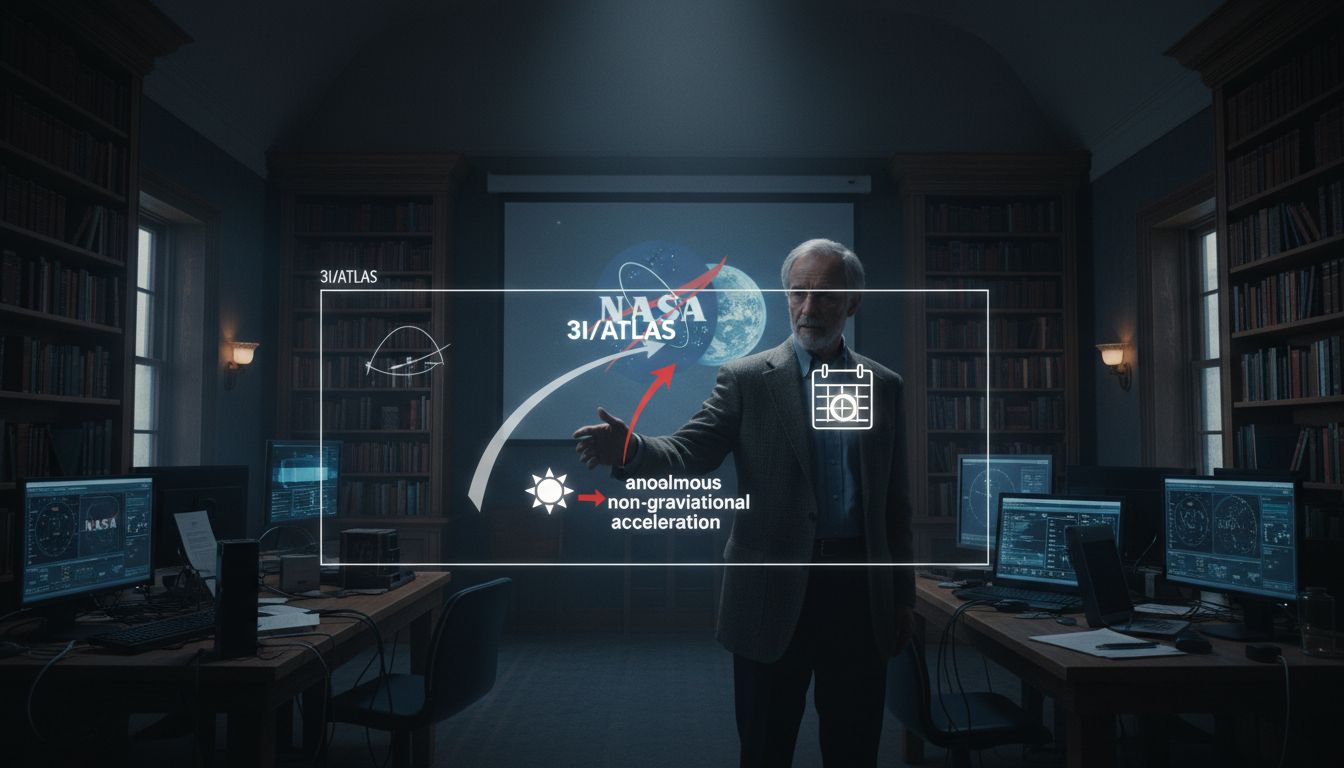
During the week that followed the perihelion passage of the interstellar visitor 3I/ATLAS, a small but vocal group of astronomers and UFO researchers turned their attention to a data set that has yet to appear in the public domain. Harvard professor Avi Loeb, a noted advocate for open scientific inquiry, posted a formal request on his personal Medium page urging NASA to release all raw observations of the object, including high‑resolution images captured by the HiRISE camera aboard the Mars Reconnaissance Orbiter (MRO). Loeb argues that the data are “crucial for independent verification of the anomalous non‑gravitational acceleration reported at perihelion on 30 October 2025,” a deviation that, if confirmed, could imply an unknown propulsion mechanism or other forces not accounted for by conventional physics.
The request stems from a series of observations that have already raised eyebrows within the planetary science community. When ATLAS—a roughly 150‑meter‑wide, cigar‑shaped body—sliced through the inner solar system, its trajectory was monitored by a network of ground‑based telescopes and space‑based assets. Analysts at the Jet Propulsion Laboratory noted a small but statistically significant excess acceleration that could not be explained by outgassing alone, a phenomenon reminiscent of the debate surrounding the first known interstellar object, ʻOumuamua, in 2017. “We have a clear, measurable deviation from a purely Keplerian orbit,” said Dr. Maya Patel, an orbital dynamics specialist at JPL, “but the source of that thrust remains uncertain.” Loeb’s appeal is that without access to the full suite of measurements—including the HiRISE mosaics taken on 2–3 October 2025 when ATLAS passed within 30 million kilometres of Mars—external researchers cannot rigorously test alternative hypotheses.
The HiRISE images in question are particularly valuable because they offer a spatial resolution of about 30 kilometres per pixel, roughly three times finer than the best publicly released images of ATLAS to date. According to Loeb, the raw frames could reveal subtle surface features, dust plumes, or even reflective structures that might betray an artificial origin. “If there is any evidence of engineered geometry or anomalous reflectivity, it will be in the high‑resolution data that NASA has so far kept under embargo,” he wrote. Loeb highlighted a precedent for delayed data release: the same HiRISE camera had captured a series of images on 2–3 October that were withheld for four weeks, a lag he described as “unfortunate” given the scientific community’s appetite for timely analysis.
NASA has not publicly commented on the specific request, but a spokesperson for the agency’s Planetary Data System noted that “all mission data are subject to a standard validation and calibration process before they are made publicly available.” The agency typically balances the need for scientific rigor with the benefits of open data, a policy that has been both praised and criticized in past interstellar object investigations. In the case of ʻOumuamua, for example, the lack of immediate access to infrared spectra and high‑resolution imaging fueled speculation and, at times, sensational headlines. Critics argue that a more transparent approach could prevent misinformation and allow independent teams to assess claims of extraterrestrial technology more objectively.
The broader implications of Loeb’s appeal extend beyond the immediate scientific questions. In a recent appearance on the Joe Rogan Experience podcast, Loeb emphasized that “transparent data sharing is essential not only for advancing astrophysics but also for maintaining public trust when extraordinary claims are on the table.” While the UFO community has seized on the ATLAS acceleration anomaly as potential evidence of alien propulsion, mainstream scientists caution that “unknown natural processes—such as radiation pressure on a low‑mass, high‑area structure—remain plausible explanations,” according to Dr. Elena García of the European Space Agency. Nonetheless, the call for openness underscores a growing consensus that extraordinary observations demand extraordinary scrutiny, and that withholding data only deepens speculation.
As the scientific community awaits NASA’s next data release window, the debate over 3I/ATLAS serves as a reminder of the delicate balance between rigorous peer review and the public’s fascination with the possibility of extraterrestrial technology. Whether the forthcoming HiRISE images will illuminate the mystery or simply add another layer of complexity remains to be seen, but the pressure on space agencies to adopt more rapid and open data policies is now unmistakably on the rise.


