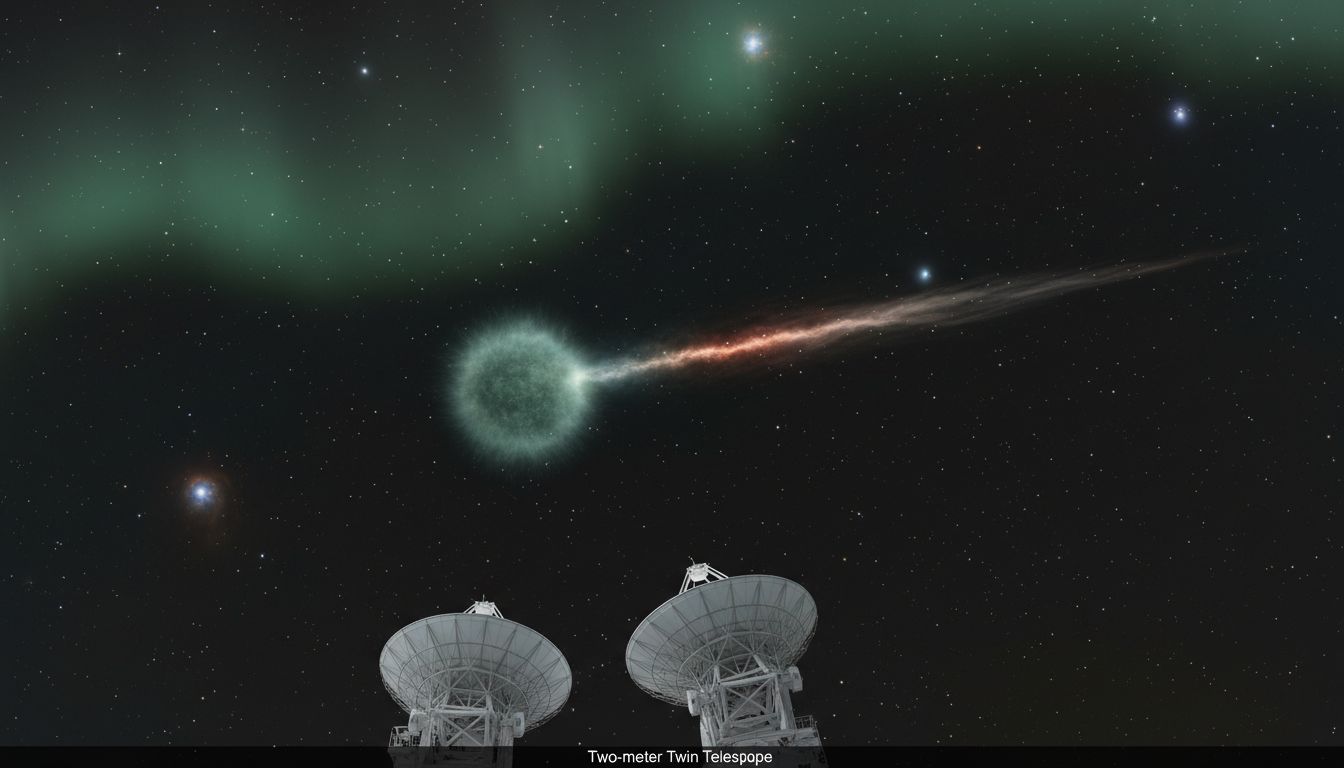
The Two‑meter Twin Telescope (TTT) on the island of La Palma captured a striking view of the interstellar object 3I/ATLAS on 2 August 2025. The composite image, assembled from 159 exposures of 50 seconds each, reveals a faint jet extending roughly 6,000 km from the object’s nucleus toward the Sun. The feature, highlighted by a purple line in the processed picture, mirrors a similar sunward jet seen in a Hubble Space Telescope image taken on 21 July 2025. Both observations show the jet pointing in the direction opposite to the usual cometary tail, a configuration astronomers refer to as an “anti‑tail” or sunward jet.
In typical comets, solar radiation and the solar wind push dust and gas away from the nucleus, creating a tail that trails behind the object as it moves away from the Sun. An anti‑tail, by contrast, appears to point sunward because larger dust particles, released earlier, follow the comet’s orbital path and are projected forward by perspective effects. Dr. Maria Fernández, a cometary physicist at the Institute of Astrophysics of the Canary Islands, explained, “Seeing a well‑defined sunward jet on an interstellar visitor is unusual; it suggests that the dust environment and release mechanisms differ from those of familiar solar‑system comets.” The jet’s length, estimated from the projected distance on the image, is comparable to the scale of the nucleus’s active region, implying a sustained outgassing episode despite the object’s high velocity.
The morphology of 3I/ATLAS has already challenged conventional classifications. Its hyperbolic trajectory, measured speed of about 45 km s⁻¹ relative to the Sun, and a mass estimate an order of magnitude larger than that of 2I/Borisov place it in a distinct category of interstellar interlopers. Spectroscopic data collected by the Very Large Telescope earlier this year indicated an atypical chemical composition, with elevated levels of carbon‑rich organics and a depletion of water‑ice signatures. Polarimetric measurements reported by the European Southern Observatory showed an unusually high degree of linear polarization, hinting at a surface texture or grain size distribution not seen in known comets. “These properties together paint a picture of an object that is not just another icy wanderer,” said Dr. Loeb, who has been monitoring 3I/ATLAS since its discovery. “The sunward jet adds another layer of complexity, suggesting active processes that we do not fully understand.”
Avi Loeb, a Harvard astrophysicist and author of several papers on interstellar objects, highlighted the jet as part of a broader set of anomalies that could point to an extraordinary origin. “The combination of a massive, fast‑moving body, a composition rich in complex organics, strong polarization, and now a persistent sunward jet is difficult to reconcile with the standard comet model,” Loeb wrote in his recent Medium post. While he stopped short of linking the observations to any extraterrestrial technology, he emphasized that the data “invite us to keep an open mind about the diversity of bodies that traverse our solar system.” He added that further monitoring with both ground‑based facilities and space telescopes will be essential to determine whether the jet persists as the object recedes from the Sun.
The discovery underscores the value of coordinated observations across multiple platforms. The TTT’s high‑resolution imaging complements Hubble’s space‑based view, while spectroscopic and polarimetric data from other observatories provide a multi‑wavelength portrait of 3I/ATLAS. As the object continues its outbound journey, astronomers plan to track its fading brightness and any changes in jet activity. “Each interstellar visitor teaches us something new about the processes shaping planetary systems beyond our own,” Fernández noted. “3I/ATLAS may well become the benchmark for the next generation of cometary science, prompting revisions to models that have, until now, been based solely on solar‑system examples.”