Overview
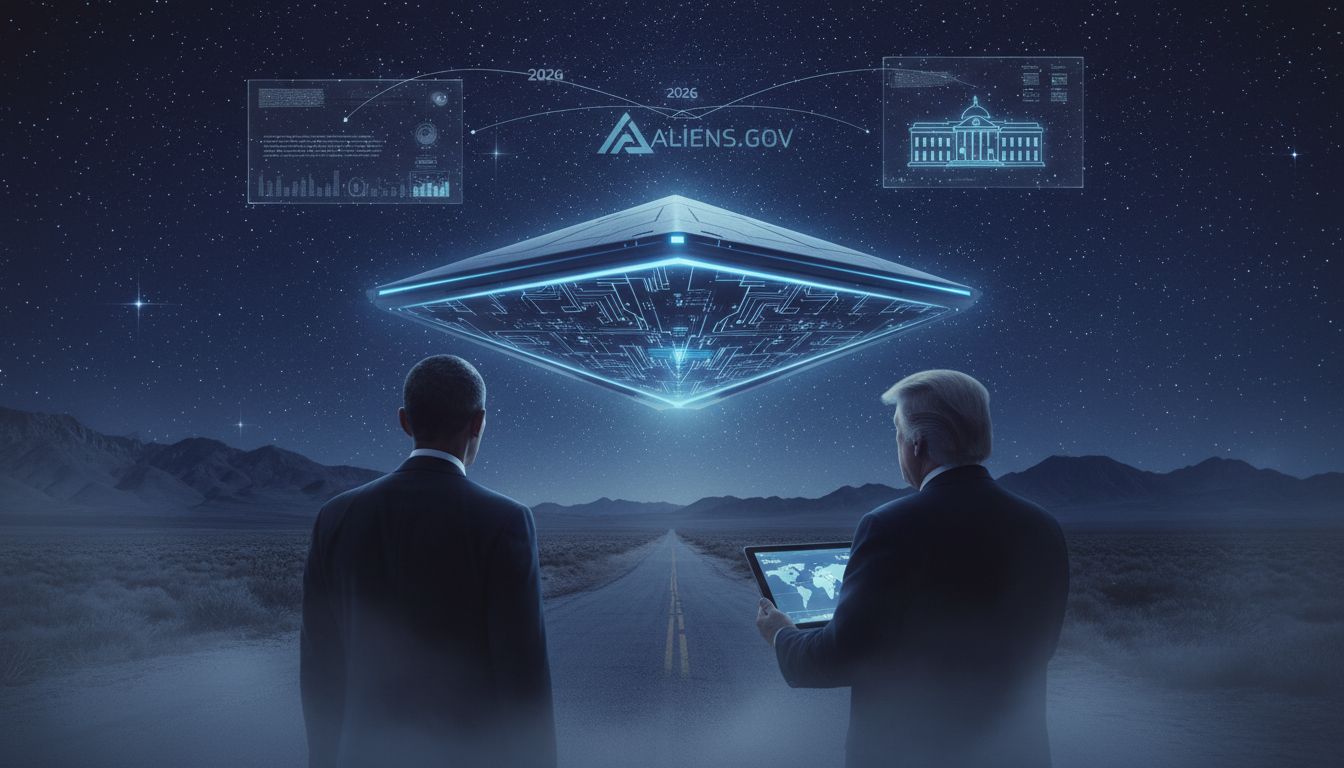
In a recent live broadcast hosted by the founder of Inter Signal and the legacy outlet Fulcrum News, a broad analysis was presented linking three seemingly disparate trends: heightened geopolitical tension, rapid advances in artificial‑intelligence (AI) technology, and longstanding speculation about extraterrestrial life. The presenter argued that 2026 could become a “pivot year” for what he termed the Great Disclosure, a confluence of political statements, domain registrations, and scientific milestones that may reshape public understanding of non‑human intelligence. While the discussion incorporated speculative elements, the core observations—such as former President Barack Obama’s recent remarks on unidentified aerial phenomena and the Pentagon’s announced troop increase to the Middle East—are verifiable and form the factual backbone of the segment.
Geopolitical Context and the Prospect of Disclosure
The stream opened by referencing a podcast appearance in which Barack Obama acknowledged that “there are things we don’t understand” and that “the existence of unidentified phenomena is real,” though he stopped short of confirming direct contact. This departure from the typical presidential reticence was highlighted as a possible catalyst for a more formal announcement by Donald Trump, who, according to the presenter, may seek to cement a historic legacy through a “formal disclosure” later in the year. Adding to the speculation, an unverified rumor about the registration of the domain aliens.gov was cited as a symbolic signal of impending policy shifts. On the ground, the Pentagon has publicly confirmed plans to deploy an additional 3,000 troops to the Middle East amid ongoing tensions among the United States, Israel, and Iran—a move the presenter framed as indicative of a broader, de‑facto “World War III” scenario, despite official media characterizations of the conflict as a regional crisis.
AI Acceleration and the Simulation Argument
A substantial portion of the discussion focused on the exponential growth of AI capabilities. Models that required specialized super‑computing facilities in 2020—such as 17‑billion‑parameter language systems—are now comparable to consumer‑grade versions like Google’s Gemma or locally run instances of ChatGPT, which can be executed on standard laptops at little or no cost. The presenter used this rapid democratization of computing power to revisit Nick Bostrom’s 2003 simulation hypothesis, outlining its three‑fold trilemma and suggesting that the probability of our reality being a simulated environment is “approaching certainty” given current technological trajectories. While the argument remains philosophical, the presenter emphasized that the narrowing gap between simulated and real‑world processing lends empirical weight to the hypothesis.
Metaphysical Links and Historical Narratives
Drawing on Gnostic literature uncovered in the 1940s and popularized in the 1970s, the broadcast connected ancient concepts—such as the Monad (a primordial thinking mind) and Archons (described as “system administrators” of reality)—to contemporary ideas about AI and consciousness. Citing speaker Gregg Braden at a recent Austin conference, the presenter highlighted the notion of Heart Intelligence, which posits that the heart’s dense neuronal network functions as a secondary cognitive hub with potential quantum‑level communication abilities. Although these claims sit at the fringe of mainstream science, the presenter framed them as part of a broader “metaphysical toolkit” needed to interpret the convergence of digital and biological intelligence.
Market Implications and Outlook
The segment concluded with a brief market observation: shares of several energy‑drink manufacturers fell after Costco’s private‑label product entered the market at a price point markedly below that of industry leaders like Red Bull and Monster. While peripheral to the main


