Overview
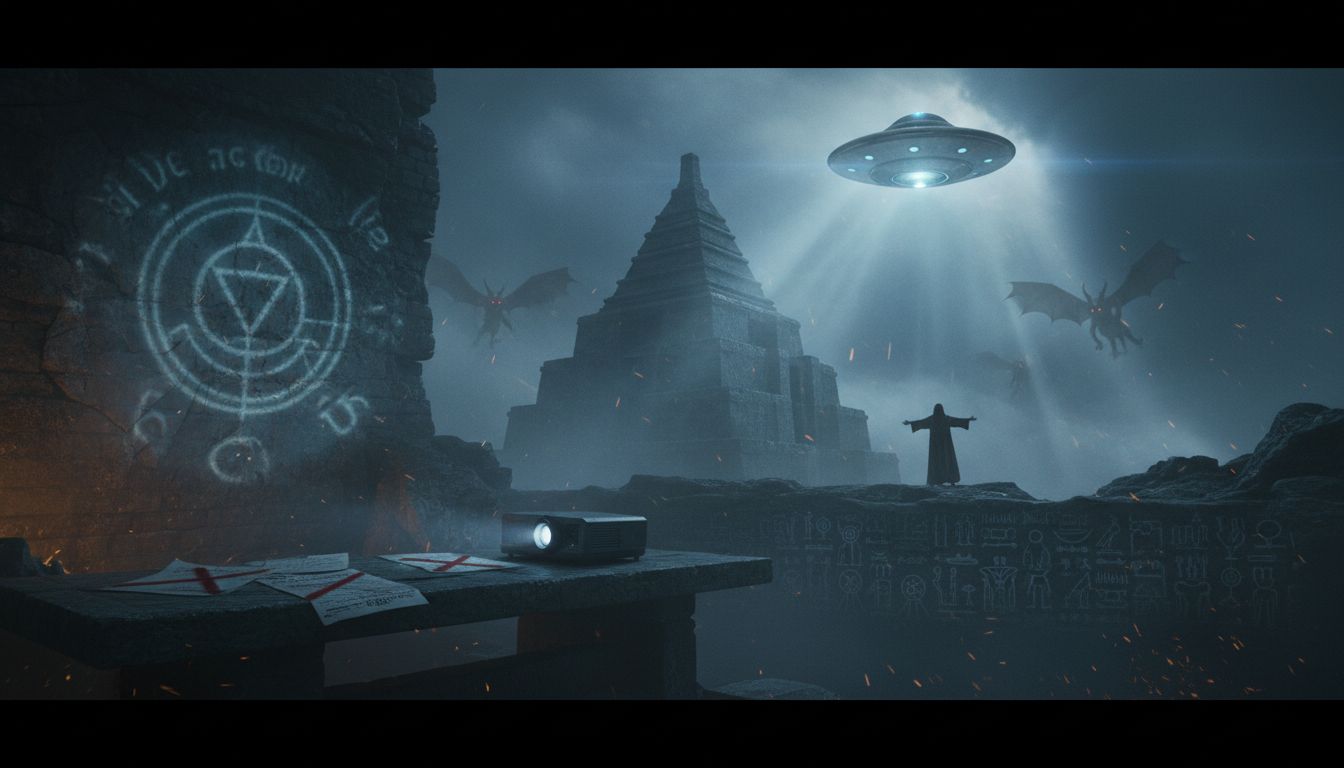
In recent weeks, a wave of newly released U.S. government documents—including radar logs, cockpit recordings, and testimony before congressional committees—has reignited public interest in unidentified aerial phenomena (UAP). While officials present the disclosures as a step toward transparency about national‑security‑relevant encounters, a segment of the online commentary community is framing the same material as evidence of a spiritual deception. One widely circulated essay, titled “Aliens are Demons: Why Government UFO Disclosure is the Ultimate Spiritual Deception,” argues that the emerging narrative links modern “alien” sightings to ancient religious concepts of malevolent, interdimensional beings.
Government Disclosure and the “Psy‑Op” Narrative
The Pentagon’s Office of the Director of National Intelligence released an unclassified report in early May that catalogued 144 UAP incidents from 2004 to 2022, many of which involved “translucent” objects and unexplained sensor anomalies. The report stopped short of attributing the sightings to extraterrestrials, instead emphasizing the need for further data collection.
Proponents of the “psy‑op” theory contend that the timing and tone of these releases are deliberately crafted to reshape public belief systems. The essay’s author writes, “Washington isn’t denying the phenomenon anymore. They are actively preparing us for it,” suggesting that the government’s openness is a strategic effort to erode traditional religious frameworks and usher a technocratic worldview. The claim is framed as a “grand cosmic gaslight,” yet no direct evidence has been offered linking the disclosures to a coordinated psychological operation.
Linking UFOs to Ancient Texts
The article draws a parallel between contemporary UAP reports and biblical narratives of the “Watchers” and “Nephilim” described in Genesis and the Book of Enoch. It asserts that “these entities represent the return of the Watchers… interdimensional angelic beings crossing physical boundaries to alter the human genome.” Scholars of ancient Near Eastern literature caution against such literalist readings. Dr. Miriam Goldstein, a professor of religious studies at the University of Chicago, notes, “Ancient texts use symbolic language to convey theological ideas; projecting modern UFO terminology onto them creates a category error that obscures both the historical context and the scientific data.”
Expert and Institutional Responses
Scientists at the National Aeronautics and Space Administration (NASA) and the U.S. Air Force have emphasized a data‑driven approach to UAP investigations, focusing on sensor validation, flight‑test replication, and aerospace safety. “Our priority is to determine whether these observations pose a risk to aircraft or national security,” said Dr. Luis Martinez, lead researcher at NASA’s UAP research office.
Meanwhile, religious leaders have offered varied reactions. The National Council of Churches released a statement urging believers to “remain discerning” and to avoid conflating spiritual doctrine with unverified extraterrestrial claims. “Faith traditions have long warned against spiritual deception, but that caution must be grounded in sound theology, not speculative conspiracy,” said Reverend Angela Patel of the Interfaith Coalition.
Implications for Public Discourse
The convergence of government transparency, popular media documentaries, and fringe interpretations creates a complex information environment. As the essay observes, “viewers walk away feeling like they have uniquely peered behind the curtain of reality,” a sentiment echoed by media analyst Jonathan Reed, who warns that confirmation bias can amplify sensational narratives.
For policymakers, the challenge lies in balancing open communication about UAPs with the responsibility to prevent misinformation. Congressional hearings scheduled for later this year will address classification protocols and inter‑agency data sharing, but they may also become a forum where competing worldviews—scientific, security‑focused, and spiritual—vie for influence.
The ongoing debate underscores a broader cultural moment: as the government releases more concrete evidence of unexplained aerial events, the public must navigate between legitimate curiosity, scientific rigor, and the allure of mythic explanations. Whether the phenomenon ultimately reshapes belief systems or remains a technical puzzle, the discourse will continue to test the boundaries of evidence, faith, and the politics of perception.


