Overview
A new theoretical study published this week suggests that the long‑standing “Great Silence” – the apparent absence of detectable extraterrestrial technosignatures – may be a consequence of the way scientists are searching, rather than evidence that intelligent life is rare. The authors argue that radio signals emitted by alien civilizations could be significantly altered by turbulent plasma surrounding their host stars, especially the abundant M‑dwarf stars, causing originally narrowband transmissions to spread out and slip past the narrow‑frequency filters used by most SETI (Search for Extraterrestrial Intelligence) programs.
How Stellar Plasma Can Blur a Message
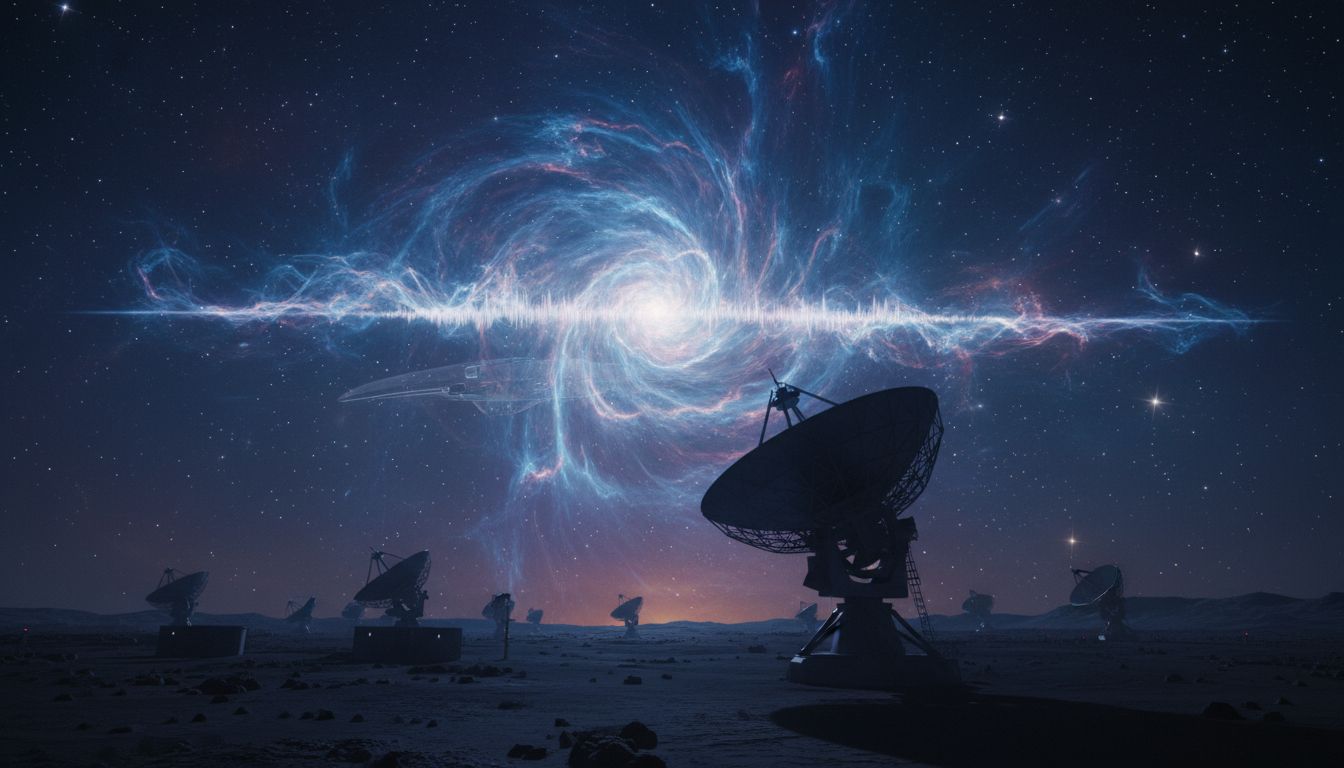
The research team, led by astrophysicist Dr. Laura Martínez of the University of Cambridge, used data from radio communications with spacecraft such as Voyager 1 and New Horizons to simulate how electromagnetic waves propagate through plasma clouds. “When a signal passes through a star’s corona or the interstellar medium, the charged particles act like a diffraction grating,” Martínez explained. “A tightly focused carrier wave can become broadened, its power diluted across a wider frequency band.”
Their models focused on M‑dwarf stars, which make up roughly 70 % of the Milky Way’s stellar population and are known for intense magnetic activity and dense plasma environments. By applying measured plasma densities from solar observations and scaling them to typical M‑dwarf conditions, the team demonstrated that a transmission originally only a few hertz wide could be stretched to several kilohertz or more before reaching Earth. Such broadened signals would be indistinguishable from natural astrophysical noise in conventional narrowband searches.
Why Current SETI Strategies May Miss Them
Since the 1960s, most SETI projects have prioritized the detection of narrowband “beacon” signals, often less than a few hertz in width, because natural astrophysical processes rarely produce such precise frequencies. The new findings challenge this assumption. “If an alien civilization is broadcasting a tight carrier wave, they might assume it will remain narrow all the way to the receiver,” said Dr. Aaron Patel, a co‑author from the SETI Institute. “Our analysis shows that the plasma around their star could undo that precision, turning a clear beacon into a smeared whisper that our pipelines discard as background.”
The study also notes that many existing surveys, such as Breakthrough Listen, employ data‑processing pipelines tuned to reject signals with excessive bandwidth to reduce false positives. Consequently, potentially valuable technosignatures could be filtered out before they are even examined.
Implications for the Search for Extraterrestrial Intelligence
If the plasma‑broadening effect is as pervasive as the models suggest, it may partially explain why, despite scanning billions of stars, SETI has yet to confirm an artificial signal. The authors caution that this does not prove alien contact has already been attempted, but it highlights a critical blind spot in our detection methodology. “The Great Silence might be, in part, a methodological silence,” Martínez said.
The paper recommends expanding search algorithms to include broader bandwidth windows, employing machine‑learning classifiers trained on simulated plasma‑distorted signals, and cross‑checking observations with stellar activity data. By correlating candidate detections with periods of low plasma turbulence—such as stellar quiescence phases—researchers could improve the signal‑to‑noise ratio for potential technosignatures.
Looking Ahead
The study arrives at a time of renewed investment in SETI, with upcoming facilities like the Square Kilometre Array (SKA) and the Next Generation Very Large Array (ngVLA) poised to deliver unprecedented sensitivity. Incorporating the new plasma‑distortion framework could shape the design of these instruments’ data‑analysis pipelines from the outset.
“Science advances by questioning its own assumptions,” Patel emphasized. “Adjusting our search criteria doesn’t guarantee we’ll hear a call, but it ensures we’re listening in the right way.” As the astronomical community digests these findings, the next wave of observations may finally address whether we have been “looking for the wrong thing” all along.