Overview
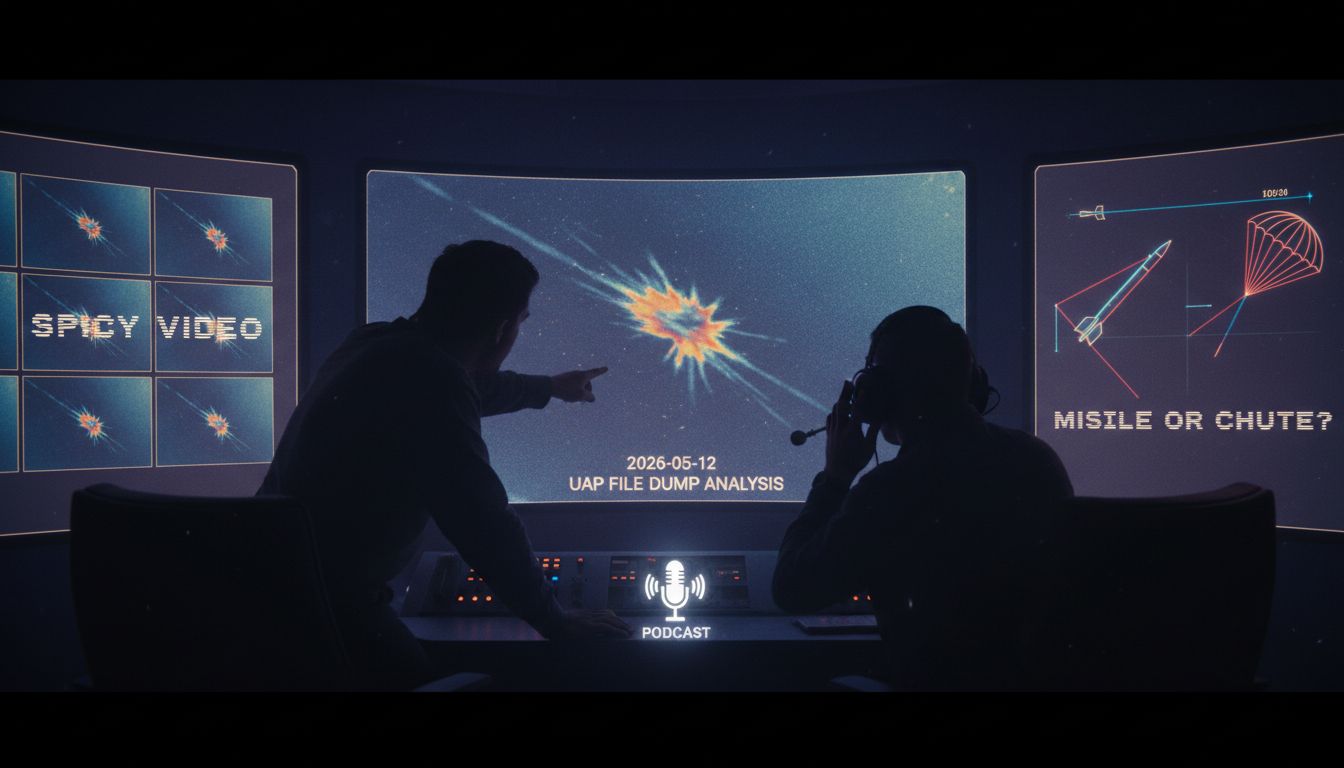
On May 12, 2026 the Out‑There Channel UFO‑paranormal chat podcast released a 46‑minute episode that dissected the “Spiky” video included in the first U.S. government UAP data dump. The clip, captured by a forward‑looking infrared (FLIR) sensor on a military aircraft, shows a brief, bright object with a series of radiating spikes that disappear after a few seconds. Since the video’s release in early 2026, analysts have debated whether the phenomenon represents a genuine aerial anomaly or a more conventional artifact such as a missile plume, a chute‑flare, a high‑altitude balloon, or even a flock of birds. The podcast’s hosts—former Navy pilot Mike “Hawk” Jensen and aerospace researcher Dr. Elena Ramirez—used the episode to weigh the technical evidence and explore the possibility that the footage may have been repurposed for artificial‑intelligence training.
Technical Analysis
Jensen began by describing the FLIR signature: a compact, high‑temperature core surrounded by linear, high‑contrast “spikes” that rotate as the object moves laterally. “The thermal contrast is exceptionally sharp, far beyond what we see in standard missile exhaust,” he noted, citing the video’s frame‑rate of 30 Hz and a resolution of roughly 640 × 480 pixels. Ramirez added that the spikes maintain a consistent angular separation—about 30 degrees apart—throughout the clip, a pattern that is atypical for turbulent missile plumes, which usually exhibit chaotic, rapidly changing edges. She referenced a 2023 U.S. Air Force study on FLIR signatures, which found that missile exhausts produce diffuse, asymmetrical heat signatures, whereas the “Spiky” video shows symmetrical, radiating structures.
Conventional Explanations
The hosts examined four mainstream hypotheses.
Missile or rocket debris – While a missile’s booster can generate bright spikes from shock‑wave interactions, the lack of a visible thrust plume and the short duration (≈ 2 seconds) argue against this. Jensen pointed out that the object’s altitude, inferred from the sensor’s tilt angle, places it above typical missile flight paths for the region.
Chute‑flare or counter‑measure – Military aircraft sometimes deploy flares that appear as point sources in infrared. However, Ramirez highlighted that flares produce rapidly expanding, circular heat signatures, not the linear spikes observed.
High‑altitude balloon or tethered sensor – Balloons can reflect sunlight and appear as bright spots, but they lack the high thermal output seen in the video. Moreover, the spikes’ symmetry would require a deliberately engineered structure, which no known balloon payload matches.
Birds or insects – A flock of birds can create multiple heat points, yet the FLIR image shows a single, coherent core with radiating lines, a pattern inconsistent with biological sources.
Each explanation was found wanting, prompting the hosts to consider a more speculative angle.
AI‑Training Data Possibility
Ramirez introduced the notion that the “Spiky” clip might have been synthetically generated or altered for use in AI‑training datasets. She cited a 2025 Pentagon memorandum on “Machine‑Learning Augmentation of Sensor Data,” which encourages the creation of realistic synthetic infrared footage to improve object‑recognition algorithms. “If the video were part of a training set, the spikes could be deliberate artifacts designed to teach a model to differentiate between genuine threats and false alarms,” she argued. Jensen concurred, noting that the video’s clean edges and lack of background clutter are hallmarks of computer‑generated imagery rather than raw battlefield footage.
Implications and Outlook
The podcast concluded that, while the “Spiky” video remains unexplained, the balance of evidence leans toward a non‑natural origin—either an undisclosed experimental platform or a synthetic construct for AI development. Both hosts emphasized the need for additional sensor data, such as radar tracks or visual‑spectrum recordings, to corroborate the infrared signature. They also called on the Office of the Director of National Intelligence to release metadata accompanying the dump, which could clarify the video’s provenance.
As the UAP community continues to sift through the government’s newly disclosed files, the “Spiky” video exemplifies the challenges of separating genuine aerial phenomena from mundane or engineered artifacts. Whether it ultimately proves to be a breakthrough in aerospace technology, a training‑tool artifact, or a misidentified conventional object, the episode underscores the importance of rigorous, multidisciplinary analysis in the ongoing effort to understand what, if anything, lies beyond the known skies.
Source: “Analyzing the USA Gov Spiky Video from first Dump. Is it all Artifacts of missile or ChuteFlare 2026,” TheOutThereChannel UFO Paranormal Chat Podcast, 12 May 2026, https://www.spreaker.com/episode/analyzing-the-usa-gov-spiky-video-from-first-dump-is-it-all-artifacts-of-missile-or-chuteflare-2026--71970886