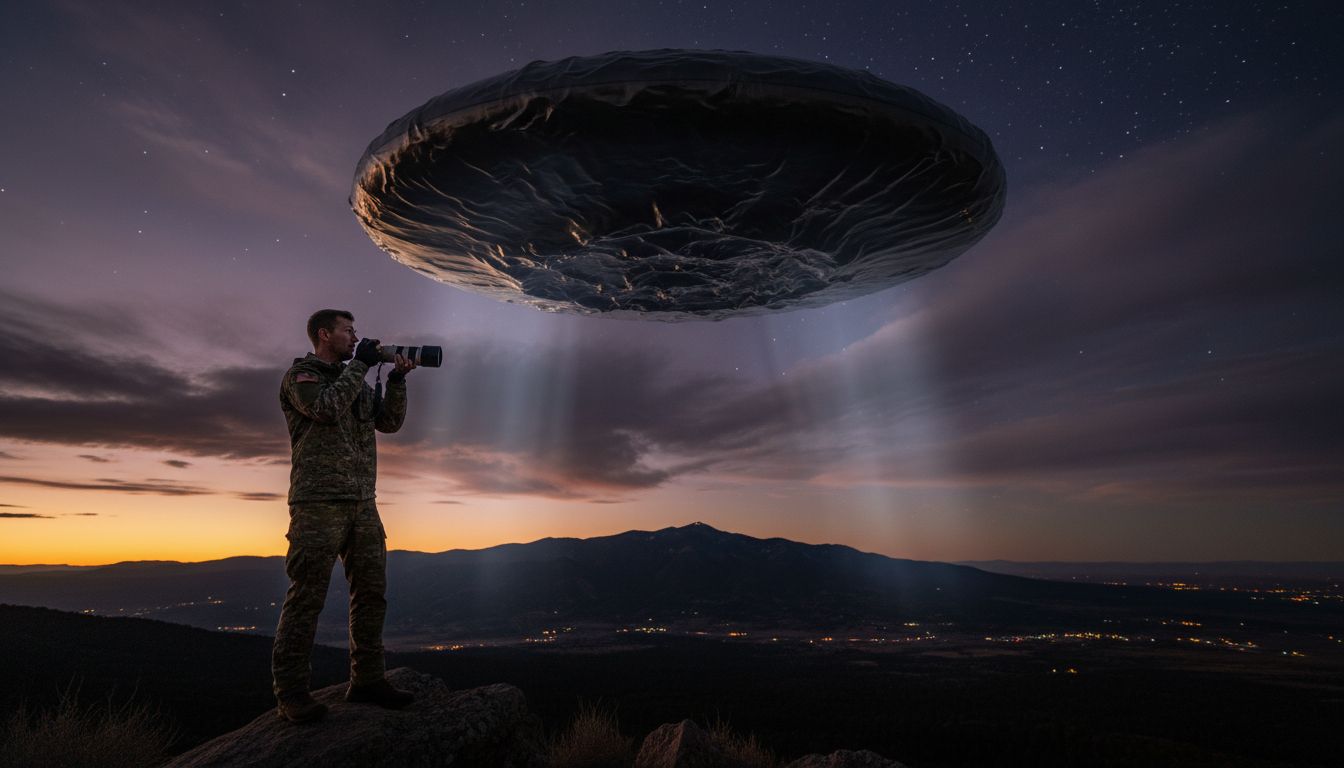
A recent interview with Caison Best, a former U.S. Army intelligence officer and West Point graduate, has brought renewed attention to an unusual unidentified aerial phenomenon (UAP) sighting near one of America’s most secure military installations. Best, who served with the 82nd Airborne and now analyzes UAP reports for Americans for Safe Aerospace, detailed his experience observing a large, elliptical object near Cheyenne Mountain, home to NORAD, in a conversation with host Chris Leato on the Lato Files YouTube channel.
According to Best, the sighting occurred under clear conditions and involved five witnesses, all of whom saw the UAP hovering motionless in the sky. “Clear as can be was a UAP just sitting perfectly still over that side. I didn't see it zip off. I didn't see it dissolve. I didn't see it dip behind the mountain. It just was there and then it wasn't,” Best recounted. The object, described as massive and elliptical, appeared stationary before it “vanished” without any visible movement. The setting—Cheyenne Mountain, known for its restricted airspace and military sensitivity—added weight to the incident, making it difficult for Best to dismiss the sighting as a conventional occurrence.
In the aftermath, Best reported the incident to relevant authorities. He received an email at his MIT address, suggesting the object might have been a surveillance balloon similar to an ISR PTED (Persistent Threat Detection System). However, Best, drawing on his intelligence background and familiarity with military technology, rejected this explanation. “I had made it clear it was not a PTED that we saw,” he emphasized, underscoring the unique characteristics of the object and the context of the sighting.
Best’s military and academic credentials lend credibility to his account. After a career that began with aspirations of becoming a fighter pilot and pivoted to West Point due to recruitment issues, Best served as an airborne infantry officer and later became involved in intelligence analysis. His work with Americans for Safe Aerospace now involves reviewing and analyzing UAP reports, where he notes patterns and recurring features in high-quality sightings from military and civilian witnesses alike.
The sighting near NORAD comes amid growing public and governmental interest in UAPs, with agencies like the Pentagon’s All-domain Anomaly Resolution Office (AARO) and the FBI increasingly fielding reports from credible observers. Best’s experience illustrates both the complexity of UAP investigations and the ongoing challenges in distinguishing between advanced technology, misidentification, and truly unexplained phenomena. “In any other location, I would just completely dismissed it. But that's an unbelievably sensitive site,” Best explained, highlighting the unique security concerns when UAPs are observed near critical military infrastructure.
Best’s willingness to speak publicly about his encounter reflects a broader shift among former military personnel, who are increasingly coming forward with their experiences and urging greater transparency. As the debate over UAPs continues, firsthand accounts like Best’s provide valuable data points and underscore the need for rigorous, science-based inquiry into aerial phenomena that defy easy explanation.


