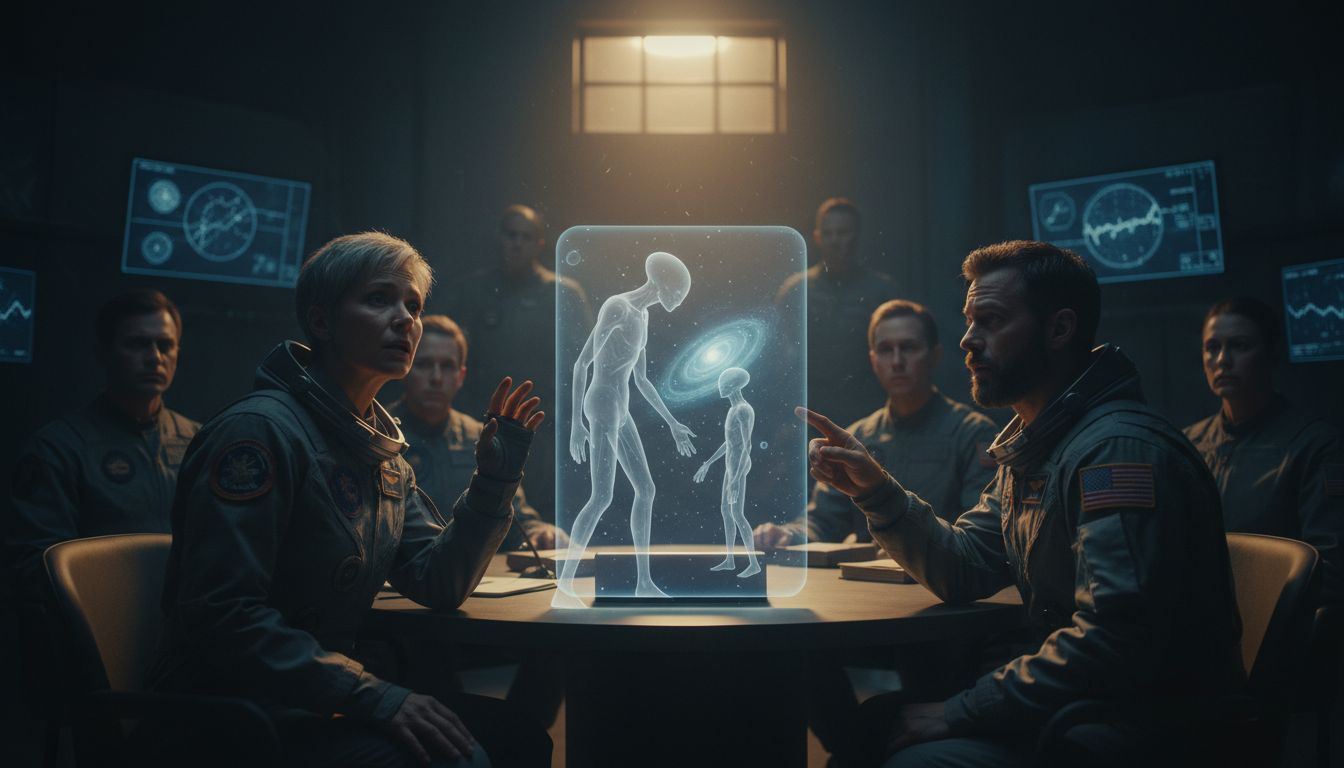
Former NASA engineer Clark McClelland, who says he worked on more than 660 spaceflight operations between 1958 and 1992, has resurfaced with a claim that could reshape public understanding of U.S. space missions. In a video released in 2012 and reiterated in recent interviews, McClelland alleges that during a classified shuttle operation he observed a ten‑foot‑tall, humanoid entity inside the shuttle’s payload bay. He describes the being as “thin, bipedal” and capable of non‑verbal communication, gesturing to the crew for roughly a minute and six seconds. According to McClelland, the astronauts responded calmly, as if the exchange were routine, and a larger, unidentified craft hovered nearby. He insists the encounter was witnessed from the Mission Control “live monitor” at Kennedy Space Center, not from the crew themselves.
McClelland’s narrative is built on his self‑identified status as a long‑time aerospace engineer and mission specialist, a background he says placed him at the heart of both public and classified launches. He claims that after the incident he raised concerns within NASA about the agency’s secrecy regarding extraterrestrial contact, leading to his dismissal and the revocation of his pension. In his final public statement he said, “I love my planet. I love the human race… I am trying to serve all of you—if you’ll just let me.” The emotional tone of his testimony has resonated with a segment of the UFO‑interest community, but it has drawn sharp skepticism from mainstream aerospace experts.
NASA has not confirmed McClelland’s employment history, and a review of public personnel records does not list a Clark McClelland among former engineers or astronauts. The agency’s spokesperson reiterated that “NASA has no record of any extraterrestrial contact during any mission, classified or otherwise,” and emphasized that all shuttle payloads are documented in detail. Independent verification of the video footage McClelland released has not been forthcoming; analysts who have examined the clip note that its source is a website known for speculative content, and the video lacks the metadata typically required for authentication.
The broader context of McClelland’s claims intersects with a recent wave of declassified government reports on unidentified aerial phenomena (UAP). In 2023, the Office of the Director of National Intelligence released a preliminary assessment acknowledging 144 UAP incidents that could not be readily explained. While those reports focus on observations made by military pilots and sensors, they have reignited public curiosity about possible non‑human presence in near‑Earth space. However, experts caution against conflating disparate sightings with the specific, detailed scenario McClelland describes—a ten‑foot humanoid directing astronauts inside a shuttle bay.
Skeptics point out that the physical constraints of the shuttle payload bay—approximately 15 feet in height—would make the presence of a three‑meter‑tall entity highly improbable without substantial modifications to the vehicle’s design and safety protocols. Moreover, the absence of corroborating testimony from any of the more than 150 astronauts who flew the shuttle program raises questions about the claim’s credibility. Until additional evidence—such as independent video analysis, corroborating eyewitness accounts, or official documentation—emerges, McClelland’s story remains an unverified anecdote that sits on the fringe of both aerospace history and the ongoing discourse on UAPs.