Overview
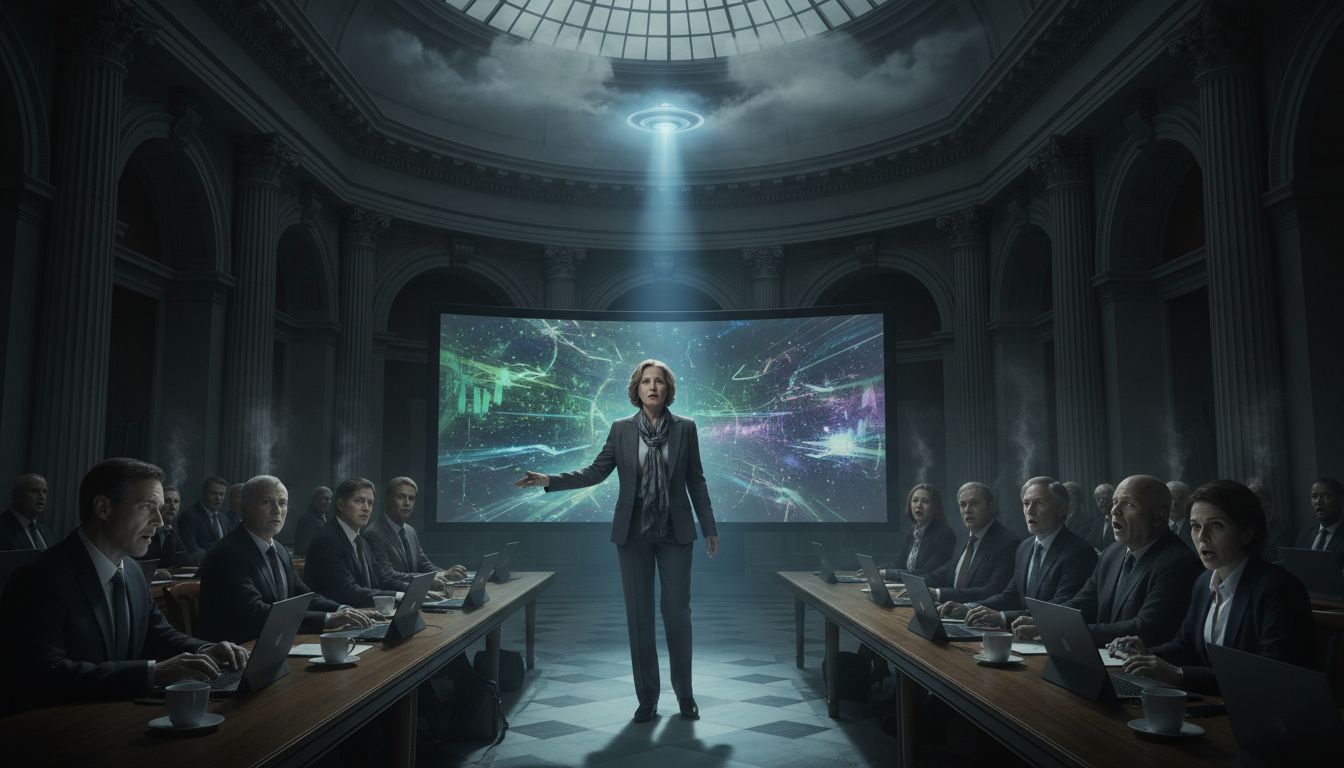
Former senior financial‑security analyst Helen McCaw, a Cambridge‑educated specialist in systemic risk, warned the Bank of England on Jan. 24 that the United Kingdom must develop a contingency plan for “inevitable financial chaos” should the United States formally confirm the existence of extraterrestrial life. McCaw’s briefing, released to the press ahead of a scheduled White House disclosure on unidentified aerial phenomena (UAP), argues that a definitive acknowledgment would trigger market turbulence comparable to major geopolitical shocks such as Brexit or the 2022 Russian invasion of Ukraine.
Potential Economic Shockwaves
McCaw contends that the confirmation of alien existence would upend long‑standing assumptions about humanity’s place in the cosmos, prompting a cascade of reactions across asset classes. “Investors will scramble for safety, sovereign bonds and cash will surge, while equities—especially those tied to defense, aerospace and technology—could see abrupt re‑pricing,” she told reporters. She highlighted three primary channels of risk:
- Liquidity strain – a sudden flight to cash could compress interbank lending and strain the gilt market, where the BoE’s quantitative‑easing programme already balances supply and demand.
- Currency volatility – the pound sterling may depreciate sharply against the dollar and yen as confidence in the UK’s macro‑policy framework is questioned.
- Social unrest – McCaw warned that “public anxiety over existential implications could spark protests, disrupting supply chains and fiscal stability.”
She cited the 2020 COVID‑19 market plunge, where the VIX spiked to historic levels within days of the WHO’s pandemic declaration, as a benchmark for the speed at which sentiment can shift.
Expert Perspective
McCaw’s analysis draws on a decade of work monitoring “black‑swans” in financial systems. In a 2023 paper for the Institute of International Finance, she outlined how “low‑probability, high‑impact events” require pre‑emptive stress‑testing, a practice she says the BoE has yet to apply to extraterrestrial disclosure. “The risk is not speculative; it is structural,” McCaw asserted. She urged the central bank to run scenario‑based models that incorporate sudden shifts in sovereign credit spreads, cross‑border capital flows, and potential emergency fiscal measures.
Other economists echo her concerns. Dr. Aisha Patel, senior fellow at the London School of Economics, noted that “the market’s reaction to any paradigm‑shifting announcement is historically swift and severe. Central banks that have prepared contingency frameworks—such as the Federal Reserve’s pandemic‑inflation‑related stress tests—were better positioned to act decisively.”
Institutional Response
The Bank of England has not issued an official comment on McCaw’s recommendations. A spokesperson declined to confirm whether a dedicated “UAP disclosure” working group exists, but reaffirmed the institution’s commitment to “maintaining financial stability under all foreseeable scenarios.” In a recent Financial Stability Report, the BoE outlined its ongoing “macro‑prudential toolkit,” which includes liquidity buffers, counter‑cyclical capital requirements, and the ability to intervene in gilt markets—tools that could be repurposed for an alien‑disclosure shock.
Outlook
As the White House prepares to release its long‑awaited UAP assessment, policymakers worldwide are watching closely. McCaw’s call for a “robust, transparent contingency plan” underscores a broader shift in risk management: the need to factor in non‑traditional, existential threats alongside conventional economic indicators. Whether the Bank of England will adopt her suggestions remains to be seen, but the prospect of a coordinated, pre‑emptive response could mitigate the “inevitable financial chaos” that McCaw predicts. In the meantime, investors are advised to monitor central‑bank communications and maintain diversified portfolios to weather any sudden market dislocations that may arise from the historic disclosure.