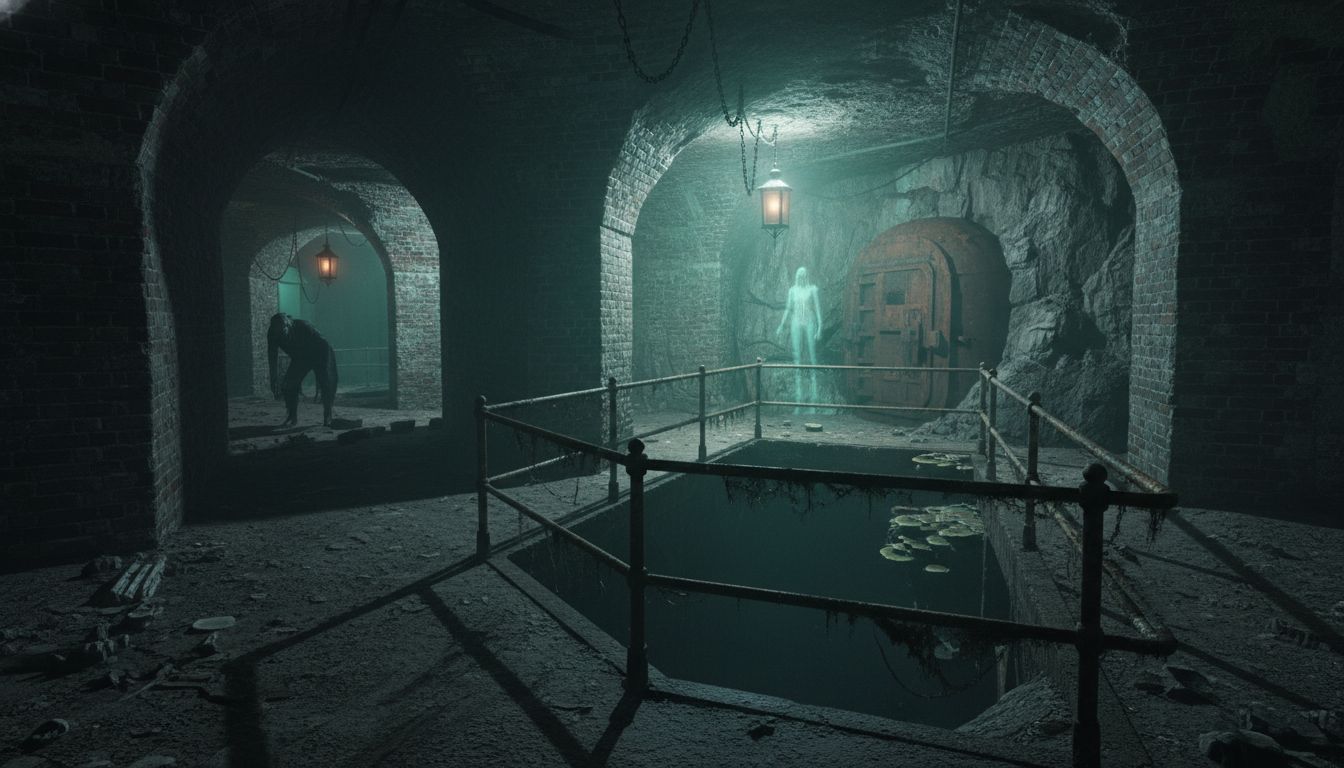
The underground vaults beneath Clerkenwell, once part of the 19th‑century House of Correction, have become a focal point for England’s modern paranormal tourism. Opened to the public as a museum in 1993, the 9,000‑square‑foot “Clerkenwell Catacombs” were originally the detention cells of a prison that held up to thirty inmates per room before its demolition in 1890. Since the museum’s closure in 2000, former staff and visitors have reported a range of unexplained phenomena: shadowy figures gliding through the darkness, a recurring apparition of an elderly woman who vanishes when approached, and the mournful sobs of a young girl that echo through the maze‑like passages. One former manager, who preferred anonymity, suggested that “children were imprisoned here and the anguish they suffered must have been terrible. Perhaps this little girl's grief has somehow impregnated the stone.” The accounts have been logged by local paranormal societies, though they remain anecdotal and unverified by scientific inquiry.
Further south, the Kelvedon Hatch Secret Nuclear Bunker in Essex offers a Cold War‑era counterpart to the Victorian prison tunnels. Constructed 125 feet underground as a regional headquarters for civil defence, the facility was decommissioned in 1992 and subsequently opened to the public. Its concrete walls, built to withstand nuclear fallout, are said to conceal a darker history: a construction worker allegedly drowned in the concrete, and several eyewitnesses claim to have encountered a “tall elderly lady” moving silently between rooms. An RAF officer has reportedly been sighted, while a disembodied female voice has instructed visitors to leave. Visitors have also described physical sensations—rocks thrown without apparent cause, sudden crashes, fleeting lights and mist, and an acrid odor that lingers in the bunker’s sick bay. A medium consulted by the site’s operators confirmed the presence of a “malevolent energy” that evokes dread, though no forensic evidence supports these claims.
Both locations illustrate a broader pattern in which sites of historical trauma attract reports of residual hauntings. The Clerkenwell prison, notorious for overcrowding and the execution of prisoners awaiting trial, mirrors the psychological imprint theory often cited by researchers: intense emotional events may leave an “energetic imprint” on the built environment. Similarly, Kelvedon Hatch’s association with the anxieties of the nuclear age—combined with the alleged death of a worker during construction—creates a narrative ripe for paranormal interpretation. Academic studies on hauntings, such as those conducted by the University of Exeter’s Department of Psychology, emphasize the role of suggestion, environmental cues, and the power of collective memory in shaping these experiences.
The phenomenon is not limited to subterranean structures. Across the country, bridges linked to historic tragedies also attract folklore. Coltishall Bridge in Norfolk, for instance, is reputed to be the haunt of “Black Shuck,” a spectral black dog said to appear after executions and witch trials in the region. Local historian Dr. Eleanor Marsh notes that “the Black Shuck legend predates the bridge’s construction, but its persistence reflects how communities embed moral warnings into landscape features.” While no empirical data confirm the dog’s existence, the story continues to draw tourists and contributes to the bridge’s cultural heritage.
Authorities in both London and Essex have taken a measured approach, maintaining the sites as tourist attractions while discouraging sensational claims. The Clerkenwell Catacombs are now managed by a heritage charity that emphasizes historical education over supernatural speculation. Kelvedon Hatch’s operators have installed motion‑sensor lighting and posted clear safety guidelines, citing occasional disturbances but attributing them to the building’s acoustics and ventilation. Neither site has been subject to formal paranormal investigation by law‑enforcement agencies, and any reported incidents remain within the realm of private testimony.
As interest in England’s haunted locales grows, the balance between preserving historical integrity and catering to paranormal curiosity becomes increasingly delicate. Researchers caution that while such stories enrich cultural narratives, they should not eclipse the documented histories of oppression, war, and societal fear that underpin these sites. In the meantime, visitors continue to descend into the dim corridors of Clerkenwell and Kelvedon Hatch, drawn as much by the allure of the unknown as by the tangible remnants of England’s tumultuous past.


