Overview
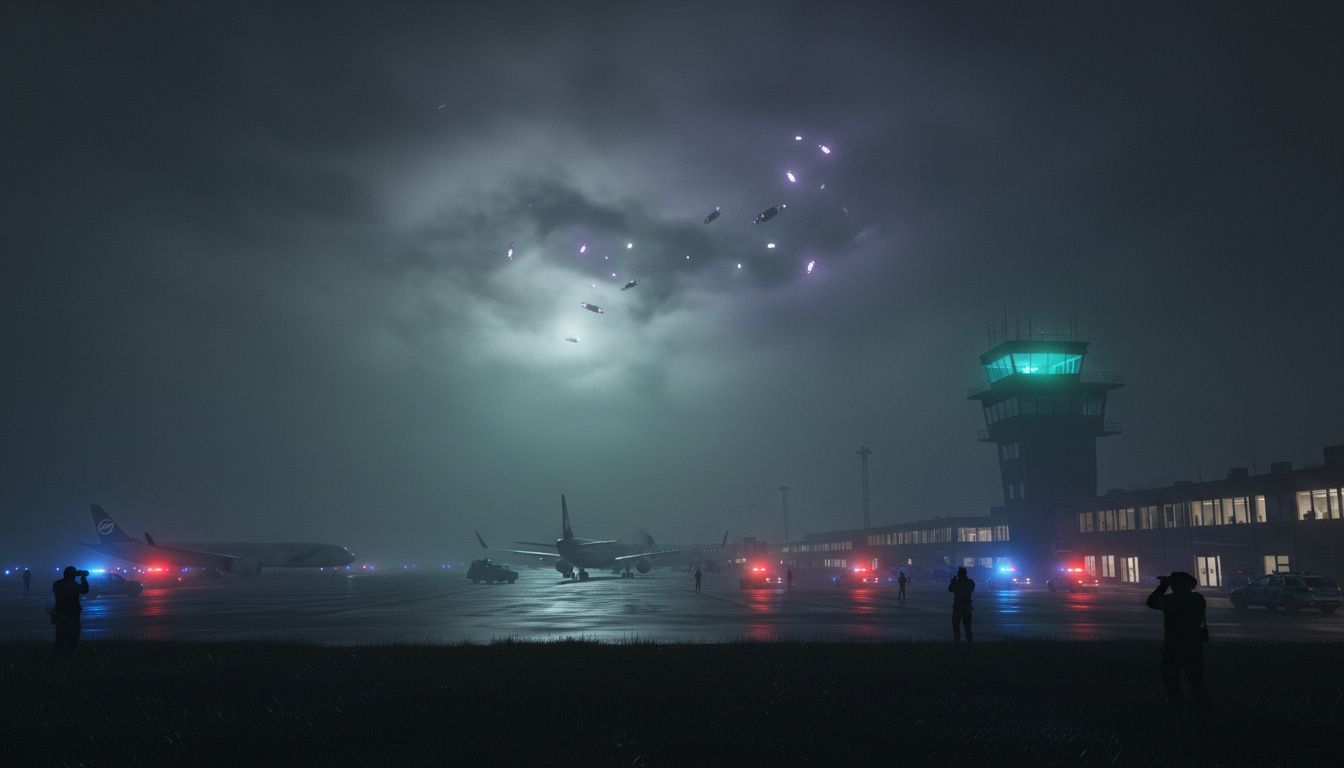
On the evening of 16 November 2025, air traffic over Aalborg Airport was halted after authorities received a “justified suspicion of drone activity” in the vicinity of the runway. The Danish Transport Authority (Trafikstyrelsen) ordered an immediate temporary closure of the airport’s controlled airspace, grounding all arrivals and departures until the source of the disturbance could be verified. While the incident was resolved without any reported injuries, the abrupt suspension of flights disrupted connections for hundreds of passengers and prompted a coordinated response from civil aviation, police, and the armed forces.
Incident Details
Radar operators at Aalborg’s control tower detected an object moving at low altitude and irregular speed, inconsistent with conventional aircraft flight patterns. The object appeared on both civilian and military surveillance systems, prompting the “justified suspicion” wording used in official communications. Airport manager Lars Jensen confirmed that the runway was cleared and all ground movements were halted within minutes of the alert:
“Our priority is safety. When an unidentified aerial presence is reported, we act decisively to protect passengers, crew, and airport personnel.”
The Danish Police (Politi) and the Royal Danish Air Force were dispatched to the site, employing visual observers and electronic counter‑measure equipment to locate the intruder. By 22:30 UTC, the object was no longer detectable, and normal operations resumed after a thorough sweep of the airfield.
Investigation
The investigation, led by the Danish Transport Authority in partnership with the National Defence and the Danish Centre for Unmanned Aircraft Systems (UAS), is focusing on two primary possibilities: a commercial or hobbyist drone operating illegally, or a potentially unidentified aerial phenomenon (UAP) that defies standard classification.
Chief investigator Maria Sørensen of the Transport Authority stated:
“We are examining flight logs, radio frequencies, and visual evidence. If the object is a conventional drone, we will pursue the responsible party under existing UAV regulations. Should the data suggest an unknown capability, we will coordinate with the Ministry of Defence and relevant research bodies.”
Preliminary forensic analysis of radar signatures has not yet matched any known drone models, but the authorities caution that technical limitations can obscure small‑scale UAV footprints, especially in cluttered airspace.
Aviation Impact
The brief shutdown affected roughly 30 scheduled flights, stranding passengers on both domestic routes to Copenhagen and international services to Hamburg and Oslo. Airlines, including Scandinavian Airlines (SAS) and Norwegian Air Shuttle, issued standard delay notices and arranged alternative transport where possible.
SAS spokesperson Henrik Larsen remarked:
“Safety is non‑negotiable. While the disruption was inconvenient, we commend the swift coordination between airport officials and security forces.”
The incident underscores the growing operational challenges airports face as drone traffic proliferates. Denmark’s 2023 UAV legislation, which mandates registration and geofencing for drones over 250 grams, is being revisited in light of recent near‑misses at other European airports.
Broader Context
Aalborg’s episode adds to a series of European airspace incursions reported over the past two years, ranging from hobbyist drones near Frankfurt Airport to unexplained radar contacts over the North Sea. While most incidents are ultimately traced to illicit UAV activity, a minority remain unexplained, fueling ongoing discussions about UAP monitoring within civilian and military frameworks.
The Danish Defence Ministry has pledged to allocate additional resources to the UAP Task Force, a joint civilian‑military panel established in 2024 to catalog and analyze anomalous aerial sightings. As technology evolves and the skies become increasingly crowded, the balance between security, regulation, and transparency will shape how authorities respond to future events.


