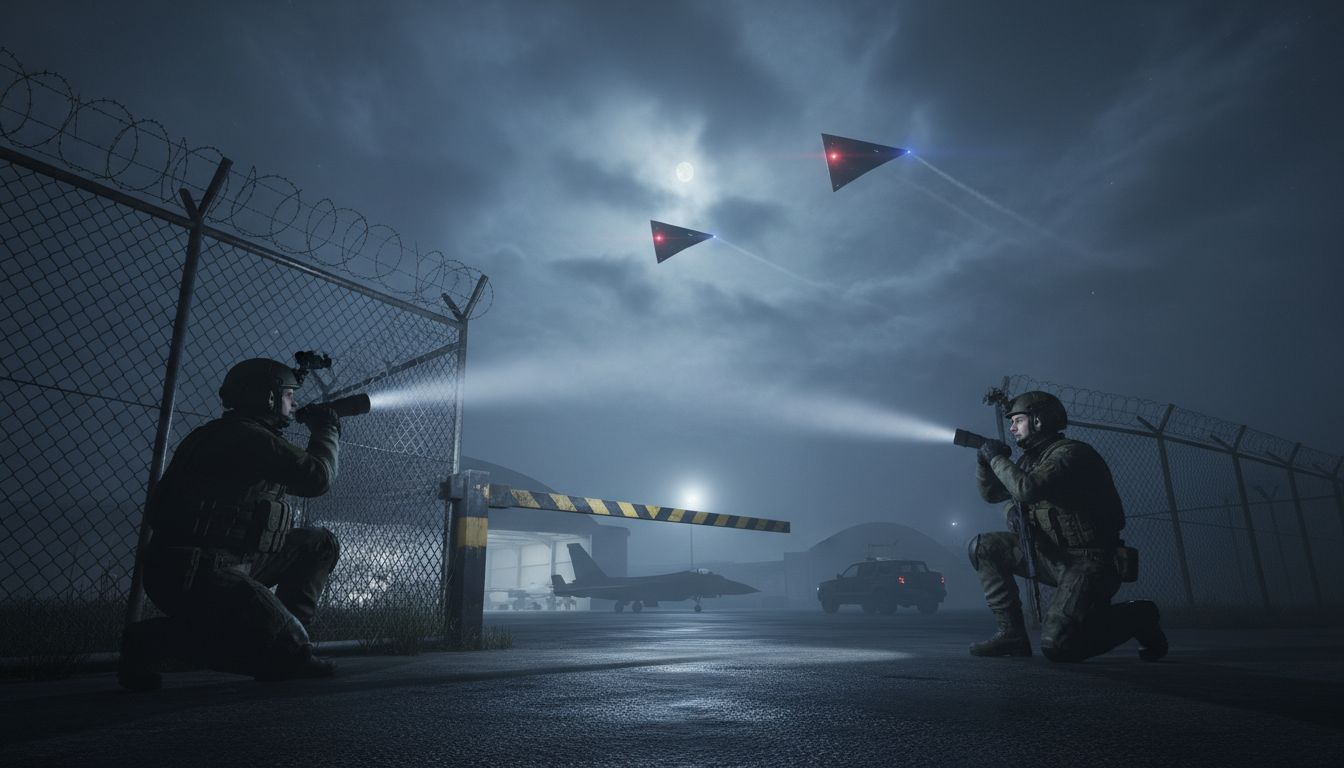
Belgian authorities have opened a formal investigation after a series of unidentified aerial objects were observed over the Kleine‑Brogel airbase in the province of Limburg earlier this week. The base, which NATO confirms is part of the United States’ nuclear sharing arrangement and is believed to store B61 nuclear bombs, is a highly sensitive installation. According to a statement from the Belgian Ministry of Defence, the drones were detected by radar and visual observers between 02:00 and 04:30 local time on Monday and again on Tuesday, flying at altitudes of roughly 1,200 to 1,500 metres and following a repeated flight path parallel to the perimeter fence.
“Given the strategic importance of Kleine‑Brogel, any unauthorized aerial activity is taken very seriously,” Defence Minister Annelies Verlinden said in a press briefing on Wednesday. “We are working closely with our NATO partners and the United States to determine the origin of these objects and assess whether they constitute an espionage attempt.” The ministry has not disclosed the number of drones, but officials described them as small, multirotor platforms capable of loitering for several minutes before departing the area.
The incident arrives at a moment of heightened scrutiny over unidentified aerial phenomena (UAP) across Europe. In recent months, several NATO member states, including Germany and Italy, have reported similar sightings near critical infrastructure, prompting the alliance to issue a joint directive on “enhanced airspace monitoring.” NATO’s spokesperson, Lieutenant Colonel Marco Rinaldi, noted that “the alliance’s collective air‑defence posture is being continually reviewed to address emerging threats, whether they stem from state actors, commercial entities, or novel technologies.” He added that no evidence yet suggests the drones were linked to any known commercial or hobbyist operators.
U.S. officials have declined to comment on the specifics of the weapons stored at Kleine‑Brogel, citing standard security protocols, but a senior Department of Defense official confirmed that the United States remains “fully engaged with Belgian counterparts to safeguard our shared assets.” Analysts at the International Institute for Strategic Studies (IISS) have warned that the proliferation of inexpensive, commercially available drone technology lowers the barrier for intelligence‑gathering missions, especially in environments where traditional air‑defence systems may be calibrated to focus on larger threats. “A small, low‑observable drone can evade conventional radar filters, making it an attractive tool for covert surveillance,” said IISS senior fellow Dr. Elise Marquez.
While the investigation is ongoing, Belgian authorities have temporarily heightened security measures around the base, including increased patrols and the deployment of additional radar assets. The Ministry of Defence has also requested assistance from the European Union’s Agency for Cybersecurity (ENISA) to examine whether the drones could have been remotely piloted from abroad or compromised by malicious software. The episode underscores the growing challenge NATO faces in protecting critical nuclear assets against a spectrum of modern threats, and it may prompt a reassessment of both physical and cyber safeguards at similar sites throughout the alliance.


