Overview
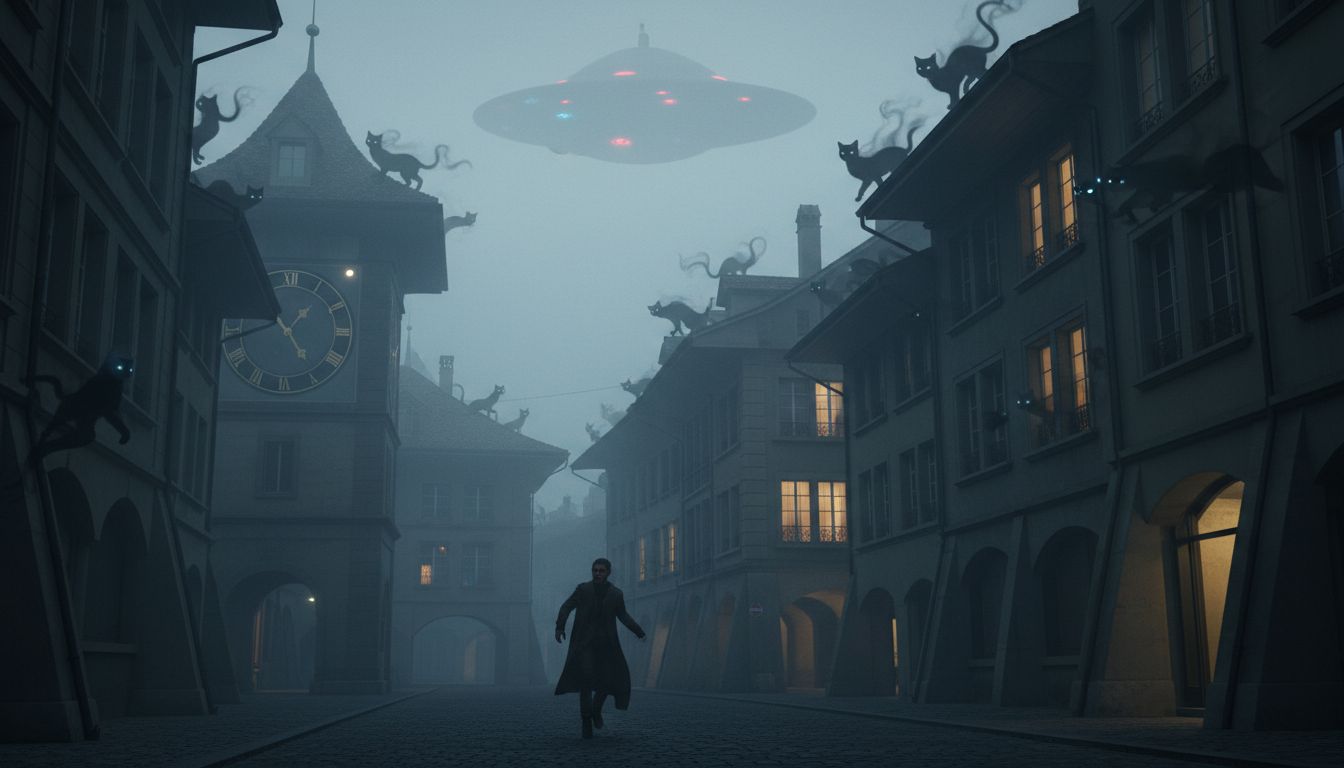
Beneath Bern’s UNESCO‑listed Old Town, a network of cobblestone alleys and medieval arcades carries more than the city’s political and architectural heritage. Residents and visitors alike recount sightings of spectral black cats that glide through shadows, a motif that echoes centuries‑old European folklore linking the animal to both luck and ominous magic. The stories, first compiled by Hedwig Correvon in her 1919 collection Gespenstergeschichten aus Bern, continue to surface in local anecdotes and guided tours, reinforcing a lingering cultural fascination with the feline phantoms.
Historical Context
Black cats have occupied a dual role in European myth: in some regions they are considered talismans of good fortune, while in others they serve as harbingers of misfortune. In Bern, the folklore reflects the latter tradition. The Moon Mausoleum article notes that “the black cat in European folklore is shrouded in mystery and magical lore,” and highlights several Bern‑specific legends, such as the “talking cat” that greeted a midwife on the steep stairs of Brunngasse before vanishing, and the tale of a beautiful recluse whose death‑like stillness was interrupted by a leaping black cat that revived her. These narratives were recorded in the early twentieth century, a period when oral histories were being systematically documented across Switzerland.
Recent Documentation
The most detailed accounts appear in Correvon’s anthology, which the Moon Mausoleum site reproduces in part. One story, titled “The Horrible Beautiful Girl and the Kiltgang,” describes a nocturnal courtship ritual in which a group of young men discovered a motionless girl and a black cat that entered her window, after which the girl revived. Another legend, “Wicked Women and Cursed Cats,” tells of a cruel woman who, after death, returns as an immortal black cat to torment those who defy her, surviving attempts to strike it down. While the original texts are over a century old, the website’s 2026 publication revives these tales for a modern audience, positioning them alongside other Swiss paranormal accounts.
Local Perspectives
Bern’s cultural office acknowledges the folklore as part of the city’s intangible heritage but stops short of endorsing supernatural claims. “These stories are valuable for understanding how past communities interpreted unexplained phenomena,” said a spokesperson for the Bern Tourism Board in an email interview. Local guides, however, often incorporate the cat legends into walking tours, noting that “the allure of the unknown draws visitors to the alleys where the tales originated.” Residents surveyed by the Bern Gazette expressed mixed feelings: some view the legends as charming folklore, while others consider them a source of lingering superstition, especially among older citizens who recall hearing the stories from grandparents.
Cultural Impact
Beyond tourism, the black‑cat narratives have inspired artistic projects, including a recent mural in the Kornhaus district that depicts a stylized feline silhouette against the city’s historic skyline. Scholars of folklore, such as Dr. Lena Schmid of the University of Zurich, argue that the persistence of these tales reflects a broader European pattern where animals embody collective anxieties. “The black cat serves as a cultural mirror, projecting fears of the night, the unknown, and social transgression,” Schmid explained in a 2025 conference paper. As Bern continues to balance its medieval charm with contemporary life, the feline phantoms remain a subtle yet enduring thread in the city’s narrative tapestry.