Overview
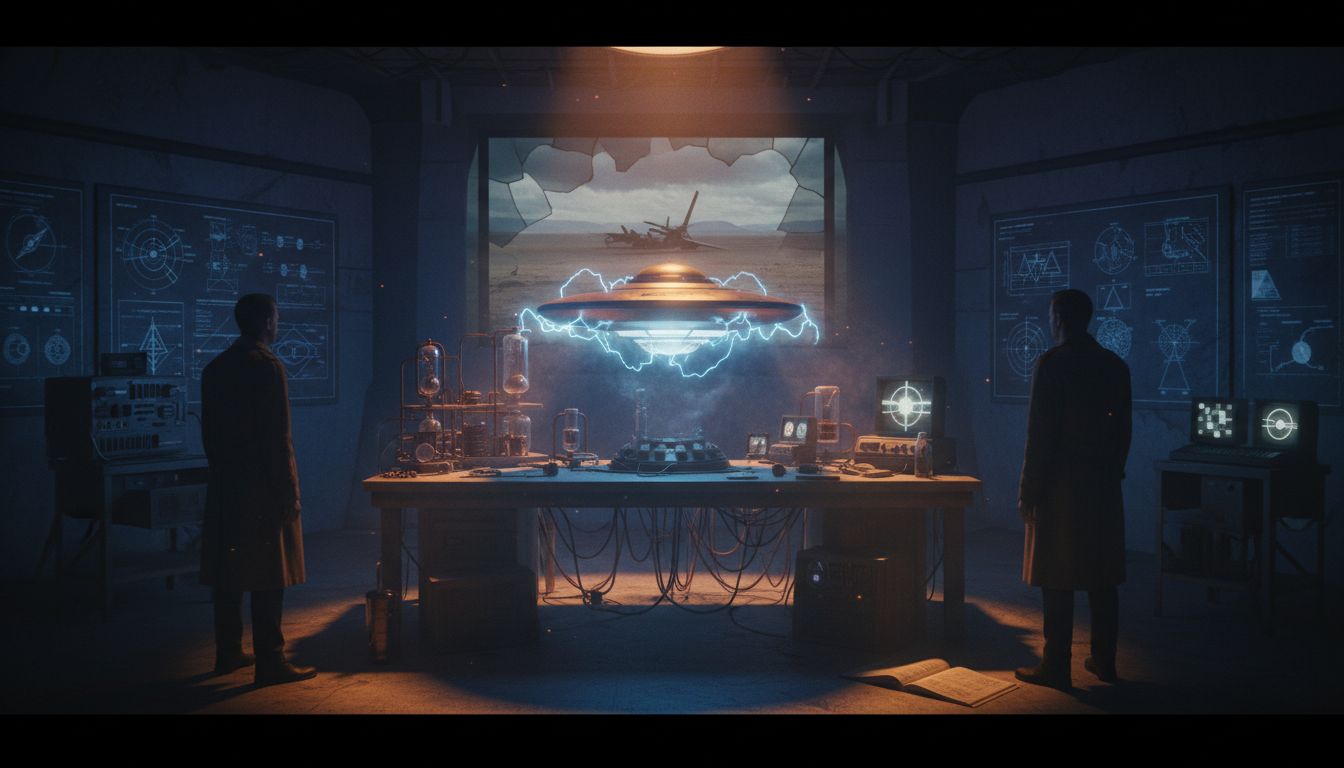
A resurfaced 1990 US Air Force study titled "Electric Propulsion Study" is challenging decades of mainstream scientific consensus by validating controversial research into anti-gravity propulsion. The document, prepared by Science Applications International Corporation, examines the Biefield-Brown Effect—a phenomenon long dismissed by academic physics as mere ion wind—as a genuine candidate for exotic propulsion. This revelation suggests that classified research into technologies with potential UFO-like capabilities persisted well into the late 20th century.
Biefield-Brown Effect: From Fringe to Feasible
For decades, the Biefield-Brown Effect, discovered by Thomas Townsend Brown in the 1920s, has been relegated to the fringes of physics. Brown claimed that high-voltage, asymmetric capacitors could produce thrust through an interaction with gravity, not just by pushing air. Mainstream science has typically explained reported effects as "ion wind," or electrical devices moving by pushing against surrounding air, thus dismissing any gravitational connection.
However, the 1990 Air Force study directly contradicts this view. "It places the Biefield-Brown configuration at the top of its list of legitimate propulsion candidates," the video transcript notes, highlighting the study’s willingness to endorse phenomena that academic institutions have long ignored or denied. The study evaluates the underlying physics of the effect as a real, potentially gravitational phenomenon deserving of further military research.
Mass Fluctuation and Reactionless Propulsion
One of the most striking proposals in the document is the idea that electrical charge and mass may be interconvertible. According to the study, rapidly modulating the energy stored in a capacitor could lead to "genuine fluctuations in mass." This suggests the possibility of dynamically reducing an object’s weight—a concept that, in lay terms, constitutes anti-gravity.
The report goes further, exploring the possibility of violating the traditional law of momentum conservation. "If momentum conservation is broken or bypassed, you can generate thrust without expelling anything," the video points out. This reactionless propulsion is precisely the kind of technology that could explain the silent, high-acceleration, and exhaust-free maneuvers often reported in UFO sightings.
Gravitational Engineering and Energy Potential
The study also delves into unified field theories, suggesting that "power densities 10 billion times greater than nuclear reactions become possible and accessible" under certain interactions. To put this in perspective, nuclear energy already eclipses chemical energy by several orders of magnitude. If such energy densities were achievable, it could revolutionize technology and society overnight.
Additionally, the document proposes that gravitational components of electromagnetic waves could be amplified at specific frequencies. This blurs the line between electromagnetism and gravity, hinting at the engineering of gravity itself by tuning electromagnetic systems. The report even claims that electromagnetic energy could penetrate a superconducting Faraday cage—a device typically impervious to such signals—if transformed into a mixed gravitational mode.
Implications and Continuing Research
While the resurfacing of this study does not provide direct evidence that operational anti-gravity craft exist, it does show that serious military and scientific investigation into these concepts continued far beyond their public dismissal. The presence of such ideas in a formal Air Force document, presented without sensationalism, suggests that classified research may have pursued technologies once thought impossible.
The findings link directly to the behaviors reported in numerous UFO encounters: silent operation, high acceleration, and lack of visible exhaust. While the true extent of the research remains classified, the study’s technical assertions present a significant crack in the facade of mainstream scientific narratives—raising new questions about the limits of physics and the potential for breakthrough propulsion systems.