Overview
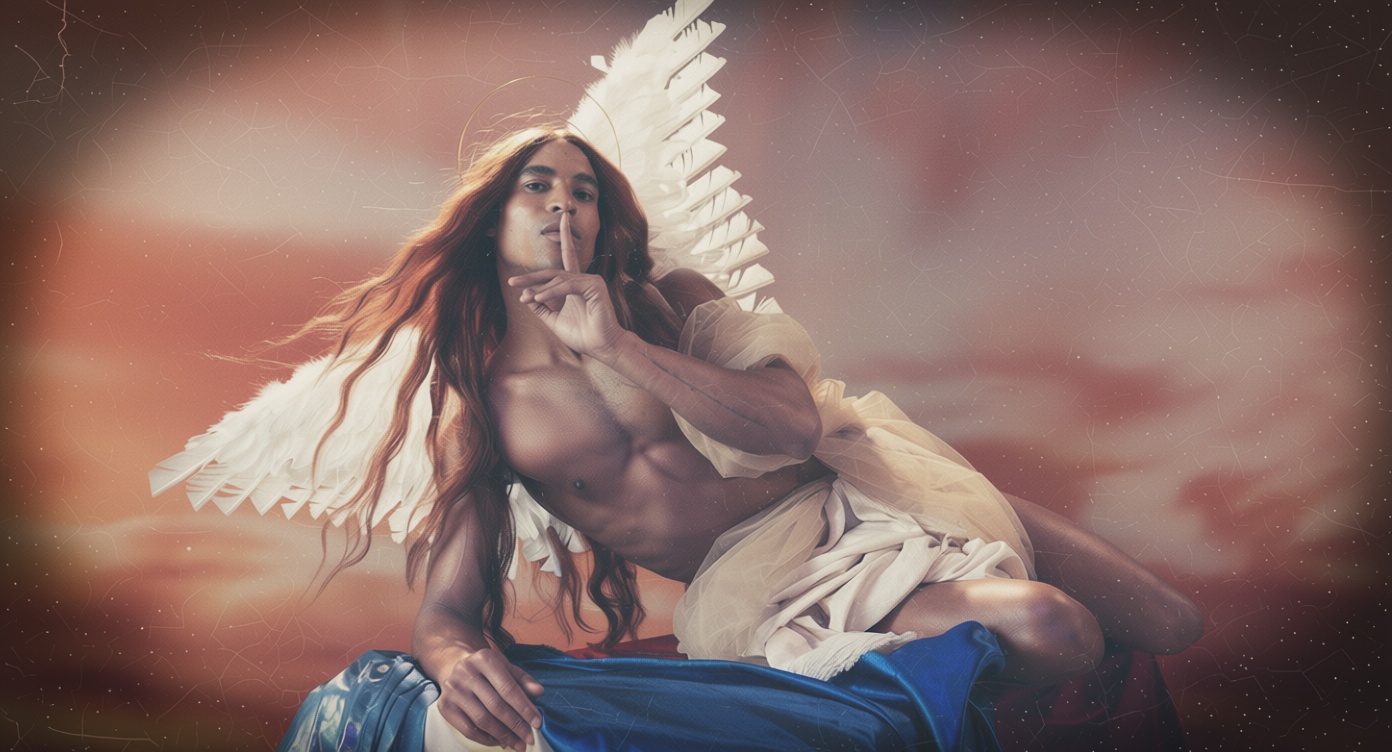
In a new Dazed Digital feature, Canadian artist Chloe Wise uses an old mystery from Basel, Switzerland, to pose a contemporary question: could UFOs actually be angels? The piece does not present the idea as a factual claim about unidentified aerial phenomena, but rather as a speculative meditation on how people across different eras interpret encounters they cannot explain. Wise’s latest show, Extrasensory, places that question at the center of a broader reflection on spirituality, perception and the language humans use to describe the unknown.
The article begins with the historical episode that continues to fascinate both theologians and UFO researchers: the 1566 reports of a “fight” between red and black spheres in the sky over Basel. At the time, many observers reportedly understood the event as a religious sign or miracle; in more recent decades, ufologists have reinterpreted it as evidence of an alien confrontation. Dazed frames both readings as products of their respective cultural moments, suggesting that the phenomenon itself may be less important than the meanings people attach to it.
Reframing the Unknown
Speaking near the gallery that hosts her exhibition, Wise argues that the core experience of witnessing something inexplicable may remain unchanged even as the vocabulary around it shifts. “It’s not the experience that changes,” she says. “It’s the words we use to describe it, and to make sense of it, that change over time.” Her comment underpins the essay’s central idea: that human beings consistently search for frameworks strong enough to contain the uncontainable, whether those frameworks are religious, scientific or technological.
Wise expands that thought by contrasting earlier spiritual interpretations with the present-day tendency to read mystery through a technological lens. “In a religious paradigm, governed by Christianity, you’re met with something ineffable and you call it an angel,” she says. “But now, we’re in a technological, post-nuclear [age]. We sent Katy Perry to space. So the way that we make sense of something unfathomable would be through a more technological lens.” The quote situates her work in a world where space travel, satellites and UAP discourse have become part of mainstream cultural conversation, even as the urge to explain the inexplicable remains deeply familiar.
Art, Faith and UAP Culture
The Basel reference is especially resonant because it bridges several interpretive traditions at once: folklore, religion, art history and modern UFO culture. Dazed notes that stories of bright lights, humanlike figures and mysterious voices have long appeared in myths and canonical religious texts, from ancient Egypt to fourth-century China and across Christianity’s own scripture. In that context, Wise’s question is less about proving a theory than about examining how belief systems shape perception. The article suggests that what one era calls an angel, another might call a UFO.
That ambiguity gives Extrasensory a distinctly contemporary edge. Rather than treating UFOs as purely extraterrestrial craft or angels as purely theological beings, the show appears to invite viewers to consider the overlap between spiritual wonder and speculative science. In doing so, Wise taps into a broader cultural moment in which interest in UAPs often intersects with questions about consciousness, faith and the limits of human knowledge.
For readers following UAP discourse, the piece is notable not for advancing evidence, but for highlighting how cultural interpretation remains central to the phenomenon. Wise’s work suggests that the real mystery may be less about what is in the sky than about how people decide what they are seeing.