
Overview
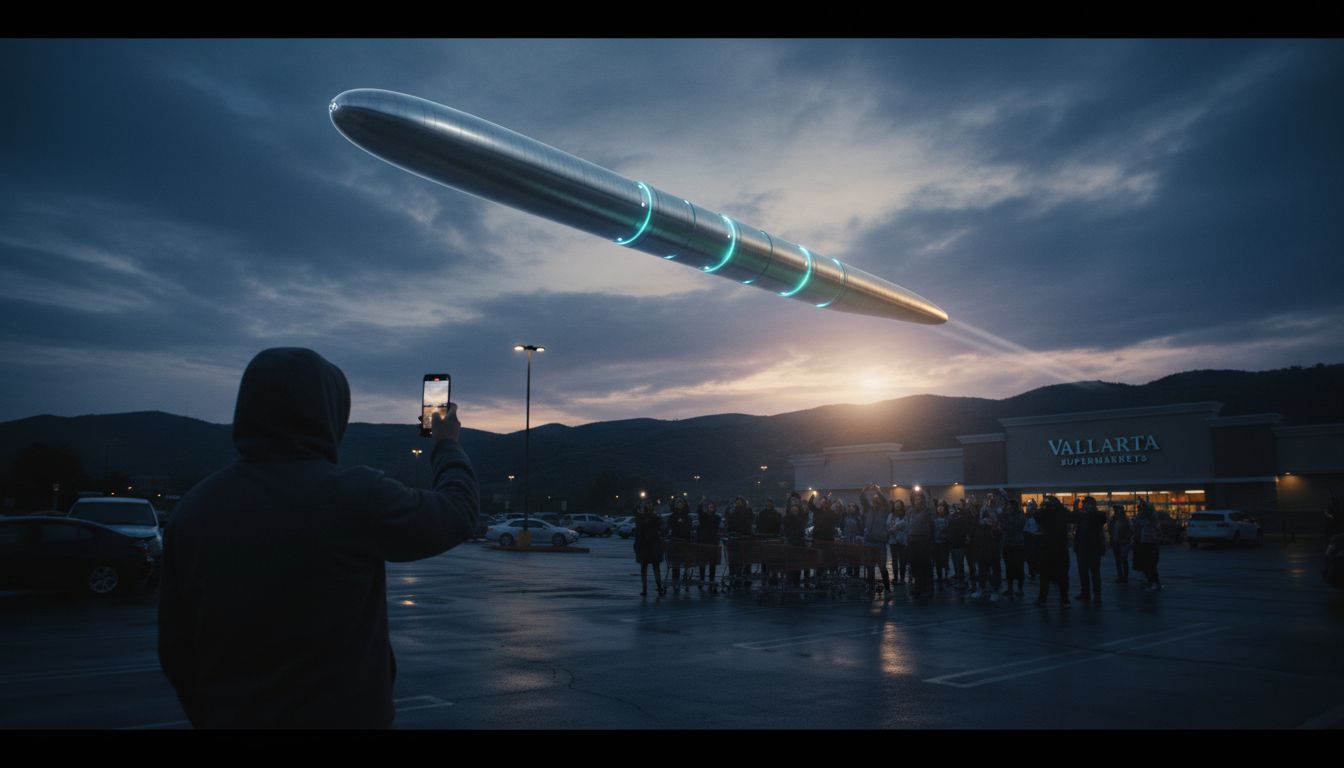
On March 14, 2025, a video captured by a local resident showed a cigar‑shaped unidentified aerial phenomenon (UAP) descending over the outskirts of Paso Robles, California. The clip, posted to a public Twitter thread and quickly circulated within the UAP‑research community, depicts the object moving from a high altitude to a lower altitude while maintaining a smooth, elongated silhouette. Although the original media file is no longer accessible online, multiple screenshots and third‑party reposts have been archived, prompting renewed discussion among both amateur investigators and professional analysts.
Incident Details
The sighting occurred at approximately 19:45 PST from a grocery store parking lot on the north side of Highway 46. According to the witness, who chose to remain anonymous for safety reasons, the object appeared as a metallic, cigar‑shaped body about 15–20 feet long, with faint illumination along its lower edge. It hovered briefly before descending at a steady rate, reaching an altitude estimated at 500 feet before disappearing behind a cluster of oak trees. The video, recorded on a smartphone, shows no visible propulsion exhaust, rotors, or conventional aircraft features, and the descent appears to be controlled rather than a free fall.
Witness Account
The recorder, identified only as “M.J., a 34‑year‑old resident of Paso Robles, recounted the event in a brief interview with local media:
“I was loading groceries into my car when I saw this strange, silver‑colored shape moving slowly across the sky. It wasn’t a drone or a plane—I could feel the air shift as it passed. I pulled out my phone and kept filming until it vanished behind the trees.”
M.J. reported that the object emitted a low‑frequency hum, audible only when the phone’s microphone was activated. No additional witnesses have come forward publicly, but a comment thread on the original tweet indicates that at least two other drivers observed the phenomenon, though they did not record it.
Context and Comparative Analysis
Cigar‑shaped UAPs have appeared intermittently in U.S. reports over the past decade, most notably the 2020 “Tic Tac” encounter recorded by Navy pilots and the 2022 “Gimbal” video released by the Pentagon. While those incidents involved high‑altitude, high‑speed maneuvers, the Paso Robles event is distinctive for its low‑altitude, controlled descent within a populated area.
Researchers at the UAP Task Force (UAPTF) have highlighted the importance of such low‑level observations, noting that they present a higher potential for interaction with civilian infrastructure. Dr. Laura Mitchell, a senior analyst at the National Institute for Aerospace Studies, commented:
“When a UAP descends into a residential zone, it raises questions about flight safety, airspace regulation, and the need for real‑time detection capabilities. Even if the object is benign, the risk to people on the ground cannot be ignored.”
The Paso Robles clip also aligns with a pattern of night‑time, elongated sightings reported across the western United States during the spring of 2025, suggesting a possible coordinated activity or a common atmospheric phenomenon yet to be identified.
Official Response
The Federal Aviation Administration (FAA) has logged the incident under report number FAAR‑2025‑0314‑PR, stating that “no known aircraft, drone, or weather balloon activity matches the description provided.” The FAA’s preliminary assessment indicated that the sighting occurred outside of controlled airspace, but the agency is coordinating with the U.S. Air Force’s All‑Domain Anomaly Resolution Office (AARO) to investigate further.
A spokesperson for the California Department of Forestry and Fire Protection (CAL FIRE) confirmed that no emergency calls or fire incidents were reported in the area at the time, and that “ground crews observed no debris or unusual activity following the reported descent.”
Next Steps
Investigators are urging anyone who captured additional footage, audio, or radar data to submit it to the AARO’s public portal. Meanwhile, local authorities plan to increase night‑time aerial monitoring over Paso Robles during the upcoming summer months, employing both ground‑based radar and infrared sensors.
The Paso Robles sighting underscores the growing need for transparent data collection and inter‑agency cooperation when dealing with UAPs that intersect civilian environments. As the investigation proceeds, both officials and the public will be watching closely for any new evidence that could clarify the nature of this enigmatic, cigar‑shaped craft.


