Overview
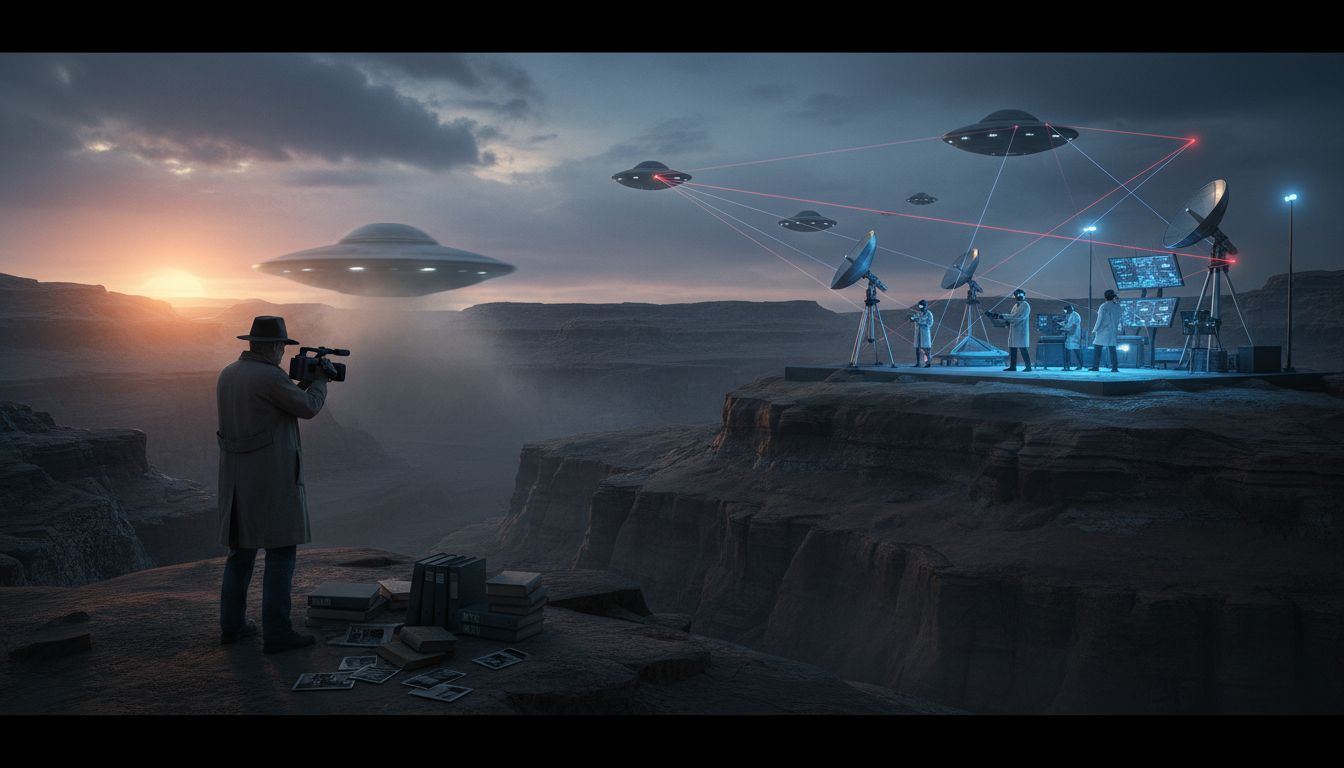
In a recent talk organized by the Human Institute and UAPMed, Michael Cifone, a philosopher of science with the Society for UAP Studies, outlined a shift in how researchers approach unidentified aerial phenomena (UAP) and non‑human intelligence (NHI). He contrasted the “classical ufology” model—largely forensic, retrospective, and reliant on eyewitness accounts—with what he described as the “emerging science of UAP,” a demonstrative effort that builds dedicated instruments, synchronizes data streams, and seeks direct observation. Cifone’s presentation, part of a series titled Investigating Non‑Human Intelligence, highlighted the need to move beyond cataloguing past reports toward a systematic, data‑driven methodology.
Epistemological Challenges
Cifone warned that the assumptions embedded in traditional natural sciences can blind investigators to the very phenomena they aim to study. He posed a provocative question: “What if the problem is not missing evidence but missing categories?” According to his framework, three interrelated issues shape the epistemic landscape:
- Evidence is not neutral – the tools and theories we employ predetermine what we can measure.
- The epistemic loop – extraordinary claims demand evidence that existing apparatuses are not designed to capture.
- Phenomena may be transient, participatory, and relational – unlike the stable, repeatable events that conventional science favors.
Cifone argues for a new kind of empiricism that blends objective instrumentation with phenomenological, first‑person experience, allowing researchers to “listen to the data” before imposing preconceived categories.
Emerging Scientific Approaches
The talk outlined concrete steps for transforming UAP research into a rigorous science. Among the proposals were:
- Building dedicated sensor networks that can capture high‑resolution, multi‑modal data in real time, moving the field from retrospective testimony to live observation.
- Professionalising forensic investigative methods, ensuring that trace evidence—such as electromagnetic anomalies or material residues—is collected and analysed with the same standards applied in aerospace or forensic labs.
- Treating humans as sensors, a concept explored by Maya Cowan, which acknowledges the reliability and limits of human perception while integrating it with instrumental data.
These initiatives echo the UAP Studies community’s focus on “local behaviours and dynamic relations,” distinguishing it from the distant, message‑oriented goals of SETI. By synchronising human reports with instrumented measurements, researchers hope to create a richer, cross‑validated dataset.
Interdisciplinary Frameworks
Cifone emphasized radical interdisciplinarity as essential for any emerging science of NHI. He cited the 6Ws Model—who, what, when, where, why, and how—as a scaffold for organizing investigations that combine physicalist research with lived experience. Phenomenologists like Kim Engels are developing methods to capture the “whole UFO experience,” integrating narrative accounts with sensor logs. This approach seeks to bridge the gap between objective data and subjective meaning, a step he believes is necessary to overcome anthropocentric bias.
Reintegrating the humanities with the natural sciences, Cifone suggested, could also expand the conceptual vocabulary needed to describe phenomena that are “participatory and relational” rather than merely external objects.
Outlook and Skepticism
While the vision is ambitious, Cifone himself questioned its feasibility, noting that many of the proposed practices remain “utopian” without sustained funding, institutional support, and methodological consensus. Nonetheless, the talk highlighted several pilot projects—such as coordinated sky‑watch networks and collaborative workshops between physicists, anthropologists, and pilots—that demonstrate the practical potential of this interdisciplinary model.
The broader scientific community continues to watch these developments closely. As Cifone concluded, “The real question is not whether non‑human intelligence exists—the universe is vast enough for that to be almost trivial. The question is whether our sciences are yet intelligent enough to perceive it.” If the emerging science of UAP can successfully integrate instruments, phenomenology, and rigorous epistemology, it may finally provide the systematic evidence that has long eluded both skeptics and believers.