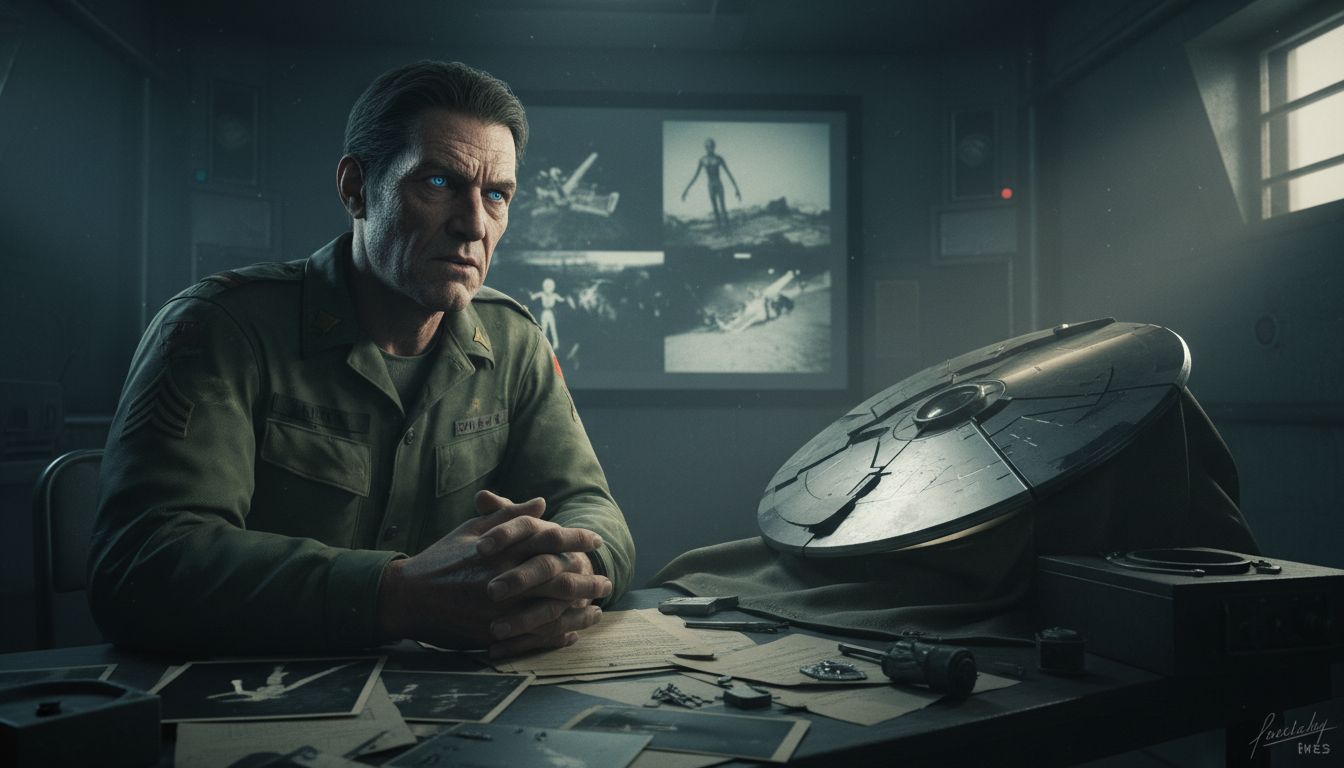
Sergeant Clifford Stone, a former member of a classified U.S. military unit tasked with unconventional aerial phenomena (UAP) investigations, recounted a series of crash‑retrieval missions and direct contacts with non‑human entities during a recorded interview conducted in July 2019 in Roswell, New Mexico. The interview, preserved in the Vortex archives and published by VibeWire Magazine on 30 October 2025, offers a rare first‑hand perspective from a veteran who claims to have participated in operations that were subsequently concealed from both the public and most senior defense officials. Stone, who passed away in 2021, described his role as part of a “rapid‑response recovery team” that was mobilized after anomalous aerial objects were reported to have impacted remote locations across the United States and allied territories.
According to Stone, the recovery teams were instructed to secure any debris and, when possible, any occupants, before the sites could be “sanitized” by a separate security element. He recalled a 2014 incident in the Nevada desert where a metallic craft, roughly the size of a small aircraft, was recovered alongside several humanoid figures described as “approximately 4 feet tall, with elongated limbs and a translucent membrane covering their heads.” Stone said the material exhibited “unusual electromagnetic properties” that interfered with standard instrumentation, prompting the involvement of a specialized scientific unit. He added, “We were told to keep quiet, not because we were scared, but because the chain of command wanted to control the narrative until a higher‑level assessment could be made.”
Stone’s testimony aligns with a growing body of declassified material and congressional hearings that have acknowledged the existence of UAPs and the challenges they pose to national security. In June 2022, the Office of the Director of National Intelligence released a preliminary assessment noting 144 incidents of unexplained aerial objects between 2004 and 2021, many of which demonstrated advanced maneuverability. While the ODNI report stopped short of confirming extraterrestrial origins, it called for greater inter‑agency coordination and transparency. Stone’s account adds a personal dimension to these official acknowledgments, suggesting that some incidents may have progressed beyond observation to physical recovery and analysis.
The interview also touched on what Stone described as a systematic “cover‑up” designed to prevent public panic and protect sensitive technology. He claimed that after each retrieval, the debris was either transferred to a secure facility at Wright‑Paterson Air Force Base or, in certain cases, to a covert laboratory operated jointly by the Department of Defense and an unnamed civilian research consortium. “The technology we saw could have revolutionized energy, propulsion, and medical fields,” Stone asserted, “but the decision was made to file it away, citing national security.” He urged current policymakers to reconsider this stance, arguing that controlled disclosure could yield scientific breakthroughs and restore public trust.
Experts caution that while Stone’s narrative is compelling, it remains anecdotal and uncorroborated by independent evidence. Dr. Laura Miller, a senior researcher at the Center for Aerospace Studies, noted, “Personal testimonies from former service members are valuable, but they must be evaluated alongside physical artifacts, documentation, and corroborating witness accounts.” Nonetheless, the interview has sparked renewed interest among legislators pushing for more comprehensive UAP reporting requirements, a movement that gained momentum after the 2023 National Defense Authorization Act mandated the establishment of an Unidentified Aerial Phenomena Task Force.
Regardless of the veracity of Stone’s specific claims, his story underscores a broader tension between secrecy and accountability within the defense establishment. As VibeWire’s coverage highlights, the push for disclosure is not merely about confirming the existence of extraterrestrials but also about assessing potential technological advantages and ensuring democratic oversight. Whether future investigations will substantiate Stone’s recollections remains to be seen, but his testimony adds a human element to the ongoing debate over how governments handle phenomena that sit at the intersection of national security, science, and public curiosity.