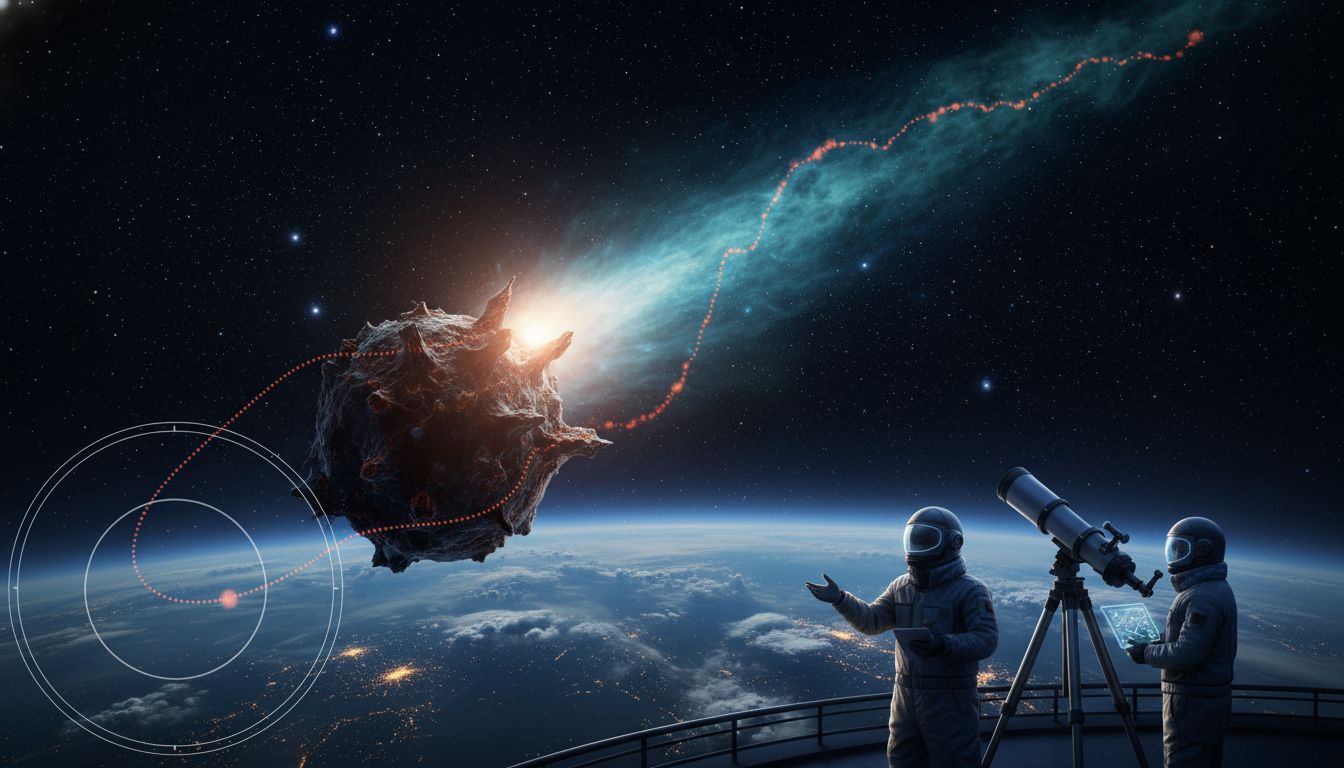
The interstellar comet designated 3I/ATLAS has emerged from behind the Sun for a second time, offering astronomers a rare window to study an object that does not belong to our solar system. The comet, first spotted in early 2024 as it raced through the inner solar system, passed perihelion in late August and is now climbing back into view from the northern hemisphere. Its trajectory, which bends sharply away from the ecliptic plane, has prompted a flurry of observations from ground‑based telescopes and from ESA’s Mars orbiters, which are now being repurposed as opportunistic comet monitors. “We are seeing a body that is moving at roughly 60 km s⁻¹ and its inbound path is unlike any known solar‑system comet,” said Dr. Elena Martinez, a senior scientist at the European Space Agency. “The fact that it is still detectable after more than a year suggests it is exceptionally large and possibly over seven billion years old, predating the formation of the Sun.”
The comet’s unusual characteristics have revived, albeit briefly, speculative chatter about extraterrestrial technology. Social media posts have likened its hyperbolic orbit to a “spacecraft,” but the scientific community has been quick to reject such notions. “We have no evidence of artificial propulsion or any anomalous emissions that would indicate a manufactured object,” explained Dr. James Patel of NASA’s Near‑Earth Object Program. “Its brightness and lack of a detectable coma are consistent with a very low‑activity, icy body that has lost most of its volatile material after a long interstellar journey.” Observations to date have not confirmed a classic cometary tail, a point noted by ESA’s Mars Express team, which has been using its spectrometer to search for water‑ice signatures. The instrument has detected faint dust scattering but no significant gas emissions, reinforcing the view that 3I/ATLAS is a “depleted” comet rather than a fresh, active one.
Scientists are also using the event to refine models of how interstellar objects interact with solar radiation and planetary atmospheres. The data collected by the Mars orbiters, combined with measurements from the Lowell Observatory’s 4.3‑meter telescope, will feed into simulations that could improve predictions for future interstellar visitors. “Every time we catch an object like 3I/ATLAS, we learn a little more about the building blocks of other planetary systems,” said Dr. Li Wei, an astrophysicist at the University of Cambridge. “It helps us test theories about the composition of protoplanetary disks beyond our own.”
While the astronomical community focuses on the comet, climate scientists are issuing a stark reminder that Earth is crossing a critical threshold. The latest report from the Intergovernmental Panel on Climate Change (IPCC) confirms that global average temperatures have now risen 1.5 °C above pre‑industrial levels, a figure once thought to be a near‑future milestone. “We have already breached the 1.5 °C limit, and the window to limit warming to 2 °C is closing rapidly,” warned Dr. Maya Rosenberg of the Climate Action Institute. The report links the temperature rise to accelerating heatwaves, sea‑level rise, and increased frequency of extreme weather events, urging immediate implementation of the emissions‑reduction pathways outlined in the Paris Agreement.
The juxtaposition of an ancient, silent wanderer from beyond our solar system and the pressing urgency of a warming planet underscores how humanity’s gaze can be split between the cosmos and our own fragile environment. As 3I/ATLAS continues its outbound trek, astronomers will keep a vigilant eye on its faint glow, hoping to extract every possible clue about the universe’s distant past. Meanwhile, policymakers and citizens alike are being called upon to translate climate science into decisive action before the next threshold is crossed. The dual narratives—one of interstellar curiosity, the other of planetary stewardship—serve as a reminder that while we look outward for answers, the most consequential challenges may still be right here on Earth.