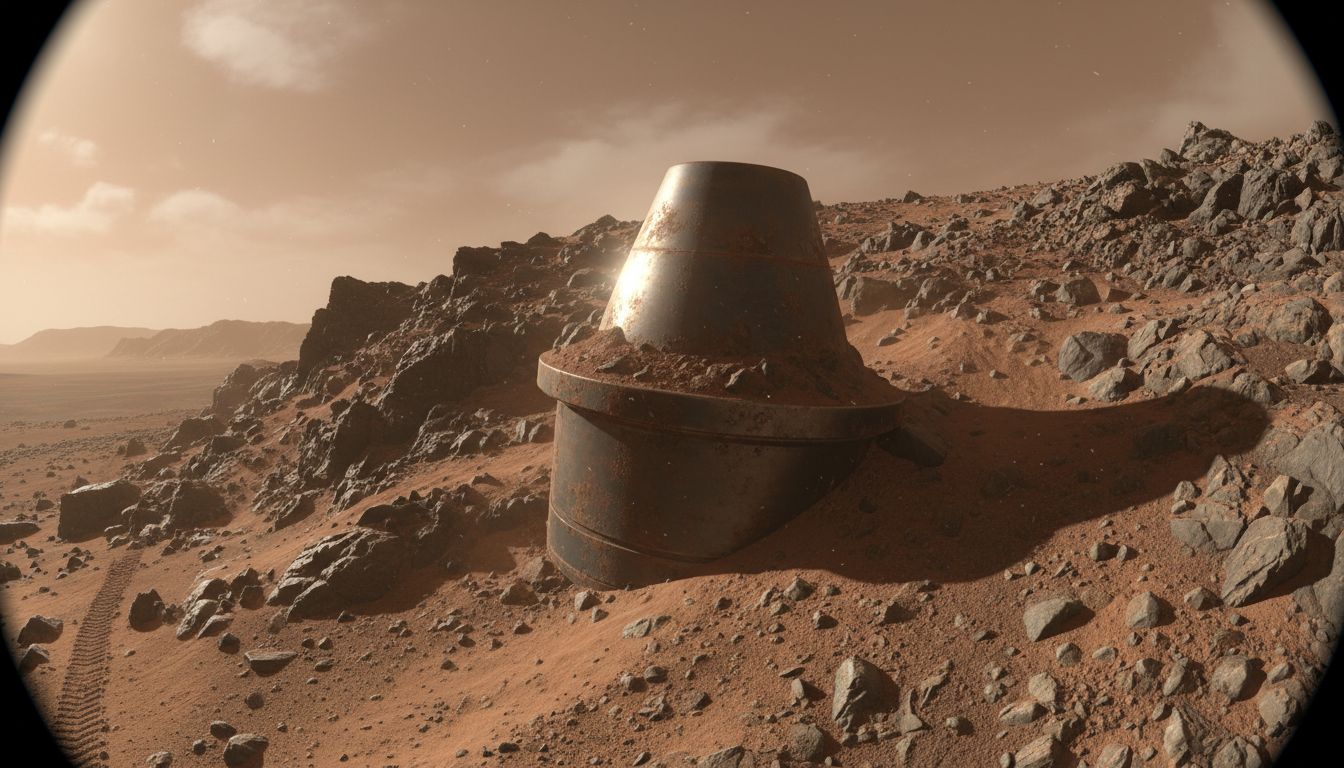
An image taken by NASA’s Curiosity rover on Martian sol 3556—roughly 9 years into its mission—has resurfaced on the r/UFOs subreddit, prompting renewed debate among amateur researchers and UFO enthusiasts. The photograph shows a small, sharply defined object that resembles a cone or short cylinder, half‑buried in a sloping rock outcrop on the rover’s traverse near the “Mojave” area of Gale Crater. The feature’s straight edges and regular geometry contrast with the surrounding basaltic debris, leading some observers to label it an “out‑of‑place artifact” (OOPA) and to speculate about possible extraterrestrial origins, such as debris from an unidentified aerial phenomenon (UAP) or remnants of a hypothetical ancient base.
NASA’s Jet Propulsion Laboratory, which operates Curiosity, has not issued an official comment on the specific image, but mission scientists routinely assess unusual formations as part of routine geological surveys. Dr. Maria K. Liu, a planetary geologist at JPL who has worked on Curiosity’s imaging team, explained that “Mars is a highly eroded landscape where wind, water, and impact processes can produce surprisingly regular shapes. When we see something that looks too angular, the first step is to compare it with known rock types and erosional patterns.” She added that similar “cone‑shaped” structures have been documented on Earth as volcanic plugs or concretions, and that the thin dust coating on the Martian object could be a result of aeolian deposition rather than any artificial construction.
The discussion echoes earlier episodes in Mars media coverage, most notably the 2021 “Tic‑Tac” anomaly captured by the Perseverance rover’s mast camera. Initial speculation linked that bright, rectangular object to a possible UAP, but subsequent analysis identified it as a small, 9 mm metallic fragment likely dislodged from the rover itself. “That episode reminded the community that not every oddity is evidence of technology,” noted Dr. Elena Rossi, a senior researcher at the University of Arizona’s Lunar and Planetary Laboratory. “It underscores the importance of rigorous peer‑review and the need to rule out instrument artifacts before invoking extraterrestrial explanations.”
Amateur forums have already begun dissecting the cone image, with some participants pointing out its proximity—over 30 kilometres—from any of the known landing sites of past missions, arguing that this makes a human‑made debris hypothesis “improbable.” Others counter that rover‑generated debris can travel significant distances via dust storms, a process documented in several studies of Martian aeolian transport. The Reddit user who originally posted the photo, identified only as u/fd40, wrote, “The shape is too perfect to be a rock; it looks engineered.” In response, a moderator on the same subreddit reminded members, “We have to be careful not to let excitement override scientific method.”
While the cone’s origin remains unresolved, the episode illustrates the continuing public fascination with potential signs of life beyond Earth and the challenges of interpreting limited visual data from another planet. As Curiosity continues its trek toward the “Murray Buttes” region, mission scientists will likely revisit the site with higher‑resolution imaging and perhaps spectroscopic analysis, which could determine the object’s composition. Until then, the scientific community remains cautious, emphasizing that “extraordinary claims require extraordinary evidence,” a principle that guides both planetary geology and the broader search for extraterrestrial life.