Overview
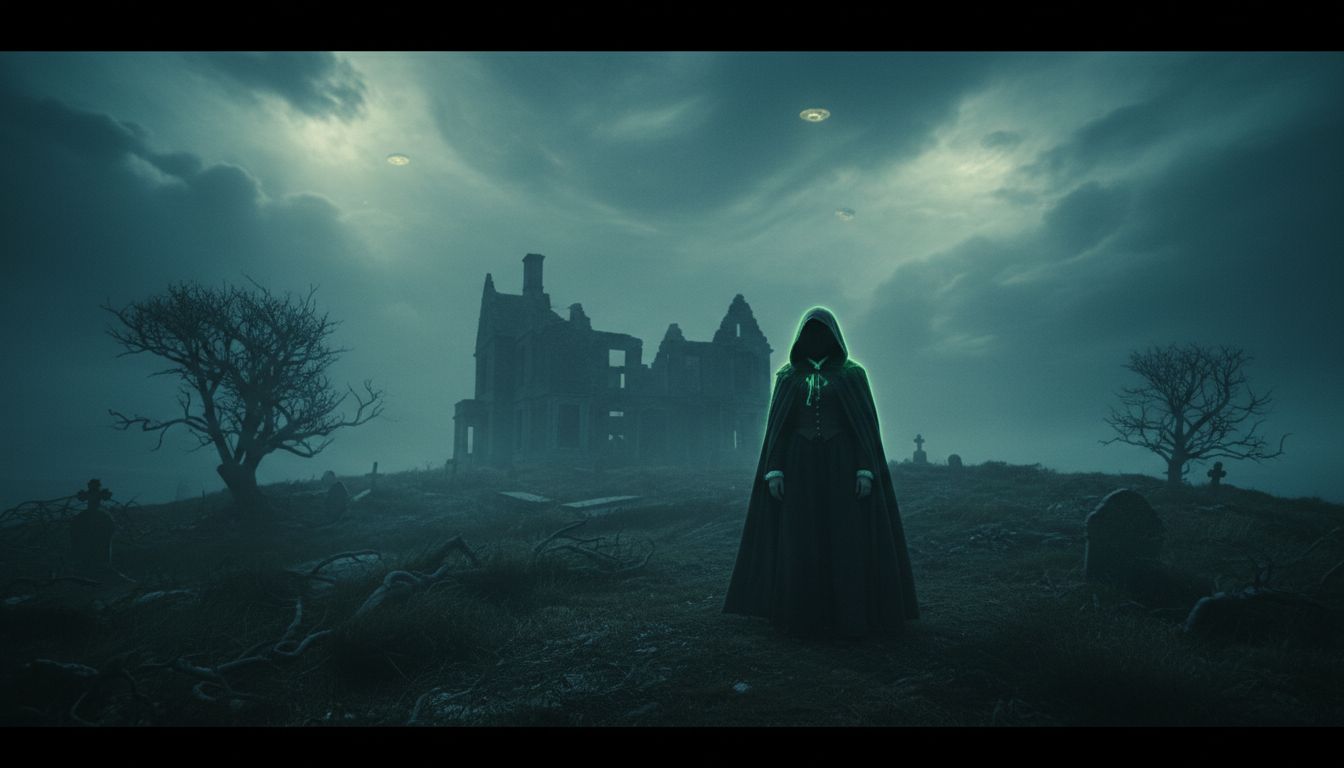
In Dublin’s historic Liberties district, a pale figure draped in green light is said to glide along the stone steps of St Audoen’s Church. Locals refer to the apparition as the Green Lady, a ghost story that has endured for more than two centuries. The spirit is traditionally linked to Dorcas “Darkey” Kelly, an 18th‑century innkeeper and brothel madam whose 1760 execution for murder and alleged witchcraft sparked a blend of fact, folklore, and political intrigue. Recent scholarship revisits contemporary court records, newspaper accounts and the social climate of Georgian Dublin to determine whether Kelly was a victim of misogynistic persecution, a participant in the city’s illicit underworld, or the subject of later myth‑making.
Historical Context and Life of Darkey Kelly
Dorcas Kelly operated the Maiden Tower brothel on Fishamble Street, a bustling thoroughfare near Dublin’s commercial centre. Contemporary city directories list her as the proprietor of a “public house” that catered to sailors, tradesmen and, according to later accounts, members of the secretive Hell‑fire Club—a gathering of aristocrats and officials known for blasphemous revelry and rumored occult practices. One of the club’s most prominent figures, Simon Luttrell, the Sheriff of Dublin, was reputed to frequent Kelly’s establishment and was nicknamed “King of Hell.”
While no surviving ledger confirms the exact clientele, the convergence of a high‑profile magistrate and a women‑run brothel created a volatile mix in a society where women in the sex trade were already stigmatized. Historians such as Dr Eileen O’Connor of Trinity College note that “the overlap of political power and illicit commerce made figures like Kelly easy targets for moral panic and legal exploitation.”
Trial, Conviction and Execution
In early 1760 Kelly was accused of murdering a local shoemaker, John Dowling, a charge that carried the death penalty. The trial, recorded in the Dublin Gazette of January 1760, presented scant forensic evidence; the prosecution relied heavily on testimonies from rival innkeepers and a few “respectable” witnesses who claimed to have seen Kelly with a knife.
The jury returned a guilty verdict, and the sentence was carried out on 7 January 1760 at St Stephen’s Green. An eye‑witness account by the English publisher Edward Cave, reproduced in his 1773 memoir, describes the grisly method:
“She was placed on a stool… the rope was burnt, and she sunk till the chain supported her… the flame being furious, she was soon consumed.”
The description highlights a hybrid execution—partial hanging followed by burning—commonly reserved for those convicted of witchcraft rather than ordinary homicide. This procedural anomaly has fueled speculation that the charge of murder was a pretext for a witch‑hunt motivated by Kelly’s alleged knowledge of the Hell‑fire Club’s clandestine rites.
Post‑Execution Folklore and the Green Lady
After Kelly’s death, a group of former sex‑workers reportedly retrieved fragments of her remains and held a wake in Copper Alley. The gathering was swiftly broken up, and the thirteen women were sentenced to Newgate Prison for “disorderly conduct.” The episode entered contemporary pamphlets as a cautionary tale of “wicked women defying divine law.”
Over the ensuing decades, oral tradition transformed Kelly into a spectral figure. By the 19th century, travel guides described a green‑clad apparition haunting the stairwell beneath St Audoen’s, a detail absent from any 18th‑century source. Folklorist Seán Murphy argues that the colour green—long associated with Irish folklore’s “fairy folk” and with the “green lady” archetype—was grafted onto Kelly’s story to make it more marketable to tourists and local storytellers.
Separating Fact from Myth
Modern researchers stress that the narrative linking Kelly to the Hell‑fire Club and to serial killings is largely speculative. No court documents name Luttrell as a co‑conspirator, and the alleged infanticide claim appears only in 19th‑century sensationalist broadsheets. The conflation of murder, witchcraft, and occult affiliation reflects broader gendered anxieties of the period: women who wielded economic independence and interacted with powerful men were often portrayed as morally corrupt and supernatural threats.
Professor Micheál Doyle of University College Dublin summarizes the consensus: “Darkey Kelly’s execution was a product of its time—an intersection of criminal law, misogyny, and the fear of hidden societies. The later ghost story is a cultural overlay that tells us more about Dublin’s fascination with the macabre than about Kelly herself.”
Conclusion
The legend of the Green Lady endures as a compelling piece of Dublin’s paranormal tourism, yet the historical record paints a more nuanced portrait of Dorcas Kelly: a businesswoman navigating a hostile social landscape, a victim of a legal system that could weaponize witchcraft accusations, and a figure whose memory was reshaped by successive generations. While the green‑lit specter may continue to drift through the Liberties, the truth lies in the documented trial, the political power plays of the era, and the enduring tendency to mythologize women who defied conventional roles.