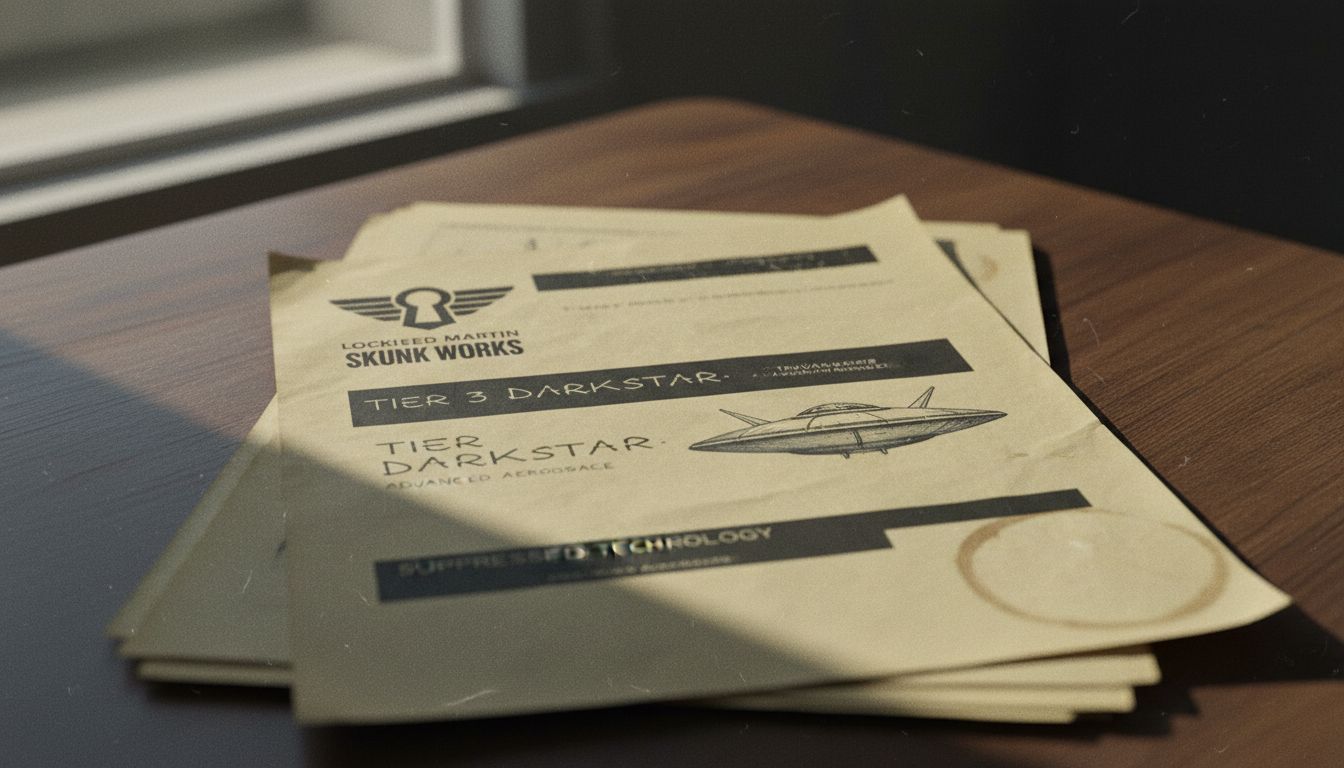
Document Puts “Tier 3-Dark Star” in Skunk Works History
A publicly available Lockheed Martin Skunk Works paper places the Tier 3-Dark Star alongside some of the company’s most prominent aircraft-development programs, including the U-2, SR-71 Blackbird and F-117. The document, titled Skunk Works Lessons Learned, was authored by Leland M. Nicolai of Lockheed Martin Skunk Works and presented at an AGARD symposium in Drammen, Norway, from Sept. 22 to 25, 1997.
The 11-page paper is hosted in the NATO Science and Technology Organization’s public publications archive as part of AGARD Conference Proceedings 602. Although it is sometimes described online as a “declassified Lockheed Martin document,” the available source identifies it as a conference paper rather than a separately released intelligence file. Its publication in a public archive confirms that the material is accessible, but does not by itself establish that every design detail associated with the program was previously classified or suppressed.
The Skunk Works Development Model
Nicolai’s paper focuses primarily on the management principles developed by Clarence “Kelly” Johnson, the founder of Skunk Works. It argues that the organization’s success came not only from advanced engineering, but also from an operating model built around small teams, rapid decision-making and limited bureaucracy.
“The Skunk Works has demonstrated a unique ability to rapidly prototype, develop and produce a wide range of highly advanced aircraft,” the paper states. It identifies the P-80, U-2, F-104, SR-71, F-117, YF-22 and Tier 3-Dark Star as examples of programs that used breakthrough technology to achieve new levels of performance.
The document also summarizes Johnson’s well-known operating rules. These included giving a program manager broad authority, maintaining small customer and contractor teams, limiting the number of personnel connected to a project, simplifying drawing and approval systems, minimizing routine reports and conducting regular cost reviews. According to the paper, such measures allowed Skunk Works teams to develop sophisticated aircraft quickly and at comparatively low cost.
What the Reference Says—and Does Not Say
The DarkStar reference has attracted interest because of descriptions circulating online that characterize the aircraft as a “saucer with wings” and connect it to claims about hidden or suppressed aerospace technology. However, the excerpt provided from the paper does not use that phrase, nor does it describe an unconventional saucer-shaped propulsion system. Instead, the aircraft is mentioned briefly as one of several Skunk Works achievements.
DarkStar was publicly associated with an advanced unmanned reconnaissance-aircraft effort conducted by Lockheed Martin and Boeing in the 1990s. The program’s designation, commonly rendered as Tier III Minus DarkStar or RQ-3 DarkStar, referred to a high-altitude, low-observable unmanned aircraft concept. Its inclusion in a discussion of Skunk Works methods demonstrates that the company considered the program part of its advanced-development legacy, but it does not independently verify claims that the aircraft incorporated exotic propulsion or nonconventional physics.
Significance and Remaining Questions
The paper is valuable primarily as a first-person account of how Skunk Works organized complex aerospace projects. It offers historical context for the company’s role in classified and highly sensitive military aviation while illustrating the practical principles—small teams, rapid prototyping and strict cost control—that shaped its programs.
No evidence in the cited document establishes a connection between DarkStar and extraterrestrial technology, antigravity propulsion or a deliberate technology-suppression campaign. Those interpretations go beyond the text currently available. Further assessment would require examining the document’s figures, related program records and contemporaneous technical sources rather than relying on later descriptions of its alleged shape or capabilities.