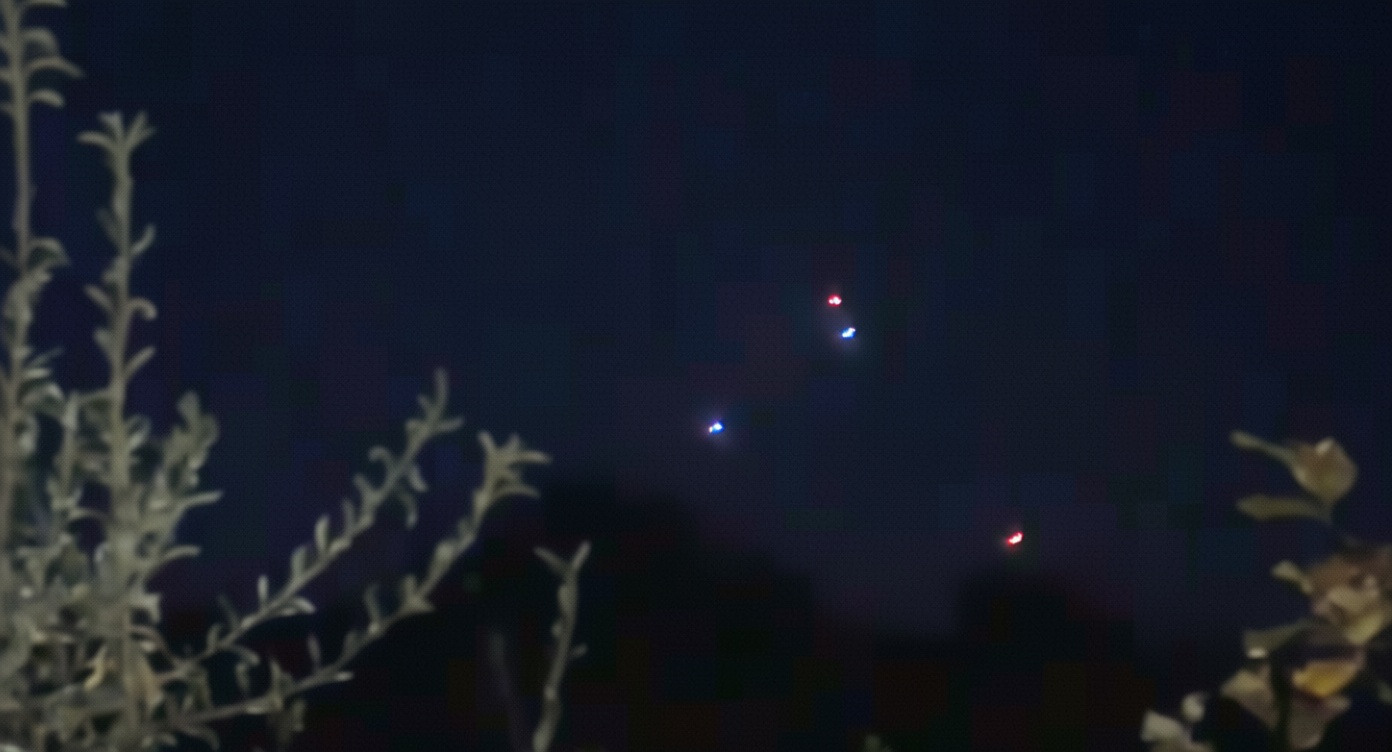
Recent weeks have seen a surge of reports describing unidentified aerial phenomena that share striking similarities with the “drone waves” documented by U.S. defense officials in 2024. Witnesses across several states have described clusters of orb‑like objects moving in tight, coordinated formations, executing rapid accelerations, and disappearing from radar screens despite being observed visually. In one incident near a Midwestern nuclear power plant, a group of pilots reported a series of luminous spheres that hovered, split into multiple vectors, and then vanished within seconds, leaving no trace on the facility’s air‑traffic surveillance. The pattern of behavior—tight formation, high maneuverability, and radar evasion—mirrors the anomalous incursions that the Pentagon labeled “unidentified aerial phenomena” (UAP) in its 2024 annual report, which warned of potential foreign surveillance technologies targeting critical infrastructure.
The Department of Defense’s UAP Task Force, now operating under the All‑Domain Anomaly Resolution Office, has not yet identified the source of these recent sightings. In a briefing last month, Deputy Assistant Secretary of Defense for Intelligence, Dr. Laura Kelley, noted that “the characteristics we are seeing—especially the ability to operate below conventional radar thresholds while maintaining precise formation—are consistent with capabilities that exceed known U.S. platforms.” She added that the agency is reviewing data from both civilian reports and classified sensor feeds to determine whether the objects could represent advanced foreign unmanned systems, such as hypersonic drones being tested by near‑peer competitors, or something that falls outside current technological understanding.
Academic experts caution against jumping to conclusions. Professor Michael Hernandez, a senior researcher at the Institute for Aerospace Studies, emphasized that “historically, many UAP reports have later been explained by novel but terrestrial technologies, ranging from high‑altitude balloons to experimental aircraft.” Nonetheless, he acknowledged that the specific combination of visual brightness, silent propulsion, and abrupt radar disappearance observed in the latest cases is “unusual enough to merit rigorous, multidisciplinary investigation.” Hernandez’s team is collaborating with the National Institute of Standards and Technology to develop a framework for systematically cataloguing these events, integrating eyewitness testimony, electromagnetic signatures, and satellite data.
The broader context of these sightings underscores a growing tension between national security and scientific inquiry. Since the release of the 2024 “UAP Threat Assessment,” Congress has authorized increased funding for sensor upgrades at critical sites, including nuclear facilities, to better detect low‑observable objects. At the same time, civilian organizations such as the Mutual UFO Network (MUFON) have reported a 27 % rise in submissions of similar orb‑type phenomena over the past twelve months. While some analysts argue that the uptick reflects heightened public awareness and reporting, others warn that adversarial actors could be exploiting this ambiguity to mask reconnaissance missions, leveraging the public’s fascination with UFOs as a form of strategic camouflage.
As the investigation proceeds, officials stress the importance of maintaining a balanced perspective. The Office of the Director of National Intelligence’s recent statement reiterated that “unidentified does not equal extraterrestrial,” but also affirmed that “any technology capable of evading our detection systems and operating near critical infrastructure warrants thorough scrutiny.” Until conclusive evidence emerges—whether confirming a foreign drone program, a new class of atmospheric sensor, or an as‑yet‑unexplained phenomenon—the episode serves as a reminder that the skies above sensitive sites remain a contested domain, demanding both vigilant security measures and open‑minded scientific analysis.