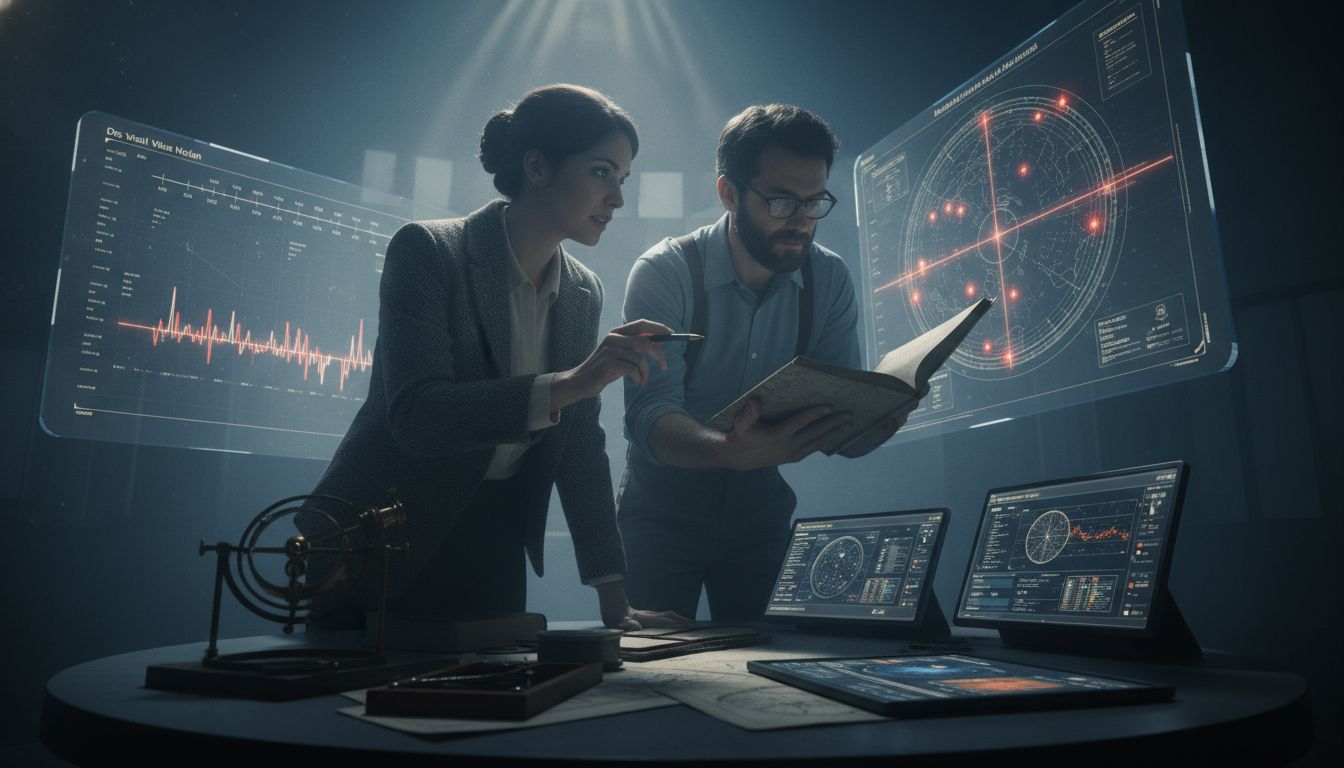
In a recent session of the Soul Forum, a digital gathering focused on the scientific and cultural dimensions of unidentified anomalous phenomena (UAP), two leading researchers—Dr. Beatriz Villarroel and Dr. Garry Nolan—delved into compelling evidence that challenges conventional narratives about the origins of mysterious objects observed in Earth’s orbit. The discussion revolved around Dr. Villarroel’s pioneering research, which suggests that UAP-like objects were detected in space long before the advent of satellite technology, raising provocative questions about their potential non-human origin.
Dr. Villarroel, an astronomer and visiting professor at the Nordic Institute of Theoretical Physics at Stockholm University, leads the Vanishing and Appearing Sources during a Century of Observations (VASCO) project. Her work focuses on “transients”—astronomical objects that appear and disappear in historical sky surveys. Through meticulous analysis of archival data, particularly from the US Naval Observatory catalog dating back to the 1950s, she has sought to determine whether stars or other celestial objects can simply vanish without an obvious natural explanation, such as a supernova.
The research began as a creative curiosity for Dr. Villarroel during her PhD studies, inspired by a fictional story she wrote about a disappearing quasar. This led her to a fundamental question: Can a star or other object truly vanish, and has anyone systematically searched for such occurrences? Upon discovering extensive historical sky catalogs, Dr. Villarroel launched a pilot study with the help of students, combing through tens of thousands of possible candidates. The team cross-referenced old catalogs with modern surveys, such as Pan-STARRS and the Sloan Digital Sky Survey (SDSS), ultimately narrowing their focus to 24,000 potential transient objects and identifying 100 cases where objects appeared or vanished in a single photographic plate exposure.
Notably, Dr. Villarroel and her colleagues observed that some of these transients in orbit predate the launch of artificial satellites, which began with Sputnik in 1957. “If these objects really were satellites, they should not have existed in the era before we had the technology to put them there,” Dr. Nolan remarked during the forum. The implication is that either natural explanations remain undiscovered, or these objects could represent something entirely different, possibly linked to non-human technological activity.
The research intersects with broader debates on “technosignatures”—indicators of advanced technology beyond Earth—and the search for extraterrestrial intelligence. Dr. Villarroel’s work stands out for its rigor and its willingness to investigate overlooked data, challenging her peers to reconsider assumptions about both technological artifacts in space and the limitations of historical astronomical records. As Dr. Nolan noted, “This is cutting-edge research that forces us to ask uncomfortable but necessary questions about the history of our skies.”
With ongoing studies and upcoming presentations—including a symposium in Italy later this year—the VASCO project continues to attract attention within the scientific community. By bringing together historical inquiry, advanced data analysis, and open-minded skepticism, Dr. Villarroel and her team are pushing the boundaries of what is known—and what is possible—regarding unexplained phenomena above our planet.