Overview
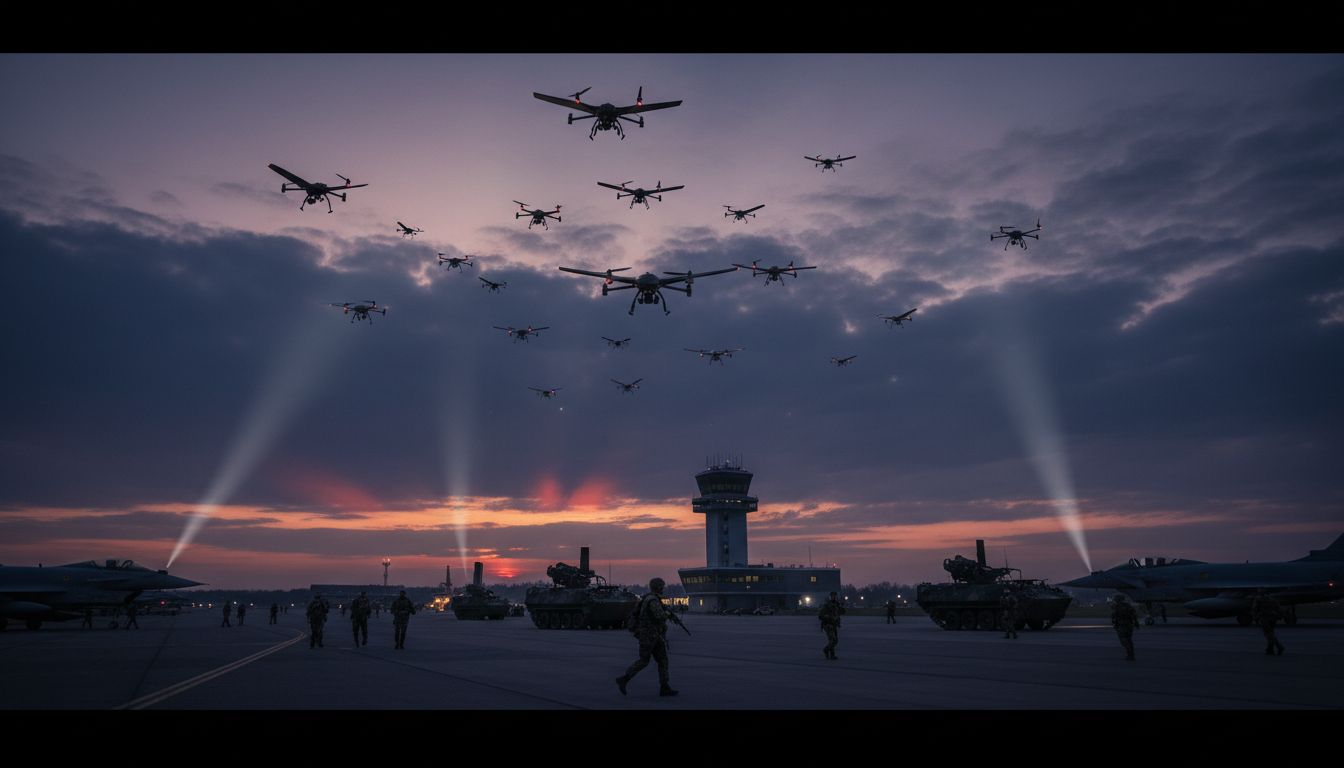
In the early hours of February 1, 2026, personnel at the Immelmann‑Kaserne, a Bundeswehr airfield in Lower Saxony, reported a drone alarm after 23 unidentified aerial devices were observed hovering over the installation for several hours. The sighting prompted the activation of the base’s air‑defence protocols, but none of the drones were intercepted or forced to land. The incident continued into the following day, with additional sightings reported despite ongoing counter‑drone measures, raising questions about the effectiveness of Germany’s military readiness against unmanned‑air‑system threats.
Timeline of the Incident
At approximately 02:15 CET on February 1, radar operators at the Immelmann‑Kaserne detected an anomalous cluster of small, low‑altitude objects approaching the perimeter. Visual confirmation by ground crews identified 23 drones maintaining a stationary position roughly 500 metres above the runway. The devices remained in place for more than three hours, during which time the base’s air‑traffic control was forced to suspend flight operations.
By 06:00 CET, the Bundeswehr’s Joint Air Defence Command (JADOC) had been alerted, and fighter jets were scrambled to the vicinity. However, the drones exhibited minimal maneuverability and did not respond to electronic jamming attempts. By 08:30 CET, the aircraft returned to base without having engaged the objects.
On February 2, the same area experienced re‑sightings of several of the original drones, as well as a few additional ones. Despite renewed deployment of counter‑drone assets—including portable radar, radio‑frequency jammers, and a ground‑based laser system—none of the devices were compelled to descend or be captured.
Military Response
A spokesperson for the Bundeswehr’s Cyber‑ and Information Domain Service (CIDS), Lt. Col. Markus Hintermann, stated: “Our standard operating procedures were fully executed. The drones were identified, tracked, and subjected to all available electronic‑countermeasure tools, yet they remained airborne.” He added that the failure to force a landing does not necessarily indicate a technical shortfall, but rather reflects the rapid evolution of commercial‑grade drone capabilities, which can now evade many traditional defence systems.
The incident prompted an internal review ordered by the Federal Ministry of Defence. The review will assess sensor coverage, rules of engagement for unmanned threats, and the integration of emerging technologies such as AI‑driven detection algorithms and high‑energy laser weapons. Preliminary findings are expected within the next two weeks.
Security Implications
Analysts at the German Institute for International and Security Affairs (SWP) warn that the Immelmann‑Kaserne event underscores a growing vulnerability of military installations to low‑observable, inexpensive drones. “When a single, coordinated swarm can linger over a strategic airfield for hours without being neutralised, it challenges the very premise of air‑space sovereignty,” said Dr. Sabine Klein, senior fellow at the institute.
The incident also fuels broader concerns about potential espionage or sabotage. While no payloads were recovered, the prolonged presence of the devices could have enabled high‑resolution imaging of aircraft, ground equipment, and personnel movements. The lack of a decisive response may embolden hostile actors to test similar tactics against other NATO facilities.
Outlook
In the wake of the drone alarm, the German armed forces are accelerating plans to modernise their counter‑UAS (Unmanned Aerial System) architecture. The Defence Ministry has earmarked €150 million in the 2026‑2027 budget for next‑generation radar, directed‑energy weapons, and a centralised command‑and‑control hub to coordinate civilian and military air‑space monitoring.
Meanwhile, the European Defence Agency (EDA) is reviewing the incident as part of a continent‑wide effort to standardise drone‑threat protocols among member states. As the investigation proceeds, officials stress that the Immelmann‑Kaserne episode serves as a critical learning point rather than an isolated security breach, prompting a recalibration of both tactical responses and strategic policy on unmanned aerial threats.