Overview
The disused East Side Train Tunnel beneath College Hill in Providence has shifted from a relic of early‑20th‑century rail infrastructure to one of the city’s most talked‑about paranormal sites. Built in 1906 to connect the downtown station with the burgeoning East Side neighborhoods, the tunnel was sealed after a 1981 safety inspection deemed it too costly to maintain. In the two decades since its closure, the dark, graffiti‑scarred passage has become a magnet for ghost tours, urban‑legend enthusiasts, and occasional reports of unsettling activity, including alleged satanic ritual sightings and “frightening encounters” that local media have begun to document.
Historical Context
The tunnel was part of the Providence and Worcester Railroad’s ambitious expansion, intended to alleviate street‑level congestion and provide a faster link for commuters and freight. Original engineering plans, archived at the Rhode Island Historical Preservation Commission, describe a 1,200‑foot brick‑lined conduit with ventilation shafts that once hummed with the clatter of steam locomotives. When the Providence Department of Transportation ordered its closure in 1981, citing structural deterioration and declining ridership, the tunnel was sealed with concrete caps and the surrounding land was repurposed for parking and a small community garden.
Despite its official abandonment, the tunnel’s physical presence remained evident: the iron grates on Oak Street and the faint echo of wind through the sealed portals kept the space in the public imagination. “It’s a piece of Providence’s industrial DNA,” says Dr. Emily Rivera, professor of urban history at Rhode Island College. “Even when it’s not in use, the tunnel shapes the way the neighborhood feels, especially after dark.”
Emergence of Ghost Tours
In 2005, a local entrepreneur, Mark “Mickey” O’Leary, launched the first organized “East Side Specter Walk,” marketing the tunnel as a “living museum of the city’s hidden past.” The tours, which combine historical narration with staged lighting effects, quickly gained traction on social‑media platforms such as TikTok and Instagram, where videos of participants’ startled reactions amassed thousands of views.
O’Leary emphasizes that the tours are “entertainment rooted in documented history.” He points out that many of the stories shared with visitors—such as the 1923 disappearance of a night watchman who allegedly vanished near the tunnel’s western portal—are drawn from newspaper archives. Yet, the commercial success of the tours has also amplified anecdotal claims that lack corroboration, including accounts of chanting voices and symbols painted on the tunnel walls that some visitors interpret as evidence of occult activity.
Reported Encounters
Since the tours began, several visitors have filed police reports describing unsettling experiences. In a June 2023 incident, a group of college students reported hearing “low, guttural chanting” near the tunnel’s southern vent, followed by a sudden drop in temperature of roughly 15 °F. Providence police logged the complaint but noted that “no physical evidence of a ritual was found at the site.”
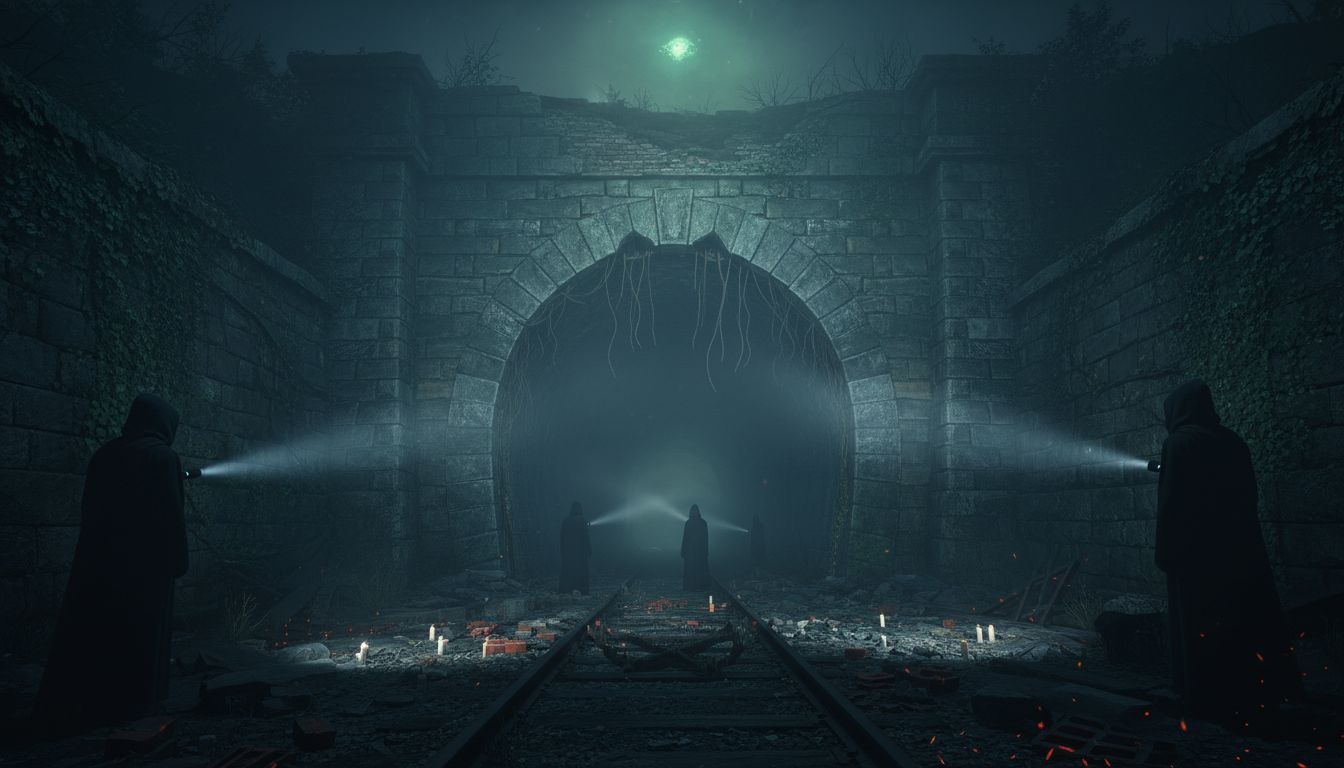
Another well‑circulated claim involves a 2019 sighting of a figure in a dark hooded robe standing at the tunnel’s entrance, allegedly holding a candle before disappearing into the darkness. Detective Laura Chen, who handles the city’s “unusual reports” unit, says, “We treat every call seriously, but so far, investigations have not produced tangible proof of illicit activity.”
Folklorist Samuel Ortiz, who studies New England supernatural traditions, cautions against conflating urban legend with fact. “The tunnel fits a classic pattern: an abandoned industrial space becomes a canvas for community fears and imagination,” he explains. “Stories of satanic rituals often surface in places that feel inaccessible, reinforcing a narrative of the unknown.”
Community Response
Local officials remain divided. Providence’s Office of Cultural Heritage has expressed interest in preserving the tunnel as a historical site, proposing a “guided heritage program” that would replace the more sensational tours with educational walks focused on the city’s rail history. Conversely, the College Hill Neighborhood Association has raised safety concerns, urging the city to improve lighting around the tunnel’s access points and to increase patrols after several trespassing incidents.
Mayor Jenna Morales addressed the issue at a recent town hall, stating, “We respect the public’s fascination with our city’s past, but we also have a responsibility to ensure safety and to protect our heritage from distortion.” She announced a feasibility study to determine whether the tunnel could be partially reopened for controlled public access, balancing historical preservation with the community’s desire for responsible tourism.
As the dialogue continues, the East Side Train Tunnel remains a symbolic crossroads—where Providence’s industrial legacy meets contemporary folklore, and where the line between documented history and speculative myth is constantly renegotiated.


