Overview
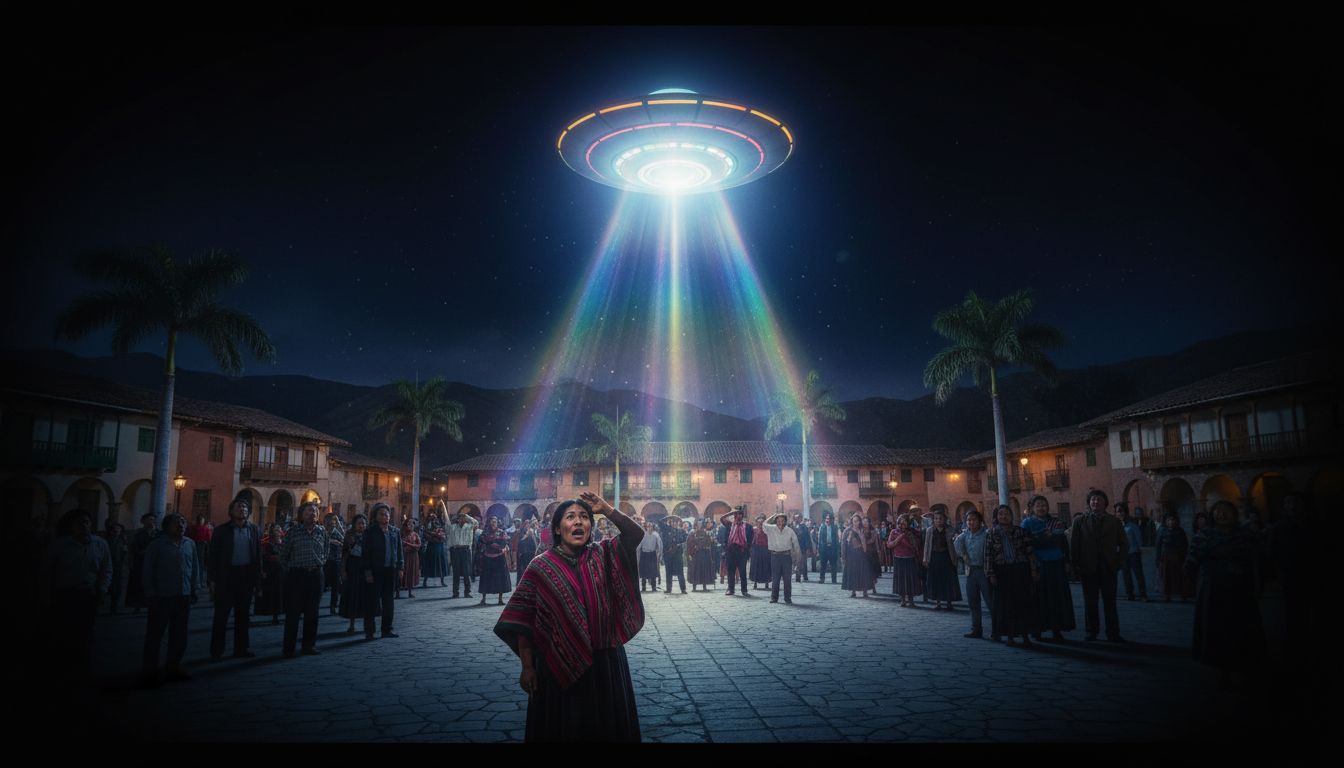
In the late evening of July 23, 1978, residents of Torata, a small town in the Moquegua region of southern Peru, reported a sudden, daylight‑bright illumination that filled the central plaza. According to multiple testimonies collected decades later, the light originated from a circular, saucer‑shaped object that hovered for a few moments before accelerating upward and disappearing at high speed. The event has since become a staple of local folklore and is frequently cited alongside the nearby “Misterio del Cerro Baúl,” a series of unexplained aerial phenomena recorded in the same area during the 1970s.
Eyewitness Account
One of the most detailed recollections comes from Mercedes Gómez, a lifelong Torata resident who was 12 years old at the time. She told investigators that the object emitted “a white light as bright as day, with flashes of red, green and blue that seemed to pulse from the rim of the disc.” Mercedes recalled the crowd’s reaction: “Everyone stopped talking, some children began to cry, and the elders raised their hands as if in prayer.” The object remained stationary for roughly 45 seconds, then shot upward with a “sharp, whistling sound” and vanished from view. Her testimony was later corroborated by three other locals who were present in the plaza that night.
Regional Context
Torata lies about a 45‑minute drive from the historic site of Cerro Baúl, a pre‑Inca fortress that has been the focus of UFO reports since the early 1970s. Between 1974 and 1979, at least six separate sightings of luminous, disc‑shaped craft were logged by villagers, farmers, and occasional military patrols operating in the high Andes. Researchers from the Peruvian Institute of Aeronautics (IPER) noted a pattern: sightings often occurred on clear nights, involved intense illumination, and were followed by brief, rapid ascents. While the institute never released an official conclusion, its archival memo from 1980 classified the Torata incident as “unexplained aerial phenomenon (UAP) – pending further analysis.”
Investigation and Official Response
The 1978 incident was not formally reported to national authorities until March 1979, when a local schoolteacher filed a written statement with the Moquegua provincial government. The dossier, now housed in the regional archives, includes the eyewitness accounts, a sketch of the craft, and a short weather report confirming clear skies and calm winds at the time. No radar data from the Peruvian Air Force corroborates the sighting, a fact the investigators highlighted as a limitation. Nonetheless, the Ministry of Defense conducted a limited field survey in 1981, concluding that “no conventional aircraft or known atmospheric phenomena match the described characteristics.” The lack of definitive evidence has kept the case within the realm of civilian folklore rather than official policy.
Significance and Continuing Interest
For scholars of contemporary folklore, the Torata illumination illustrates how UFO narratives embed themselves in community memory, especially in remote regions where oral tradition remains strong. The incident is frequently referenced in regional cultural events, and recent TikTok live streams hosted by local historian groups have revived public interest, prompting younger residents to share family stories. While the scientific community remains cautious—emphasizing the need for corroborating data such as radar logs or photographic evidence—the Torata case continues to be cited in comparative studies of Latin American UAP reports, highlighting a pattern of luminous, low‑altitude sightings in high‑altitude Andean locales. As researchers await any newly uncovered documentation, the night of July 1978 remains a vivid reminder of how extraordinary events can shape a town’s collective identity.