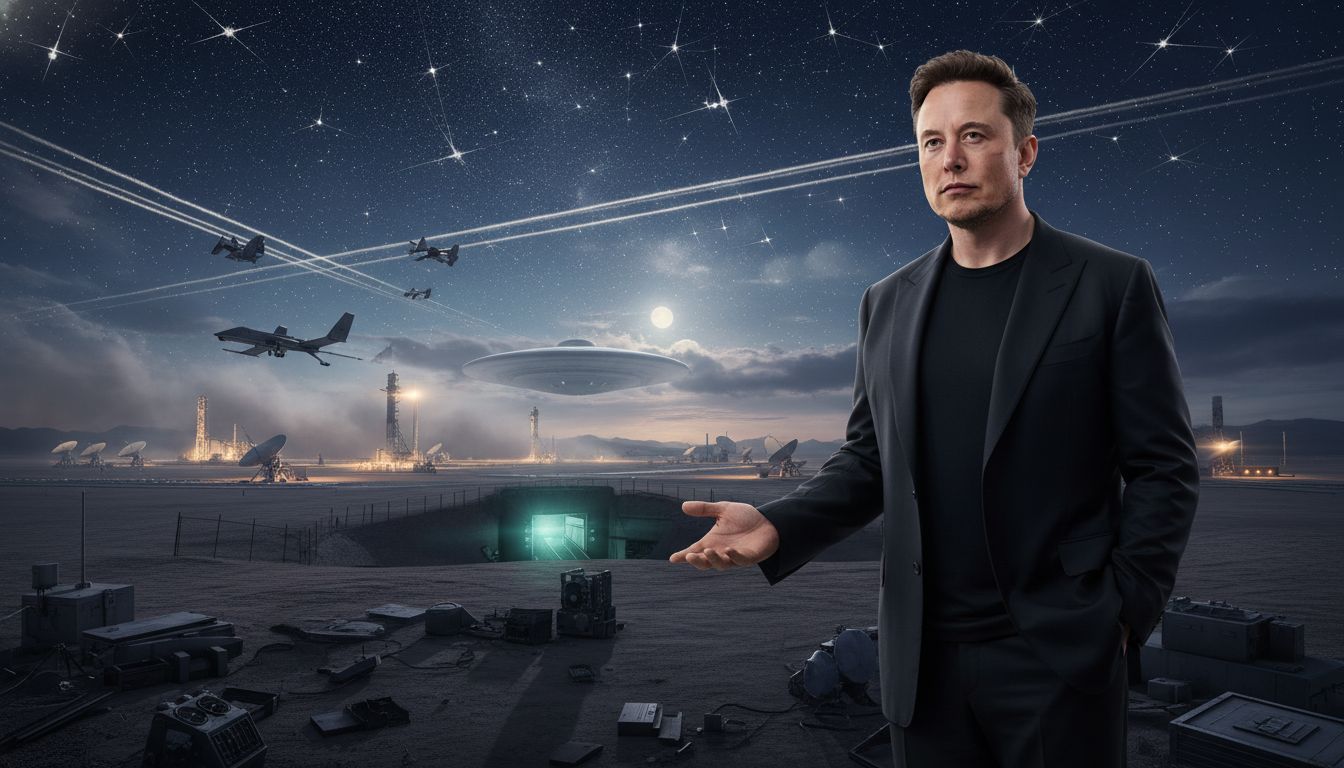
Elon Musk, the founder and chief executive of SpaceX and owner of the social‑media platform X, weighed in on the recent surge of unidentified aerial phenomenon (UAP) reports circulating in the United States. In a series of posts on X on Tuesday, Musk said he has never encountered any credible evidence of extraterrestrial life despite overseeing the launch of more than 5,000 Starlink satellites that now form a global communications network. “I’ve looked at the data coming from our satellites and the ground‑based sensors we operate – nothing points to alien technology,” he wrote, adding that any proof would be posted on X immediately.
Musk’s comments come at a time when the U.S. government has renewed public scrutiny of UAPs. The Office of the Director of National Intelligence released a preliminary assessment in June 2023 that catalogued 144 sightings by military pilots and sensors, concluding that most could not be readily explained but that there was no conclusive evidence of foreign or extraterrestrial origins. The Pentagon’s Unidentified Aerial Phenomena Task Force, now rebranded as the Airborne Object Identification and Management Synchronization Group, continues to investigate anomalous sightings, many of which are believed to involve advanced, possibly classified, aerospace technologies.
When asked what he thinks is behind the recent reports, Musk attributed the majority of sightings to “classified government programs testing advanced aircraft or weapons.” He referenced the long‑standing practice of the Department of Defense to conduct secretive flight‑test programs, noting that the rapid development of hypersonic and unmanned platforms could easily be mistaken for “otherworldly” craft by civilian observers. “When you have a test fleet that the public doesn’t know exists, it’s natural for people to fill in the blanks with UFOs,” Musk said in a follow‑up comment.
Musk’s remarks also touch on the broader debate about transparency and public access to data. While SpaceX’s Starlink constellation provides a dense mesh of optical and radio‑frequency observations that could, in theory, capture anomalous objects, the company’s data is largely proprietary and used for commercial broadband services. Musk emphasized that any anomalous signal or visual captured by SpaceX assets would be shared without delay, stating, “If we ever see something that looks like a genuine alien signal, it will be posted on X the moment we verify it.” This pledge aligns with his longstanding advocacy for open communication on the platform, though critics point out that verification standards for such extraordinary claims remain undefined.
Analysts note that Musk’s position reflects both his technical confidence and his business interests. As a private contractor heavily involved in national‑security satellite launches, SpaceX is subject to strict nondisclosure agreements that limit the disclosure of classified projects. At the same time, Musk’s public persona and his platform X have become outlets for rapid dissemination of unconventional ideas, ranging from AI to space colonization. Observers suggest his comments may be an attempt to steer the conversation toward plausible, terrestrial explanations while maintaining a stance of openness should incontrovertible evidence ever surface.
The conversation around UAPs is likely to remain active as new sightings are reported and government agencies continue their investigations. Musk’s statements add a high‑profile voice from the commercial space sector, underscoring the interplay between private aerospace capabilities, classified defense programs, and public curiosity about the possibility of extraterrestrial life. Whether future data from satellite constellations or defense test flights will clarify the nature of these phenomena remains to be seen, but for now Musk’s promise to post any alien evidence on X stands as a clear, if cautious, commitment to transparency.


