Overview
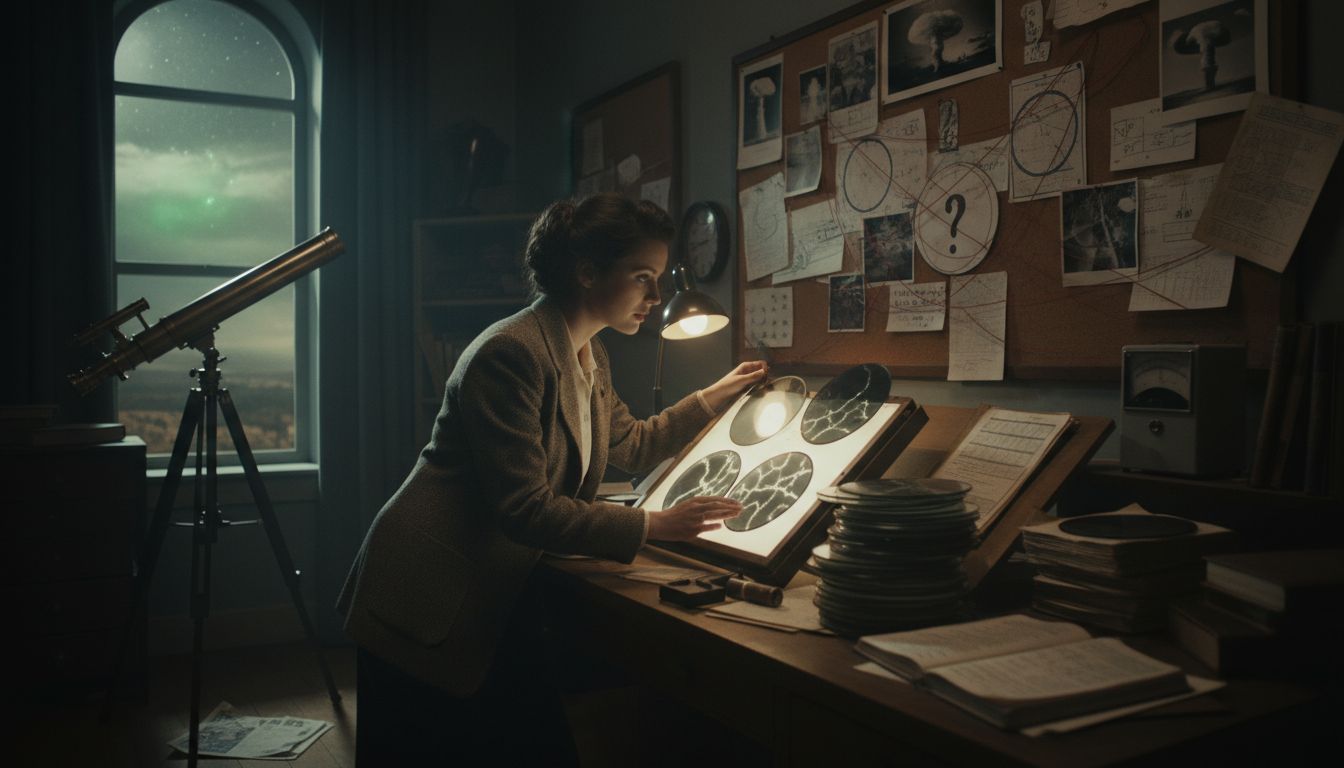
A new wave of scientific debate has erupted around a study led by Dr. Beatriz Villarroel, an astrophysicist at the Nordic Institute for Theoretical Physics (Nordita). Her team, project VASCO, analyzed hundreds of photographic plates taken at the Palomar Observatory in the early 1950s—decades before the launch of Sputnik—and reported transient light flashes that appear and vanish within seconds. By correlating the positions of these flashes with the Earth’s shadow and the timeline of atmospheric nuclear tests, Villarroel’s paper claims a 22‑sigma statistical significance, a level of confidence far exceeding that of most landmark discoveries in physics. The findings, published last week, have reignited discussions about possible extraterrestrial technology and, simultaneously, about the reliability of archival astronomical data.
Key Findings
Villarroel’s analysis identified a clustering of transient events just outside the Earth’s umbra, a pattern she argues is inconsistent with random photographic defects. Moreover, the timing of many flashes aligns with the schedule of above‑ground nuclear detonations conducted by the United States and the Soviet Union between 1951 and 1958. In a statement posted to her X account, Villarroel noted that “two independent data analysts who examined the same sample reproduced our primary results, confirming both the nuclear‑test association and the deficit of transients within the Earth’s shadow.” One of those analysts, Brian Doherty, posted a short note outlining his replication, while a second analyst chose to remain anonymous pending formal publication. Villarroel emphasizes that the 22‑sigma result is “statistically overwhelming”—for comparison, the Higgs boson discovery was validated at 5 sigma.
Criticisms and Methodological Concerns
The study’s bold claims have been met with swift criticism, most prominently from Dr. Wesley Watters, an astronomy professor at Wellesley College. In a pre‑print posted to arXiv, Watters argues that the apparent clustering can be explained by artifacts of plate handling, digitization errors, and edge effects that naturally produce higher false‑positive rates near the borders of the images. He cautions that “the data set is noisy, and the statistical model may be over‑fitting patterns that are not physically meaningful.” Watters’ paper has not yet undergone peer review, a fact Villarroel’s team points out to underscore that her own work has already cleared that hurdle. Nevertheless, the methodological debate highlights a fundamental tension in archival research: distinguishing genuine astrophysical signals from the myriad imperfections inherent in historic media.
Independent Support and Broader Context
Amid the controversy, Dr. Garry Nolan of Stanford University—renowned for his work on anomalous phenomena—has publicly defended Villarroel’s methodology. “The statistical rigor and the external replications presented give this study a solid foundation,” Nolan said in an interview with Science Horizons. His endorsement adds weight to the conversation, especially as the UAP (Unidentified Aerial Phenomena) community has recently turned its attention to pre‑Sputnik observations, seeking evidence that anomalous aerial activity predates the space age. If Villarroel’s transients do indeed represent extraterrestrial technology, they would constitute the earliest known “signature” of such activity, reshaping timelines for both scientific and defense agencies.
Next Steps and Call for Further Examination
Both sides agree that direct inspection of the original Palomar plates is essential. Villarroel’s team has requested access to the remaining unscanned plates stored at the California Institute of Technology, proposing a collaborative effort that would involve independent laboratories using modern high‑resolution scanning and spectroscopy. Watters, while skeptical of the extraterrestrial interpretation, welcomes the proposal, stating that “a thorough, blind re‑analysis of the physical plates could finally settle whether we are looking at genuine astrophysical events or systematic errors.” Funding agencies and several university departments have expressed interest in supporting a joint task force, signaling that the debate may soon move from theoretical statistics to hands‑on empirical verification.
As the scientific community watches closely, the outcome of this investigation could have far‑reaching implications—not only for the study of UAPs and potential extraterrestrial technology, but also for the broader practice of mining historic astronomical archives for new discoveries.