Overview
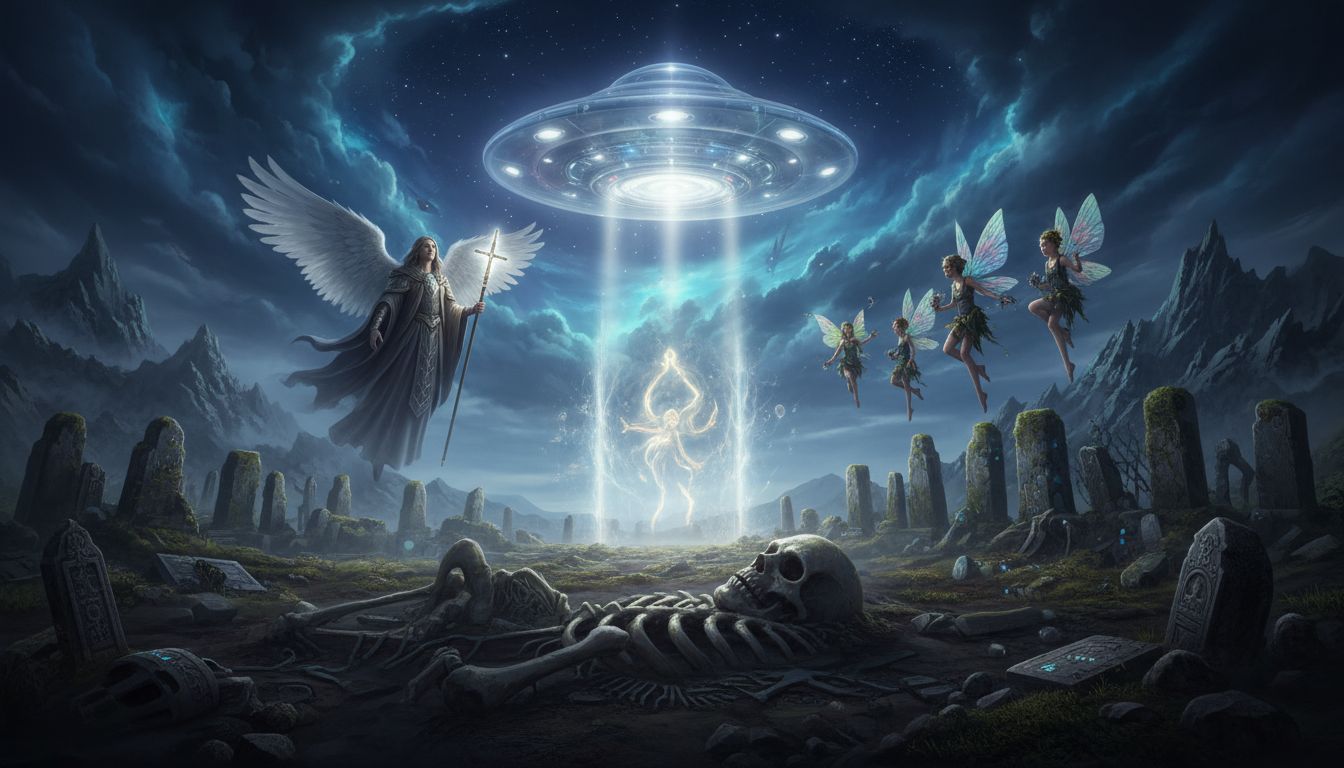
A recent essay titled “Fairies Exist: A Christian Inquiry” has sparked vigorous discussion across the UFO‑focused community on X (formerly Twitter). Written by undergraduate scholar Hunter Coates and published on the Substack newsletter Copious Flowers on March 16, 2024, the piece explores the overlap between modern UFO/NHI (non‑human intelligence) discourse, traditional angelology, and European fairy folklore—all examined through an Orthodox Christian lens. The author argues that references to “good fae” in medieval texts bear a conceptual resemblance to contemporary reports of benevolent extraterrestrials, and he links these ideas to biblical narratives of the Nephilim and the notion of a Christ‑like consciousness that could underlie both angelic and fairy phenomena.
Key Connections
Coates begins by defining his terminology, distinguishing fairies (fae) as a class of spiritual beings rooted in pre‑Christian folklore, while noting that early Church Fathers such as Origen occasionally incorporated similar entities into their cosmology. He then draws parallels between the “good fae” described in medieval hagiography and the “benign UFO pilots” reported in recent declassified briefings, citing a 2023 Pentagon release that hinted at “non‑human intelligences exhibiting altruistic behavior.”
The essay further ties these motifs to the Nephilim of Genesis 6, suggesting that the ancient Hebrew term for “giants” may have originally denoted a class of hybrid or semi‑divine beings—an interpretation echoed in some contemporary theological circles. Coates writes, “If the Nephilim were understood as a bridge between the divine and the material, then the modern image of a ‘cosmic shepherd’ guiding humanity is not a novel invention but a reinterpretation of an age‑old archetype.”
Community Reaction
Within hours of the Substack post’s release, the hashtag #ufotwitter lit up with commentary. Users ranging from UFO researchers to theological scholars shared the essay, noting its “bold synthesis of myth and modern disclosure.” One prominent ufologist, @SkyWatcher, quoted the piece: “The suggestion that fairies could be ‘Christ‑like consciousnesses’ offers a fresh framework for interpreting the benevolent messages many pilots claim to receive.” Conversely, skeptics warned against conflating folklore with empirical data, urging a clear separation between subjective testimony and scientific investigation.
The publisher’s note accompanying the essay emphasizes its exploratory nature, acknowledging that “even when I don’t agree with (or know what to think about) particular points… these are the fruits of a labor that I’m honored to share.” This disclaimer has been highlighted by several commentators as an attempt to maintain academic humility while navigating a highly speculative field.
Implications for Disclosure
If the connections Coates outlines gain traction, they could influence how governmental agencies frame future disclosures. The U.S. Office of the Director of National Intelligence (ODNI) has already indicated an interest in “the cultural and psychological dimensions of anomalous aerial phenomena.” By situating UFO encounters within a broader mythopoetic tradition, policymakers might consider the impact of collective belief systems on public reception of any forthcoming revelations.
Nevertheless, experts caution that integrating theological constructs—such as the notion of a Christ‑like consciousness—into official briefings risks blurring the line between evidence‑based assessment and spiritual interpretation. Dr. Elena Marquez, a professor of religious studies at the University of Chicago, remarks, “While the essay provides a fascinating interdisciplinary dialogue, any official narrative must remain grounded in verifiable data to preserve credibility.”
Scholarly Perspective
Coates, an aspiring Orthodox Christian academic, situates his argument within a broader scholarly conversation about the Chain of Being and its decline in modern scientific thought. He cites Wendell Berry’s observation that “angels are known to be extremely shy and given to flight at the approach of objective observers,” underscoring the difficulty of obtaining empirical proof of such entities.
The essay’s extensive bibliography—including references to medieval Christian texts, patristic writings, and contemporary UFO reports—demonstrates a rigorous attempt to bridge historical theology with current anomalous research. While the piece stops short of claiming definitive proof of fairy existence, it invites further interdisciplinary study, urging scholars to “re‑examine the margins where myth, faith, and unexplained aerial phenomena intersect.”
In an era where both government transparency and public imagination are in flux, “Fairies Exist: A Christian Inquiry” stands as a provocative contribution that challenges conventional boundaries between science, religion, and folklore—a conversation that is likely to continue evolving across both academic and online communities.