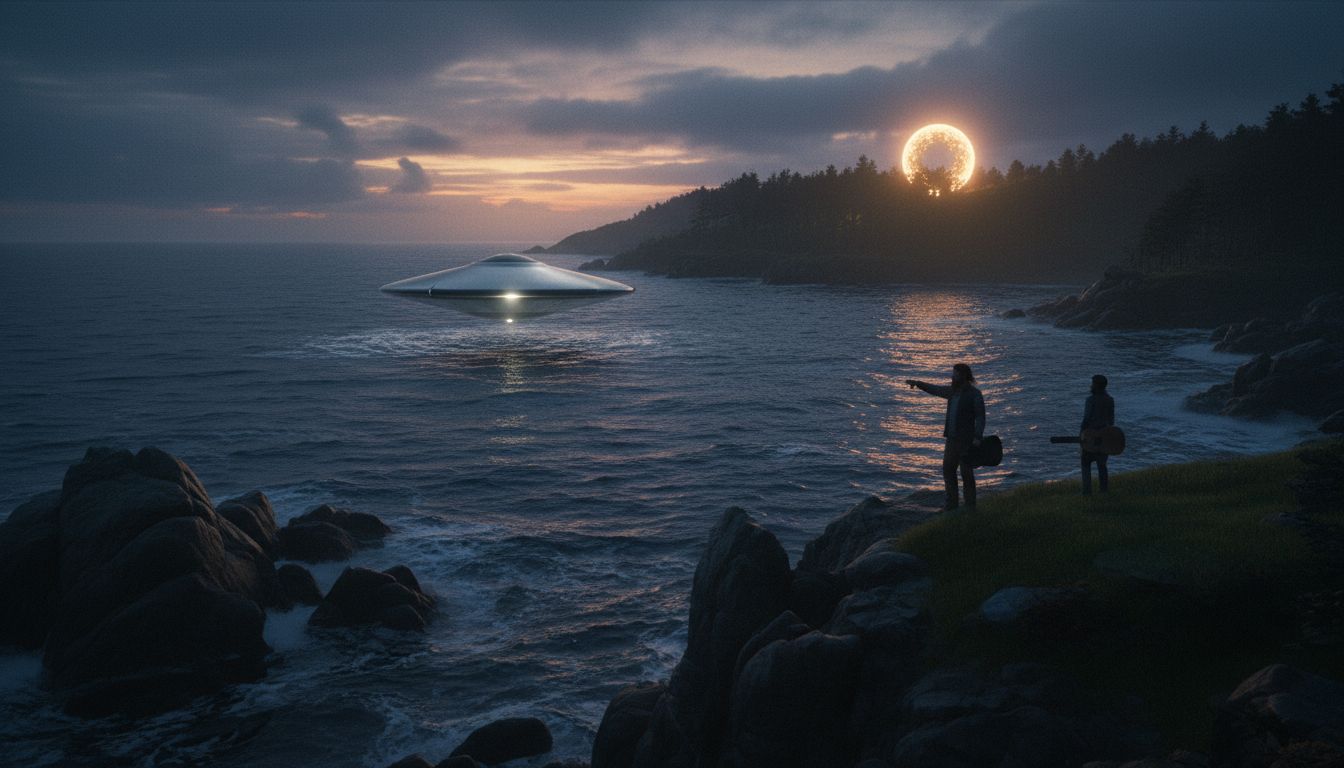
The conversation around unidentified aerial phenomena (UAP) has moved from classified government briefings to mainstream media in recent months, and a growing number of high‑profile individuals have added their own observations to the public record. In 2010, acclaimed director James Cameron recounted a dive off the coast of Belize in which a “silvery disc” hovered a few meters above the water before accelerating away at a speed he described as “far beyond any known aircraft.” Cameron, who has spoken publicly about the encounter in several interviews, said the sighting left him “both unsettled and fascinated,” prompting him to follow the emerging scientific investigations into UAP with a level of curiosity uncommon among Hollywood executives.
A similar anecdote emerges from the world of music. Paul McCartney, reflecting on a family holiday in the 1970s, recalled a “glowing object” that lingered above the roof of his home in the English countryside. In a 2023 documentary, the former Beatle noted that the object remained stationary for several minutes, casting an eerie light that illuminated the garden, before disappearing without a sound. McCartney’s account, though brief, underscores a pattern noted by researchers: many sightings occur in quiet, residential settings where witnesses have little expectation of encountering aerial anomalies.
More recent reports involve younger entertainers and actors who have spoken about their experiences on social platforms. In 2013, pop star Miley Cyrus posted a short video taken while traveling in the southwestern United States, showing a bright, pulsating light that hovered for a few seconds before vanishing. Cyrus later explained that the footage sparked a “deep sense of wonder” and encouraged her to follow the ongoing de‑classification efforts by the Pentagon’s UAP Task Force. Actor Dan Aykroyd, known for his long‑standing interest in the paranormal, has also spoken publicly about a 1980s incident in which a UFO allegedly appeared on the set of one of his films, prompting crew members to pause production for several minutes. While Aykroyd’s story is often cited in tabloid circles, he has consistently framed it as a personal curiosity rather than proof of extraterrestrial visitation.
Other celebrities have described more fleeting, but nonetheless striking, encounters. Whoopi Goldberg, in a 2022 interview, described a “bright, almost electric light” that darted across the sky during a commercial airline flight, moving in a manner that defied conventional aeronautical behavior. Kiefer Sutherland, speaking at a 2024 podcast on outdoor adventure, recalled observing “unusual, synchronized lights” while camping near a remote lake in Canada, noting that the phenomenon lingered long enough to be captured on his phone. Even athletes such as former NBA star Michael Jordan have mentioned seeing “odd, hovering lights” during a night practice in Chicago, though he has not elaborated beyond a brief comment to a sports reporter.
The accumulation of these testimonies does not constitute scientific proof, but it does illustrate why UAP discussions have gained traction beyond defense circles. When individuals with global platforms describe unexplained aerial events, they draw public attention to the need for transparent data collection and rigorous analysis. Researchers at the All‑Domain Anomaly Resolution Office (AARO) have cited civilian reports as a valuable supplement to military observations, emphasizing that “multiple independent accounts, especially from credible witnesses, can help triangulate and verify anomalous events.” As the dialogue continues, the celebrity narratives serve a dual purpose: they humanize a topic often shrouded in secrecy, and they reinforce the broader cultural curiosity that drives both scientific inquiry and popular imagination.


