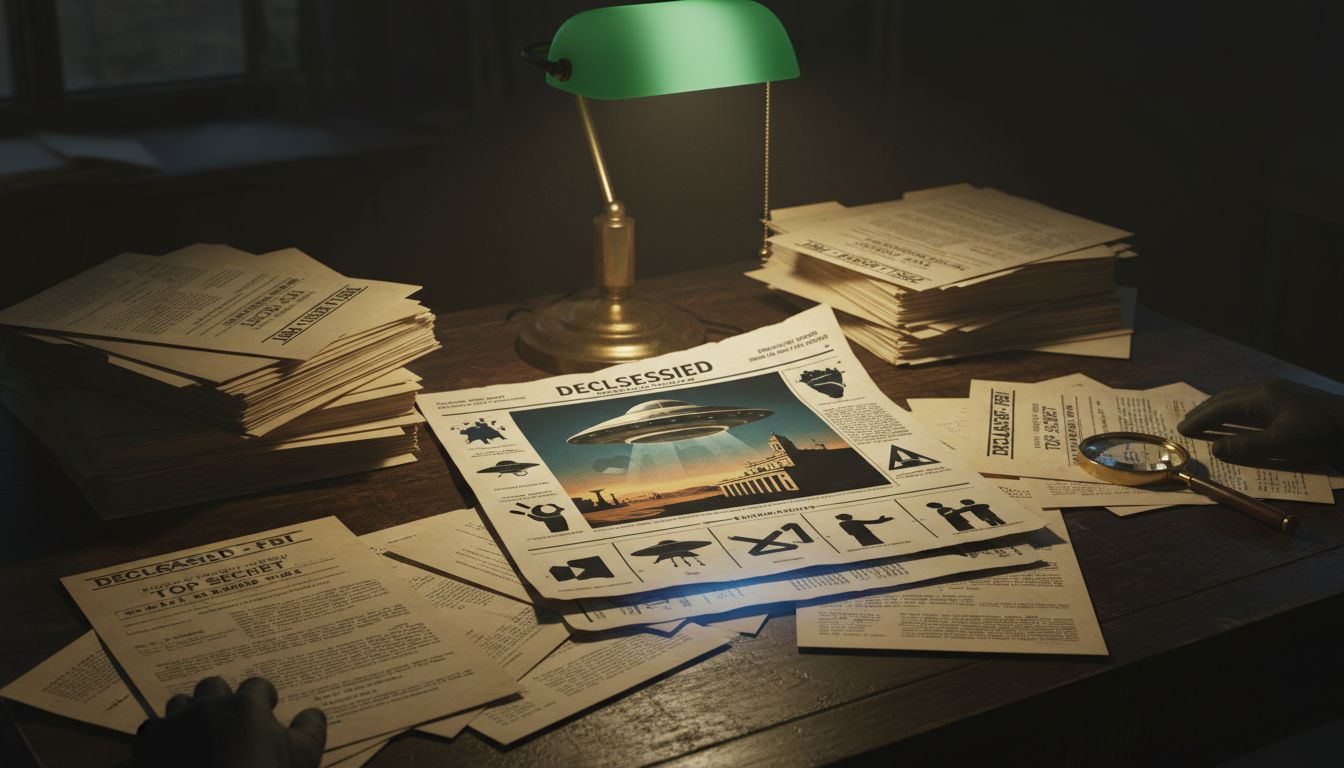
The Federal Bureau of Investigation’s recently declassified files on unidentified aerial phenomena trace a systematic inquiry that began in the late‑1940s, at the height of Cold War anxiety. In the wake of the 1947 Roswell incident, the agency’s primary concern was not extraterrestrials but national security: could the sightings represent foreign aircraft or surveillance platforms? By 1952, a spate of reports over Washington, D.C., prompted the FBI to formalize a liaison with the Air Force and other intelligence services, creating a dedicated unit to catalog and evaluate each claim. The documents show that early investigations were largely reactive, but they soon evolved into a structured effort to gather eyewitness accounts from military pilots, commercial crews, and civilian observers, laying the groundwork for a decades‑long archival record.
The released material contains more than 1,200 individual reports, many of which cite credible witnesses such as Air Force pilots and commercial airline captains. One memorandum from 1967 records a “high‑altitude, maneuverable object observed by two Navy pilots during a training sortie, exhibiting acceleration beyond known aircraft capabilities.” Although the FBI consistently concluded that most cases could be explained by weather, misidentification, or classified aircraft, the files also note several incidents that remained “unresolved” after exhaustive analysis. The agency’s language reflects a cautious stance: “While no direct evidence of foreign technology is present, the anomalous nature of these sightings warrants continued monitoring.” This measured tone mirrors the contemporaneous Project Blue Book reports, which the FBI supported with its own intelligence assessments.
Why much of this material stayed out of public view for so long is a question the files themselves address. A 1975 internal directive advises agents to “limit dissemination of UFO-related findings to prevent undue public alarm and protect sources and methods.” The justification aligns with broader Cold War secrecy policies, where the potential revelation of advanced reconnaissance capabilities could compromise national defense. Moreover, the agency’s legal counsel warned that publicizing ambiguous sightings could invite “speculative media coverage that may distract from legitimate security concerns.” Critics argue that such caution veiled legitimate scientific inquiry, a point echoed in recent congressional testimony that urged agencies to “stop treating UAPs as a joke and treat them as a data problem.”
The historical record is now intersecting with contemporary UAP scrutiny. Since the 2022 Senate Intelligence Committee hearings, whistleblowers such as former intelligence officer David Grusch have testified that the government possesses “non‑human” craft and that related data has been “systematically withheld.” Lawmakers have cited the FBI’s own archives as evidence that the federal government has long been aware of credible, unexplained sightings. In a recent hearing, Representative Tim Burchett referenced the 1969 FBI memorandum on “unidentified, high‑performance objects” to argue that “the pattern of concealment stretches back generations.” The convergence of declassified documents and fresh testimony has intensified calls for a comprehensive release of all UAP‑related records.
Advocates for full disclosure contend that transparency would serve both national security and public trust. By making the complete FBI file set available, analysts could cross‑reference historical data with modern sensor logs, potentially identifying patterns or technological signatures that were previously missed. Conversely, skeptics caution that releasing raw, unverified reports could fuel misinformation, especially if the documents are taken out of context. The FBI’s own statement accompanying the release emphasizes that “the files are historical in nature and do not constitute evidence of extraterrestrial activity.” Nonetheless, the agency acknowledges that “the continued public interest underscores the need for an organized, inter‑agency approach to UAP investigation.”
As the debate unfolds, the newly accessible FBI archives provide a factual baseline for both policymakers and the public. They reveal a government that has long taken unidentified aerial phenomena seriously, albeit through the lens of security rather than scientific curiosity. Whether this historical perspective will accelerate the push for a unified, transparent UAP reporting system remains to be seen, but the documents have undeniably shifted the conversation from fringe speculation to an issue of documented governmental concern.