Overview
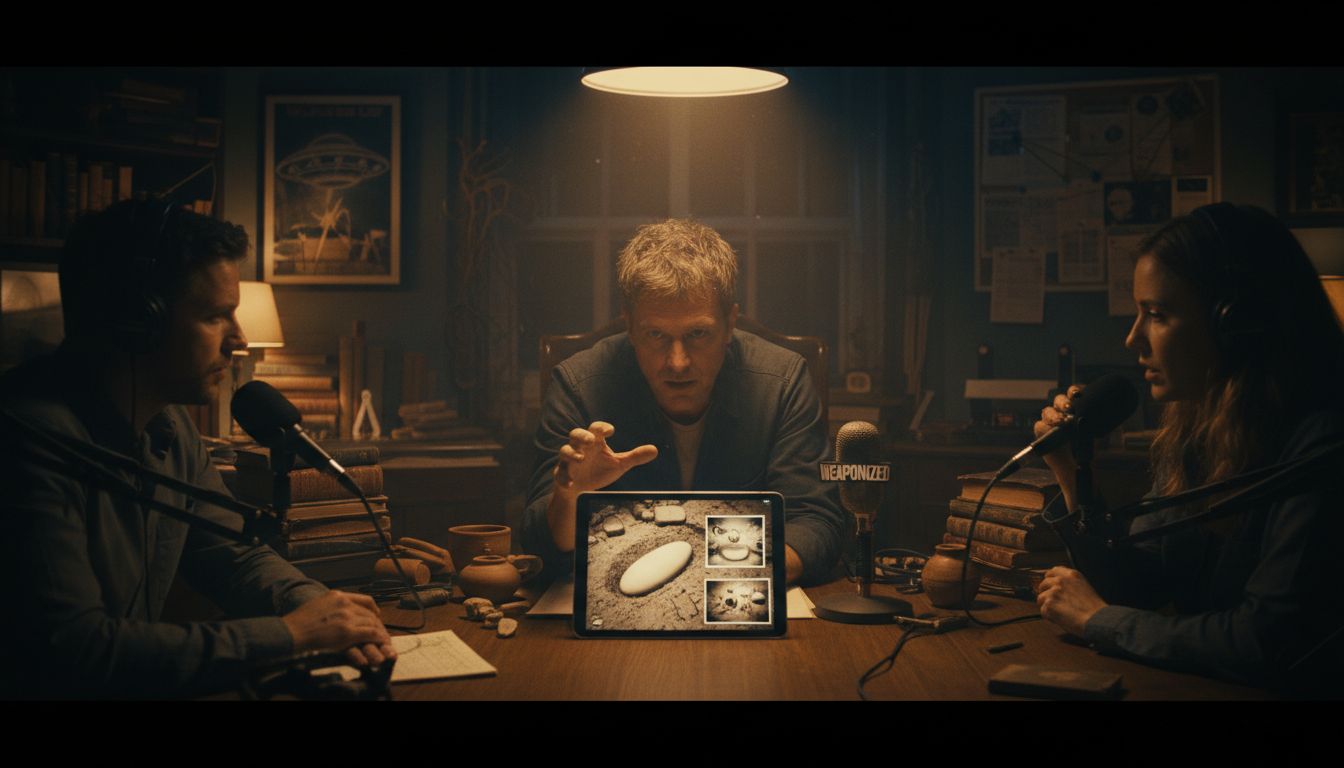
Former U.S. Air Force member and intelligence‑community whistleblower Dylan Borland told investigative journalists Jeremy Corbell and George Knapp on the WEAPONIZED podcast that he had been briefed on photographic evidence of a “Tic Tac”‑shaped craft recovered during an archaeological dig. Borland said the images were shown to personnel involved in a legacy UAP (Unidentified Anomalous Phenomena) program and that the objects were described as “very old.” The claim links contemporary UAP investigations to a pattern of alleged recoveries that date back decades and echoes earlier statements by figures such as Bob Lazar and former Pentagon official Lue Elizondo.
Borland’s Testimony
During the interview, Borland explained that his first exposure to the material occurred in 2015, when members of a classified UAP program presented him with photographs of the alleged artifact. He quoted the briefing:
“They had photographic evidence of archaeological digs of some of these, and they had photographic evidence of ones that were complete… They did not disclose where they came from, which goes back to AARO and the word games that are played with AARO on this subject.”
Borland emphasized that the briefings stressed the ancient provenance of the craft, a detail that aligns with Lazar’s 2019 claim that at least one recovered UAP “was part of an archaeological dig – so, it’s old.” The WEAPONIZED episode also referenced the well‑known “propane‑tank” or “Tic Tac” sightings reported by U.S. Navy pilots off the West Coast in 2004 and again in 2023, suggesting a possible continuity between historical sightings and the alleged physical recovery.
Historical and Institutional Context
A source outlined for Liberation Times a typical chain of custody for such discoveries: an overseas find is first reported to local authorities, then escalated to national agencies, and ultimately reaches CIA stations where the Directorate of Operations and the Directorate of Science and Technology coordinate technical recovery. This pattern mirrors earlier reports that archaeological fieldwork has attracted intelligence interest, a point highlighted in a 2003 Guardian investigation documenting archaeologists’ discomfort with their work being leveraged for espionage.
The Pentagon’s All‑Domain Anomaly Resolution Office (AARO) continues to state that it has “no verifiable evidence of extraterrestrial life,” and it has resisted calls to replace that language with “non‑human intelligence,” despite internal discussions that the term “extraterrestrial” could encompass non‑human origins. The office’s 2024 annual report noted that 4 % of UAP sightings are cylindrical, a shape consistent with the “Tic Tac” description, though it stopped short of attributing any specific origin.
Prior Sightings and Analogies
Reports of Tic Tac‑style objects are not new. In 1979, Italian Air Force pilot Giancarlo Cecconi tracked a black, tank‑like object that vanished from both visual sight and radar, an incident cited in several UAP analyses. More recently, Lue Elizondo used a King Tutankhamun analogy, suggesting that an advanced vehicle could be “buried” and later uncovered, reinforcing the notion that ancient artifacts might be linked to modern anomalous technologies.
Official Response and Outlook
While Borland’s account adds a new layer to the ongoing public discourse, no official documentation of the alleged photographs has been released, and the Pentagon has not confirmed any physical recovery of a “Tic Tac” craft. Congressional UAP hearings continue to press for greater transparency, but classified constraints limit the detail that agencies can share. Analysts caution that claims of human‑made or ancient‑civilization origins remain speculative until corroborated by verifiable evidence.
The convergence of whistleblower testimony, historical anecdotes, and the Pentagon’s cautious language underscores the complexity of the UAP issue. As the AARO and related bodies refine their investigative frameworks, the question of whether ancient archaeological finds are linked to contemporary anomalous phenomena remains open—awaiting the kind of concrete data that can move the conversation from conjecture to confirmed fact.