Overview
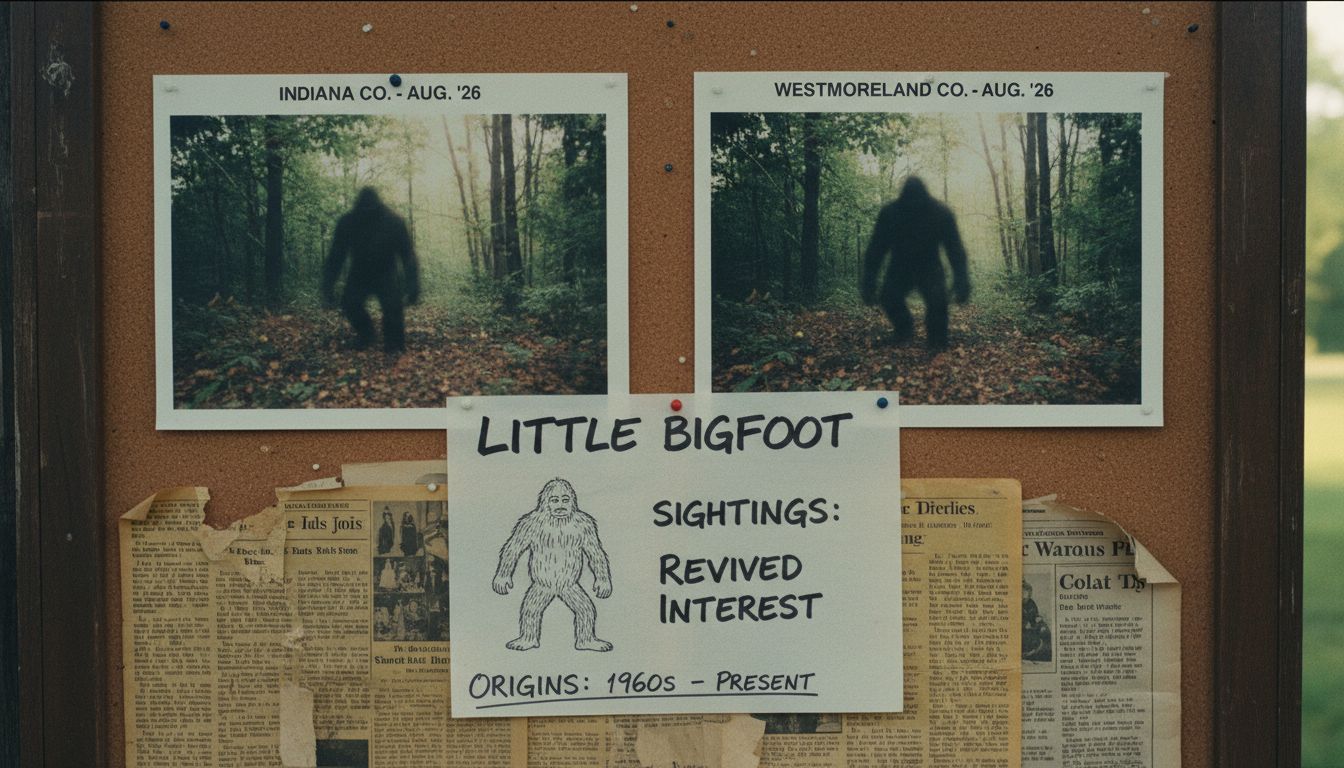
Two recent reports of an upright, unknown creature in southwestern Pennsylvania have reignited a long-running local mystery known as “Little Bigfoot.” The sightings, said to have occurred just 24 hours apart in Indiana and Westmoreland counties in August 2026, have drawn renewed attention to a cryptid legend that residents and folklore watchers say has circulated in the region for generations. While the latest encounters remain unverified, they have added fresh momentum to a story that sits at the intersection of local tradition, oral history, and modern-day mystery.
The New Reports
According to the source material, both accounts involved a bipedal, upright creature, a description that immediately evokes comparisons to more familiar North American cryptid lore. The reports were made in neighboring counties, giving the impression of a localized cluster rather than an isolated incident. That proximity is part of what has stirred interest: when two similar sightings emerge in quick succession, especially in a region already associated with strange animal encounters, they tend to revive public curiosity and speculation.
Still, there is no indication in the available material that the sightings were supported by photographs, physical evidence, or independent confirmation. As with many cryptid stories, the accounts are framed as eyewitness reports rather than established fact. That distinction is important. In regions with a strong folklore tradition, a fresh sighting can quickly become part of the broader mythos even when the underlying evidence remains thin.
A Legend With Deep Roots
What makes the Pennsylvania story notable is not just the recent activity, but the claim that similar reports may stretch back decades and, in some cases, nearly two centuries. The article’s framing suggests that “Little Bigfoot” is not a new invention but rather a modern label attached to an older body of local accounts. In that sense, the current sightings are being viewed less as a standalone event and more as the latest chapter in a long-running regional narrative.
That kind of continuity is common in cryptid traditions. Communities often preserve unusual stories through family recollections, hunting tales, and word of mouth, even when no formal record exists. Over time, those accounts can evolve into a distinct local legend, complete with recurring descriptions, familiar locations, and a shared sense that “something” has long been moving through the woods.
Why the Story Resonates
The appeal of the Little Bigfoot mystery lies partly in its scale: it is local enough to feel personal, but strange enough to resist easy explanation. Southwestern Pennsylvania’s wooded terrain and rural stretches provide a natural setting for sightings that are difficult to verify after the fact. That environment, combined with a longstanding appetite for unexplained phenomena, helps explain why two brief encounters can generate outsized interest.
For now, the story remains exactly what it appears to be: a pair of reported sightings reviving an old legend. Whether the latest witnesses saw an animal, a misidentified person, or something else entirely, the reports have clearly succeeded in doing one thing — reminding Pennsylvania that its cryptid lore is still very much alive.