Overview
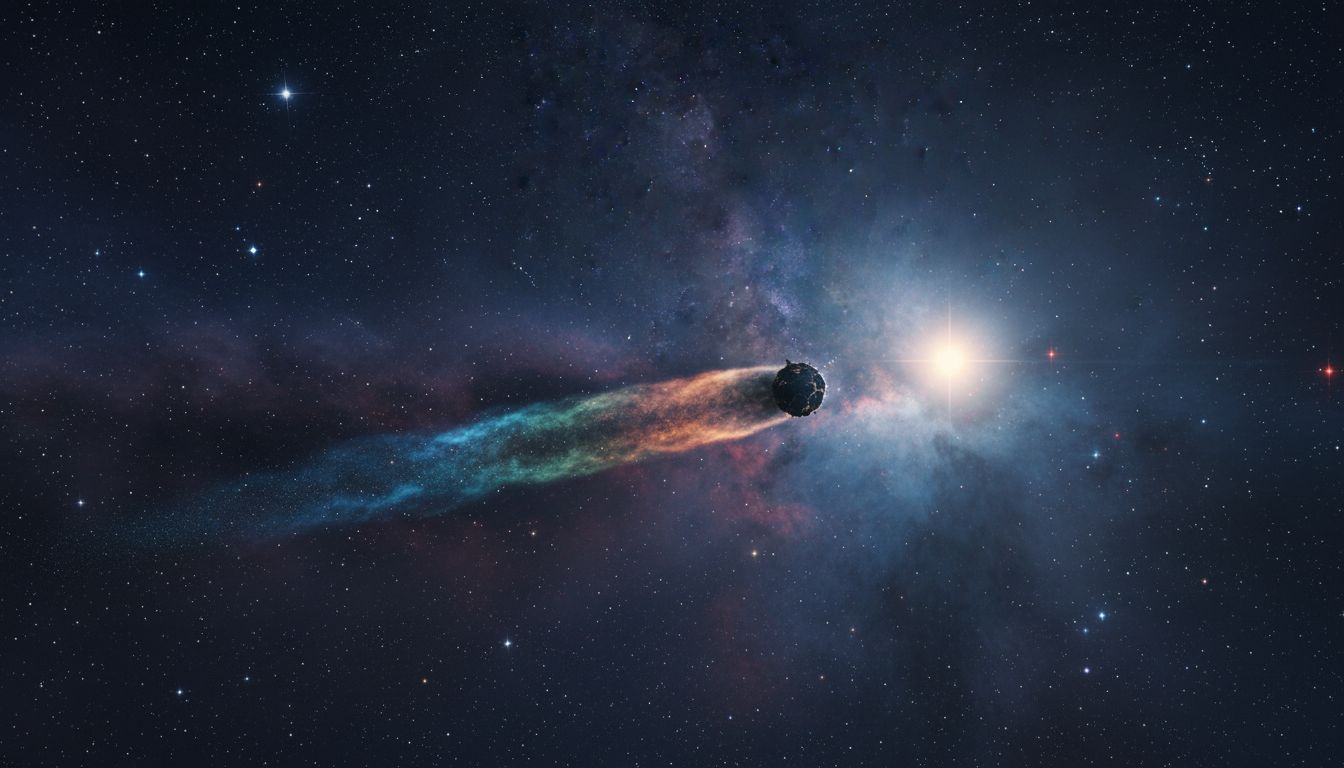
The interstellar visitor 3I/ATLAS—the third confirmed object of its kind—has once again captured the attention of astronomers and the public alike. First spotted in early July 2025 as it barreled toward the Sun at more than 130,000 mph, the object is thought to have originated from the distant “frontier” region of the Milky Way and could be as old as seven billion years. After passing perihelion on 29 October, 3I/ATLAS emerged from behind the Sun and, on 16 November, was photographed by amateur astrophotographer Satoru Murata with a modest 0.2‑meter telescope. The resulting image not only showcases the comet’s striking green coma and twin tails but also inadvertently “photobombs” the barred spiral galaxy NGC 4691, which appears in the top‑left corner of the frame.
The Photographic Capture
Murata’s long‑exposure shot reveals a bright green coma—a hallmark of ionized carbon monoxide and cyanogen gases fluorescing under solar ultraviolet radiation. Extending from the nucleus is a long ion tail that points directly away from the Sun, indicating the influence of the solar wind. A shorter, broader anti‑tail trails behind the comet, a feature created by excess dust particles that lag in the comet’s orbital path and become illuminated from Earth’s perspective. The image also shows smaller jets erupting from the nucleus, suggesting localized outgassing regions.
“The moment I realized the galaxy was in the frame, I knew we had something special,” Murata told Live Science. “It’s rare to have an interstellar comet and a distant galaxy share the same field of view—like a cosmic coincidence.” The photograph, posted to the astronomy community’s forums, quickly garnered over 12,000 likes and sparked discussion about the object’s unusual morphology.
Scientific Context and Anomalies
Since its discovery, 3I/ATLAS has exhibited a series of anomalous behaviors that set it apart from typical solar‑system comets. After perihelion, the comet brightened more rapidly than models predicted, prompting speculation about a volatile‑rich interior. Spectroscopic observations recorded a temporary color shift from green to a faint blue hue, hinting at changes in the composition of the coma as different ices sublimated. Moreover, the comet’s surface appears highly irradiated, with an overabundance of carbon‑bearing molecules such as C₂ and CN, which are rarely seen in such quantities in other comets.
These characteristics have led a small contingent of researchers to propose more exotic explanations, including the provocative—but widely contested—hypothesis that 3I/ATLAS could be an artificial probe or “alien spaceship.” Dr. Elena Mendoza of the Institute for Interstellar Studies remarked, “While the data are intriguing, the bulk of evidence aligns with natural cometary processes. Extraordinary claims require extraordinary evidence, and we have yet to see any definitive signs of technology.” The majority of planetary scientists concur, emphasizing that the observed phenomena can be explained by thermal stresses, heterogeneous composition, and solar‑wind interactions typical of icy bodies entering the inner solar system at high speed.
Trajectory and Upcoming Close Approach
3I/ATLAS will make its closest approach to Earth on 19 December 2025, passing within roughly 0.23 AU (about 34 million kilometers). At that distance, the comet’s apparent magnitude is expected to reach +6, making it visible to the naked eye under dark skies for observers in the northern hemisphere. Astronomers worldwide are coordinating a series of observations—including high‑resolution spectroscopy, polarimetry, and radio measurements—to capture the comet’s activity as it recedes from the Sun.
The object’s hyperbolic orbit confirms its interstellar origin; calculations indicate an incoming velocity of ~30 km s⁻¹ relative to the Sun, far exceeding the escape velocity of the solar system. Its trajectory suggests it entered from a direction roughly aligned with the galactic anti‑center, supporting the hypothesis that it originated in the sparsely populated outer regions of the Milky Way.
Significance for Interstellar Research
The third confirmed interstellar visitor offers a rare laboratory for studying material that formed around another star. The multiple tails captured in Murata’s image provide clues about the distribution of volatile ices and dust, while the spectral signatures of unusual chemicals may reflect a different chemical pathway in its natal system. Comparative analysis with the first two interstellar objects—‘Oumuamua (2017) and 2I/Borisov (2019)—will help refine models of planetary system formation across the galaxy.
As Dr. Ravi Kumar, a cometary physicist at the University of Arizona, noted, “Each interstellar object is a messenger from a distant world. 3I/ATLAS, with its vivid tails and unexpected chemistry, expands our understanding of the diversity of planetary building blocks beyond our own solar system.” The upcoming observations, combined with the striking visual record of its encounter with NGC 4691, ensure that 3I/ATLAS will remain a focal point of scientific inquiry and public fascination well into the next year.


