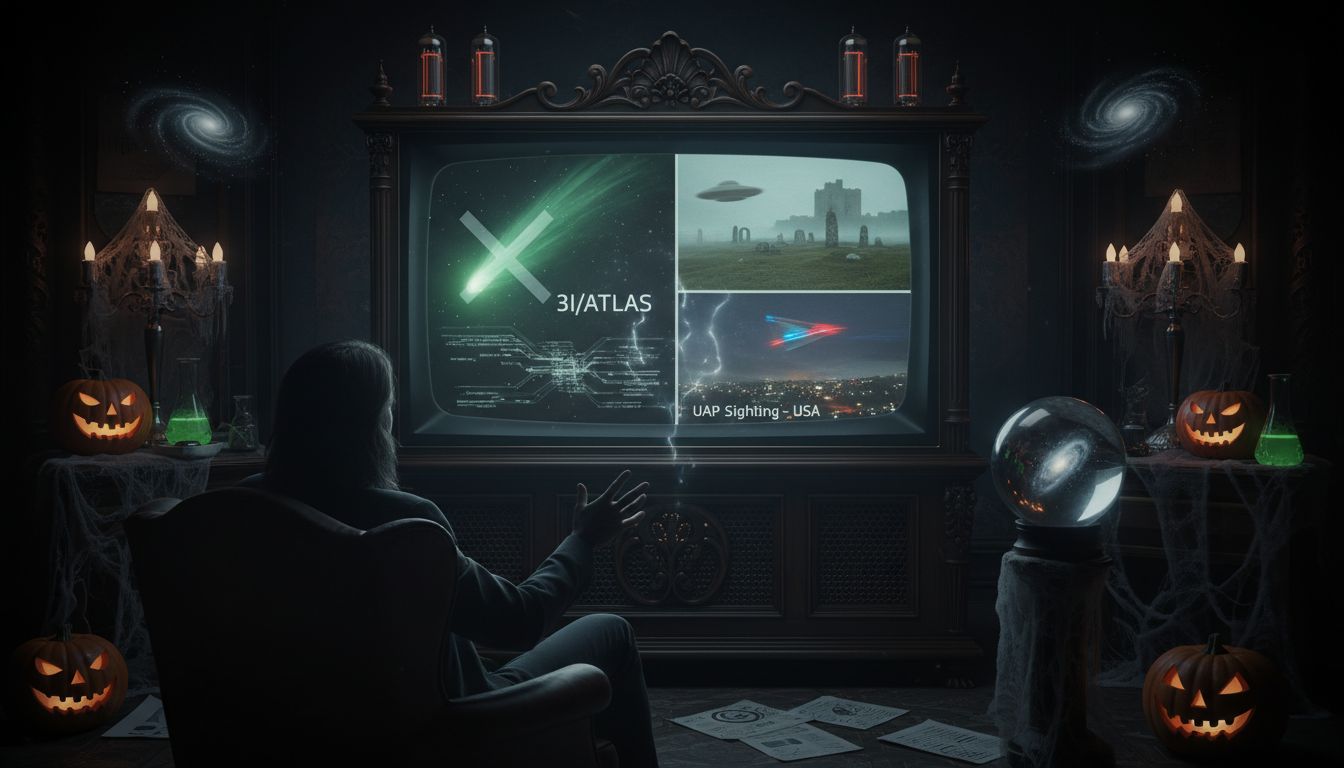
In a recent Halloween-themed episode of the YouTube channel Undercover ET, the host tackled growing misinformation surrounding the interstellar object 3I/ATLAS, while also showcasing new Unidentified Aerial Phenomena (UAP) videos from both the United Kingdom and the United States. The episode aimed to clarify scientific discussion around 3I/ATLAS and provide a platform for public-sourced UAP evidence, as interest in anomalous space and aerial phenomena continues to surge online.
Addressing rumors circulating on social media, the host directly refuted claims that Harvard astrophysicist Avi Loeb had definitively labeled 3I/ATLAS as an ordinary comet. “He hasn’t stated that it’s a comet,” the host asserted, referencing Loeb’s recent statements in interviews. “He said in his latest interview that it’s a 60/40, that it is something natural, but there’s still 40% doubt because of this anomaly, this anomaly, this anomaly…” The video emphasized the importance of referencing primary sources and cautioned against misrepresenting expert opinions to fit preconceived narratives.
To add scientific context, the episode included a segment from Professor Avi Loeb’s appearance on NewsNation, where Loeb outlined several unusual properties of 3I/ATLAS. According to Loeb, the object recently made its closest approach to Mars, allowing the Mars Reconnaissance Orbiter to capture the highest-resolution images yet—images that have not yet been released to the public due to a NASA data hold-up following a government shutdown. Loeb expressed frustration that political events had delayed scientific analysis, stating, “The politics of the day should not sabotage science; they have the data, they should share it with scientists.”
The astrophysicist pointed to a series of anomalies: the object’s unexpected brightness after passing near the sun, its blue coloration (indicating temperatures higher than the sun’s surface, which is physically puzzling), and hints of non-gravitational acceleration—suggesting forces at work beyond simple gravity. Additional peculiarities include the object’s massive size, its unusual chemical composition with high nickel and low iron (similar to industrial alloys), and jet-like emissions directed toward the sun. “There are all these indications,” Loeb said, “that make it even more interesting than it was before.”
Beyond the scientific debate, the Undercover ET episode highlighted ongoing community efforts to capture and analyze UAP sightings. The host announced an upcoming interview with “Ben in Oklahoma,” a notable contributor whose footage has garnered attention within the UAP community for its clarity and frequency of anomalous captures. The episode encouraged viewers to support public documentation and open discussion, positioning grassroots evidence collection as a vital supplement to official research and government disclosures.
In summary, the video underscored both the complexities of interpreting interstellar phenomena and the continued public fascination with unexplained aerial events. While experts like Avi Loeb remain cautious and open-minded, the episode stressed the value of skepticism, transparency, and rigorous scientific inquiry in dispelling myths and advancing understanding in the field of UAP and interstellar research.


