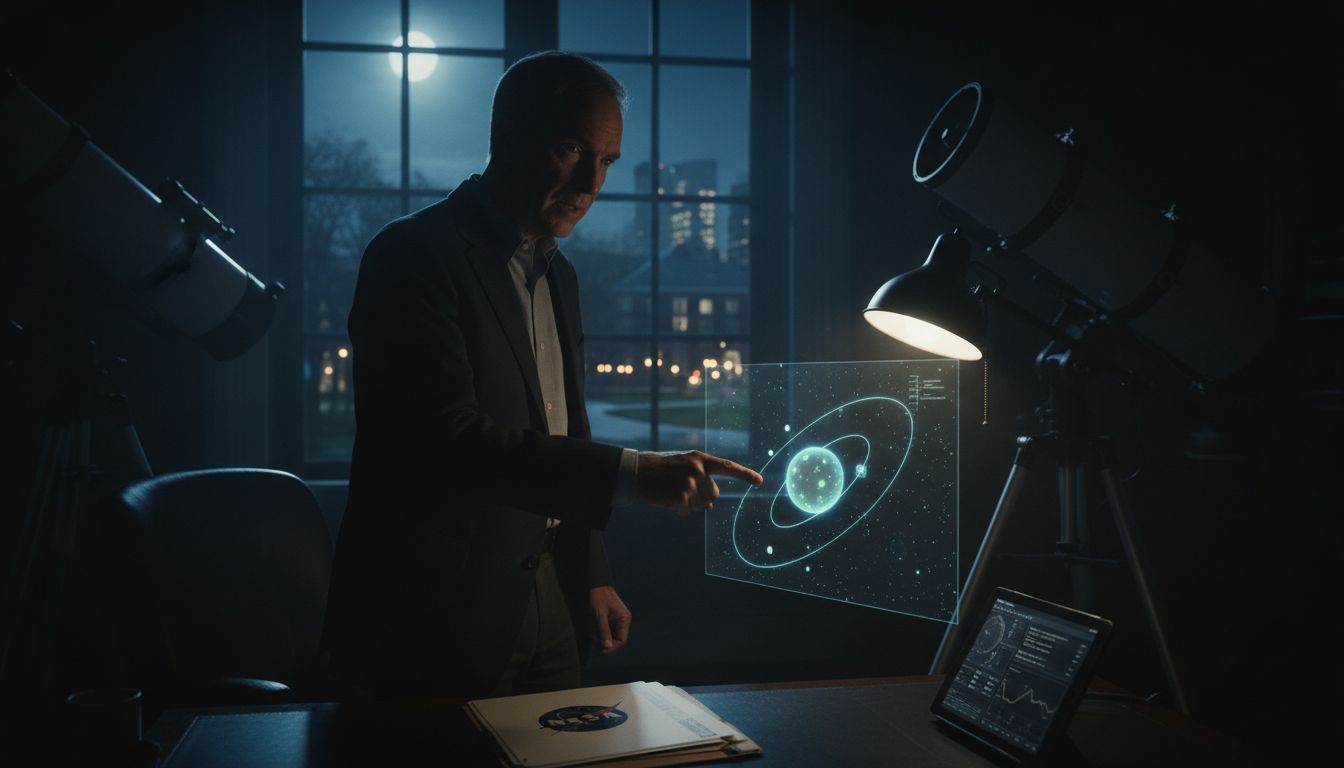
Harvard astrophysicist Avi Loeb, a professor of science at the university’s Department of Astronomy, has taken to social media and public interviews warning that the interstellar visitor designated 3I/ATLAS could prompt a “major disclosure” before the end of October. In a series of posts on X and a recent interview with a British news outlet, Loeb suggested that NASA is withholding information about the object’s unusual spectral emissions and hyperbolic trajectory, implying that it may be an artificial probe rather than a natural comet or asteroid. He urged the public to “take a vacation before October 29” in case the object makes a close approach that could have observable consequences.
3I/ATLAS was first detected on 12 October 2025 by the Pan-STARRS survey in Hawaii, marking the third confirmed interstellar object to enter the Solar System after ‘Oumuamua (2017) and 2I/Borisov (2019). Initial observations indicated a highly eccentric orbit that will carry it within 0.3 AU of Earth on 28 October, a distance comparable to that of Mercury from the Sun. Spectroscopic data from the Keck Observatory showed a series of narrow, non‑thermal emission lines in the infrared that do not match known cometary or asteroidal signatures. Loeb has argued that these emissions could be indicative of an engineered power source, citing his earlier work on the anomalous acceleration observed for ‘Oumuamua.
NASA’s Planetary Defense Coordination Office (PDCO) released a statement on 20 October confirming the object’s trajectory and noting that “no immediate hazard to Earth is expected.” The agency has not commented on the speculation surrounding artificiality, and its public briefings have focused on standard monitoring protocols. In response to Loeb’s claims, a spokesperson for the Jet Propulsion Laboratory said that the agency “continues to analyze all available data, but any assertion of extraterrestrial technology requires rigorous peer‑reviewed evidence.”
The scientific community has reacted with a mixture of curiosity and caution. Dr. Sarah Harrington, a planetary scientist at the University of Arizona, acknowledged that the emission lines are “unusual” but warned that “instrumental artifacts or unknown natural processes could also explain the observations.” Similarly, the International Astronomical Union’s Working Group on Small Bodies emphasized that extraordinary claims demand extraordinary evidence, and they have called for an open data release so that independent teams can verify the findings. Meanwhile, members of the UFO research community have seized on Loeb’s statements as validation of long‑standing theories that governments are concealing contact with non‑human intelligences.
If 3I/ATLAS does display any anomalous behavior—such as unexpected acceleration, radio emissions, or a sudden change in trajectory—NASA would be obliged under the United Nations’ Space Debris and Near‑Earth Object protocols to disclose the information promptly. However, experts note that the object’s small size (estimated at 30–50 meters) and rapid passage through the inner Solar System limit the window for detailed study. Ground‑based telescopes and the upcoming James Webb Space Telescope observations scheduled for early November may provide higher‑resolution spectra, potentially clarifying whether the emissions are natural or engineered.
Regardless of the outcome, Loeb’s warning has amplified public interest in the object and sparked renewed debate over transparency in space science. As the October 29 deadline approaches, scientists and policymakers alike will be watching closely, balancing the need for rigorous analysis with the public’s appetite for answers about one of the most enigmatic visitors the Solar System has seen in a decade.