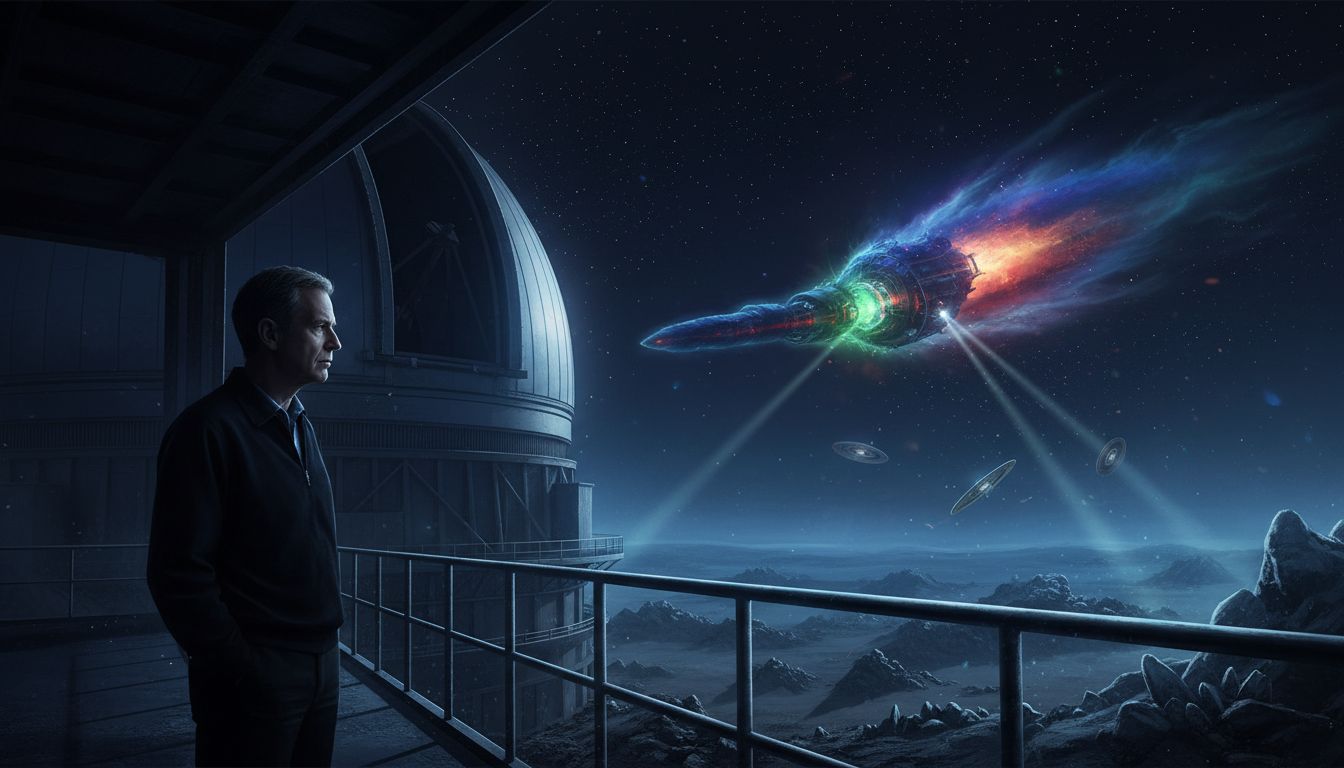
Scientists have been tracking the interstellar comet 3I/ATLAS since its discovery earlier this year, and a new hypothesis from Harvard astronomer Avi Loeb has reignited debate over whether the object might be more than a natural ice‑rock. In a paper currently under peer review, Loeb and his co‑authors argue that the comet’s unusually bright “tail” that appeared after an anti‑tail—a dust feature that points toward the Sun rather than away—could be consistent with an engineered structure used for deceleration, a maneuver they describe as “potentially hostile.” The authors caution that this is only one of several possibilities, but they note that if the feature were artificial it would imply active intelligence capable of altering its trajectory.
The comet, estimated to be roughly the size of a small city—about 10 km across, comparable to the area of Manhattan—has displayed a series of morphological changes as it hurtles through the inner Solar System. Observations from ground‑based telescopes in Chile and the Canary Islands recorded an anti‑tail in early September, followed weeks later by a bright, narrow tail extending away from the Sun. “The timing and geometry of the second tail are atypical for a comet of this composition,” said Dr. Elena Martínez, a cometary physicist at the European Southern Observatory, who is not involved with the Loeb study. “It could be the result of a sudden outgassing event, but the rapid development does merit closer scrutiny.”
Loeb’s team frames the phenomenon in terms of a speculative braking mechanism: a thin, reflective sheet or magnetic sail could be deployed to shed momentum, allowing an object of extraterrestrial origin to slow down as it approaches a star system. “If we are witnessing a technology‑driven deceleration, the most parsimonious explanation would involve a deliberately engineered surface interacting with solar radiation pressure,” Loeb wrote in the manuscript. He added that such a device would be “potentially hostile” only in the sense that it would indicate an intent to maneuver within the Solar System, not that it poses an immediate threat. The paper stresses that natural explanations—such as fragmentation of volatile‑rich material or electrostatic dust levitation—remain more likely, citing past cases where comet tails have behaved unpredictably.
NASA’s planetary science division has responded by allocating observation time on the Mars Reconnaissance Orbiter (MRO) to obtain higher‑resolution images of 3I/ATLAS as it passes within 0.3 AU of the Sun later this month. “MRO’s HiRISE camera can resolve features as small as a few meters at that distance, giving us an unprecedented view of any anomalous structures,” said Dr. Karen Liu, project scientist for the comet‑tracking program. The agency plans to complement the orbital data with spectroscopic measurements from the James Webb Space Telescope, aiming to determine the composition of the tail material and assess whether it matches known cometary ices or contains atypical metallic or polymeric signatures.
The broader scientific community remains cautious. While Loeb’s reputation for probing unconventional ideas—most famously his 2018 book on the interstellar object ʻOumuamua—has earned him both supporters and critics, his latest proposal is being treated as a hypothesis that can be tested with forthcoming data. “Extraordinary claims require extraordinary evidence,” noted Dr. Michael Patel of the SETI Institute. “If the MRO images reveal geometric regularities or non‑natural reflectivity, that would be a game‑changer. Until then, we must weigh the likelihood of natural cometary physics against the allure of alien engineering.” The next few weeks should provide the observational clarity needed to move the discussion from speculation toward a more definitive conclusion.