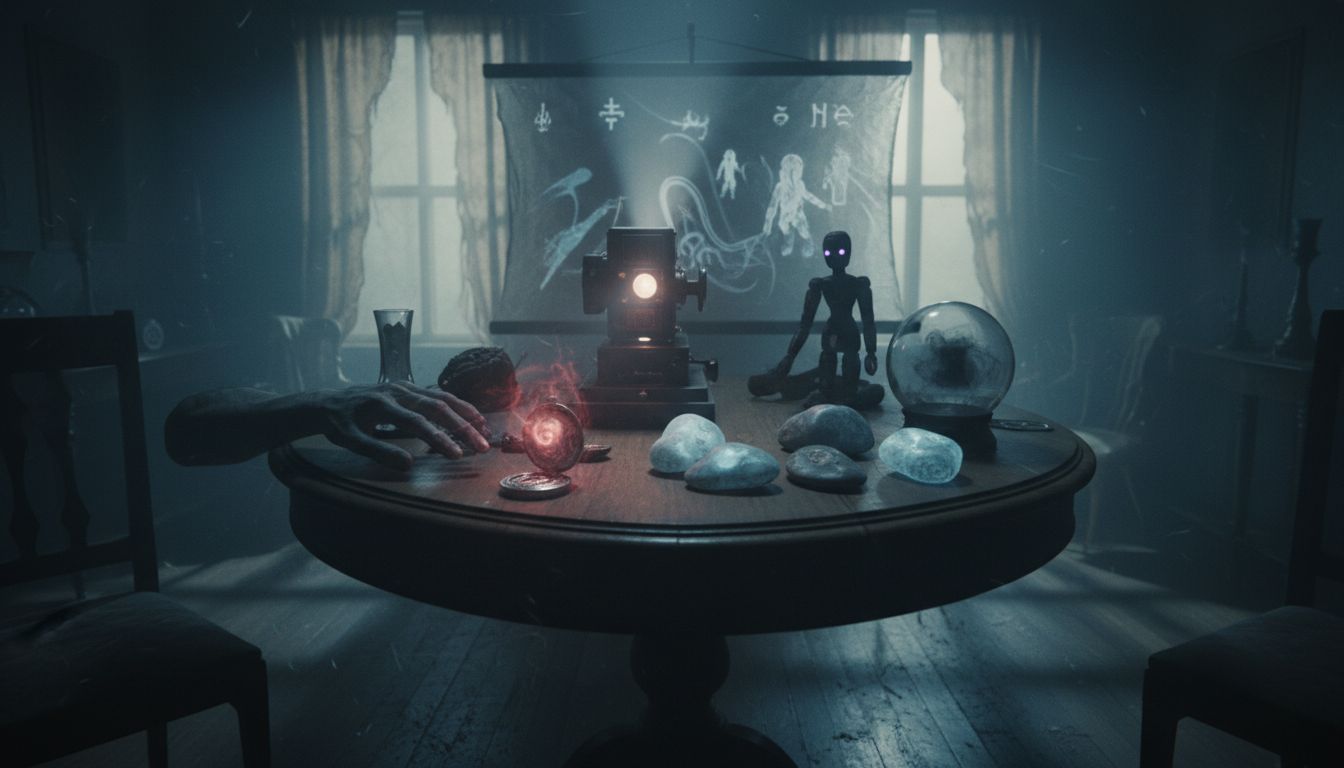
Overview
In a recent episode of Forbidden Knowledge News, host Chris Matthew interviewed paranormal researcher Tillie Treadwell about her work on “enchanted” or “inhabited” objects. Treadwell, who describes herself as an animist and esoteric exorcist, used the platform to preview her forthcoming book, Tillie Treadwell’s Guide to Enchanted Objects (Zontar Press, May 1). The conversation covered her personal background, a four‑model framework for how objects might become “haunted,” and a series of case studies that illustrate her approach to what she terms “non‑human energetics.”
Personal Background and Claims
Treadwell attributed her investigative abilities to a rare form of porphyria, a genetic condition historically linked to folklore about vampires. She claimed that medical specialists have identified “unique structures” in her eyes and ears that enable perception of light and sound frequencies beyond the typical human range. In the interview she stated, “I chose, before incarnation, to inhabit specific objects as a spirit so I could understand physical existence.” While such assertions are not supported by peer‑reviewed research, they form the foundation of her self‑described “clinical, non‑judgmental” methodology for communicating with entities she distinguishes from conventional human spirits.
Four Models of Inhabitation
Treadwell outlined a four‑part taxonomy for how objects might become sites of paranormal activity:
- Animist Model – Objects develop a form of natural awareness, an idea she likens to emerging artificial intelligence.
- Vessel Model – Non‑human intelligences occupy a physical object, analogous to a hermit crab taking up a shell.
- Imprint Model – Energetic residues from emotionally charged events replay like a recording.
- Conjuring Model – Intentional ritual placement of an entity into an object, drawing on practices such as Voodoo or Hoodoo.
She emphasized that these models are not mutually exclusive and may intersect in complex cases.
Scientific Context and Material Considerations
To bridge folklore with material science, Treadwell referenced the 1880 work of Pierre and Jacques Curie on piezoelectricity, suggesting that certain minerals—quartz, iron‑rich stone, and organic materials like wood—are more receptive to “spiritual inhabitation” because of their crystalline or amino‑acid composition, particularly glycine. She contrasted this with synthetic polymers, which she described as “difficult to inhabit and often associated with aggressive or negative spiritual activity.” Although the link between piezoelectric properties and paranormal phenomena remains speculative, her argument reflects a broader trend among some researchers to locate measurable physical correlates for traditionally anecdotal experiences.
Case Studies and Evidence
Among the examples cited, Treadwell recounted an investigation of vintage salt and pepper shakers linked to a historic domestic homicide. She interpreted the objects as having “witnessed” the violence, accumulating a negative energy mass—or egregore—that manifested as an aggressive haunting. Another topic was apports, the alleged spontaneous appearance of objects such as nails from a person’s mouth, which she suggested could serve as “anchors” for entities seeking a foothold in the material world. While these narratives are compelling to enthusiasts, they lack corroborating forensic or experimental data, a point noted by skeptics who caution against conflating anecdote with empirical proof.
Expert Commentary and Practical Guidance
Concluding the interview, Treadwell framed “demonic” possession as a convergence of mental health challenges and environmental stressors, stating, “Negative entities feed on human judgment and religious rigidity.” Her practical advice for individuals who suspect a haunted object includes removing the item, destroying or recycling it, and then sanitizing the space using ultraviolet light, sage, or beeswax candles. The interview also referenced her contributions to Outer Limits Magazine and her blog “How I Met Your Monster,” hosted by Eerie Expeditions Magazine.
While Treadwell’s perspectives add


